
How to Size a Pneumatic Actuator for Plastic Valves
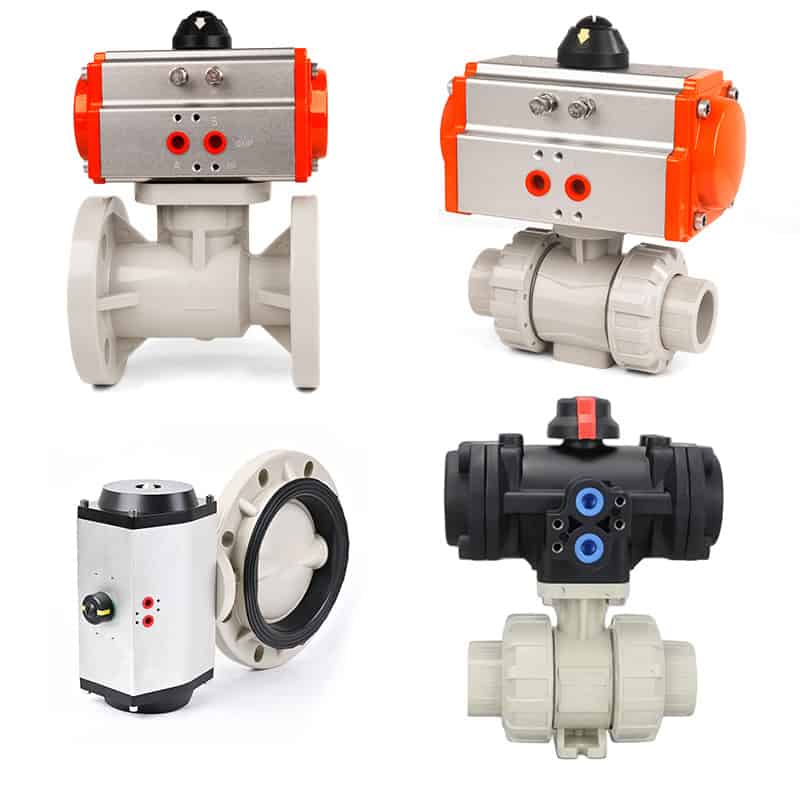
A pneumatic actuator is only right for the job when it does two things: deliver enough torque to open and close the valve under the worst conditions it will see, and fail in a safe direction if the air supply is lost. Get the torque wrong and the valve stalls, weeps, or never fully seats. Get the fail-safe wrong and an air or power outage leaves your line open when it should be shut.
On plastic valves there is a third trap that most metal-valve guides skip: over-sizing. A wildly oversized actuator can apply enough torque to over-stress a thermoplastic stem or seat, so “go bigger to be safe” is not a free choice the way it often is on steel. This guide shows how to size an actuator for a UPVC, CPVC, PPH or PVDF valve using two simple tables — the valve’s required torque and the actuator’s output torque — then how to choose between double-acting and spring-return, estimate air consumption, and avoid the plastic-specific pitfalls.
The sizing method in one line: read your valve’s required (safe) torque for its type and size → find the first actuator whose output at your air pressure meets or exceeds it → for a fail-safe valve, use a spring-return actuator and check its lowest stroke torque, not its peak.
The two things you are actually deciding
Every actuator selection comes down to two questions, and everything below serves them:
- Torque — is there enough force to drive the valve open and closed at your supply pressure, across the entire 0–90° stroke and under the pressure and media it actually runs?
- Fail-safe mode — should the valve stay put when air is lost (double-acting), or spring itself to a preset safe position (spring-return, fail-closed or fail-open)?
Answer torque first, then fail-safe. They interact — a spring-return actuator gives up some torque to the spring — so you size them together.
Step 1 — Find your valve’s required torque
You cannot pick an actuator until you know how hard the valve is to turn. The table below is Huiya’s operating torque for plastic ball and butterfly valves by nominal size.
| Nominal size | Ball valve — safe torque (N·m) | Butterfly valve — safe torque (N·m) |
|---|---|---|
| DN15 | <10 | — |
| DN20 | <10 | — |
| DN25 | <10 | — |
| DN32 | 12 | — |
| DN40 | 15 | 30 |
| DN50 | 20 | 35 |
| DN65 | 40 | 40 |
| DN80 | 45 | 45 |
| DN100 | 65 | 55 |
| DN125 | 85 | 80 |
| DN150 | 130 | 130 |
| DN200 | — | 200 |
| DN250 | — | 400 |
| DN300 | — | 600 |
| DN350 | — | 750 |
| DN400 | — | 850 |
| DN500 | — | 1200 |
| DN600 | — | 1500 |
Notes: values assume a 5–6 bar air supply and standard service. Ball valves are listed to DN15–DN150; for larger flanged ball valves, contact us for the figure.
Read the table right, and one rule matters above all others. These are not bare valve torques — they are design (safe) torques that already include a 1.6× safety factor over the measured valve torque. That margin is deliberately built in to absorb the normal variation of real service: line pressure, ordinary media, seat friction and cycle-to-cycle scatter. So the number in the table is what you size the actuator to reach.
Do not add a second safety factor. Classic actuator catalogs tell you to take the bare valve torque and multiply by 1.2–1.5. That step is already done in this table. Multiplying again stacks factor on factor and pushes you a full actuator size too large — wasted cost, and on a plastic valve, needless over-torque. Size the actuator directly against these values.
If you have read our pneumatic ball valve selection guide, the 1.3–1.5× and 1.8–2.0× ratios quoted there apply to a bare valve break torque. The table on this page is already a design torque with 1.6× built in — the two are the same rule stated from different starting points, not two factors to stack.
Step 2 — Understand actuator output, and why air pressure is a lever
A pneumatic actuator does not have a single torque rating. Its output scales almost linearly with supply pressure, so the same actuator is a different tool at 5 bar than at 6 bar. An AT-75D double-acting actuator, for instance, puts out 50 N·m at 5 bar but 60 N·m at 6 bar. Supply pressure is therefore a design variable, not a fixed condition — nudging it up can let a smaller, cheaper actuator do the job.
Two output shapes matter when you read the tables:
- Double-acting — air drives the actuator both ways, so torque is essentially flat across the 0–90° stroke. What you read is what you get at every angle.
- Spring-return — torque is not flat. It falls through the air stroke as the spring is compressed, and the spring’s return torque changes as it extends. You must size against the lowest point in the stroke (covered in the fail-safe section).
| Model | 3 bar | 3.5 bar | 4 bar | 4.5 bar | 5 bar | 5.5 bar | 6 bar | 7 bar | 8 bar |
|---|---|---|---|---|---|---|---|---|---|
| AT-40D | 5.7 | 6.7 | 7.6 | 8.6 | 9.5 | 10.5 | 11.4 | 13.3 | 15.2 |
| AT-52D | 12.0 | 14.0 | 16.0 | 18.0 | 20.0 | 22.0 | 24.0 | 28.0 | 32.0 |
| AT-63D | 21.0 | 24.5 | 28.0 | 31.5 | 35.0 | 38.5 | 42.0 | 49.0 | 56.0 |
| AT-75D | 30.0 | 35.0 | 40.0 | 45.0 | 50.0 | 55.0 | 60.0 | 70.0 | 80.0 |
| AT-83D | 45.7 | 53.3 | 61.0 | 68.6 | 76.2 | 83.8 | 91.4 | 106.7 | 121.9 |
| AT-92D | 67.4 | 78.7 | 89.9 | 101.2 | 112.4 | 123.6 | 134.9 | 157.4 | 179.8 |
| AT-105D | 97.6 | 113.8 | 130.2 | 146.4 | 162.7 | 179.0 | 195.2 | 227.8 | 260.3 |
| AT-125D | 152.2 | 177.6 | 203.0 | 228.3 | 253.7 | 279.1 | 304.4 | 355.2 | 405.9 |
| AT-140D | 260.3 | 303.7 | 347.0 | 390.4 | 433.8 | 477.2 | 520.6 | 607.3 | 694.1 |
| AT-160D | 396.6 | 462.7 | 528.8 | 594.9 | 661.0 | 727.1 | 793.2 | 925.4 | 1057.6 |
| AT-190D | 639.3 | 745.9 | 852.4 | 959.0 | 1065.5 | 1172.1 | 1278.6 | 1491.7 | 1704.8 |
| AT-210D | 781.0 | 911.2 | 1041.4 | 1171.5 | 1301.7 | 1431.9 | 1562.0 | 1822.4 | 2082.7 |
| AT-240D | 1147.6 | 1338.8 | 1530.1 | 1721.3 | 1912.6 | 2103.9 | 2295.1 | 2677.6 | 3060.2 |
| AT-270D | 1742.3 | 2033.4 | 2323.8 | 2614.3 | 2904.8 | 3195.3 | 3485.8 | 4066.7 | 4647.7 |
| AT-300D | 2390.8 | 2789.3 | 3187.8 | 3586.2 | 3984.7 | 4383.2 | 4781.6 | 5578.6 | 6375.5 |
Step 3 — Match the actuator to the valve (worked examples)
With both tables in hand, sizing is a two-table lookup:
- Read the valve’s safe torque (Step 1) for your valve type and size.
- In the actuator table, at your supply pressure, pick the first actuator whose output meets or exceeds that torque.
- For a spring-return valve, compare against the actuator’s minimum stroke torque, not its peak (next section).
Example 1 — DN100 pneumatic butterfly valve (double-acting)
Required safe torque = 55 N·m. At 5 bar, AT-75D gives 50 N·m — just short. Two clean fixes: step up to AT-83D (76.2 N·m at 5 bar), or keep AT-75D and supply it at 6 bar, where it makes 60 N·m > 55. If 6 bar air is already on site, AT-75D at 6 bar is the leaner pick. This pairs with a valve such as our CPVC pneumatic butterfly valve.
Example 2 — DN150 pneumatic ball valve (double-acting)
Required safe torque = 130 N·m. At 5 bar, AT-92D gives 112.4 N·m (short) and AT-105D gives 162.7 N·m — so AT-105D at 5 bar. But at 6 bar, AT-92D rises to 134.9 N·m > 130, which lets you drop a whole size to AT-92D. That is the air-pressure lever paying off: one column to the right on the supply, one size smaller on the actuator. The valve here would be, for example, our PVDF pneumatic ball valve.
Example 3 — DN300 pneumatic butterfly valve (double-acting)
Required safe torque = 600 N·m. At 5 bar, AT-140D is 433.8 N·m (short); AT-160D is 661 N·m — select AT-160D. On large butterfly valves like this, confirm your air header can actually hold 5–6 bar at the actuator under flow; a long, thin air line is a common reason a correctly sized actuator still moves slowly.
Double-acting vs spring-return: choosing the fail-safe
Torque is only half of sizing. The other half is what the valve should do when the air — or the control signal — disappears. This is where double-acting and spring-return part ways.
Double-acting (DA)
Compressed air strokes the actuator both ways. On air loss it stays where it is — there is no defined safe position. In return you get a flat torque curve, and for a given torque the actuator is smaller, cheaper and uses less air than an equivalent spring-return. Choose DA when the process does not need a guaranteed fail position, or when a separate interlock already handles the safe state.
Spring-return (SR, single-acting)
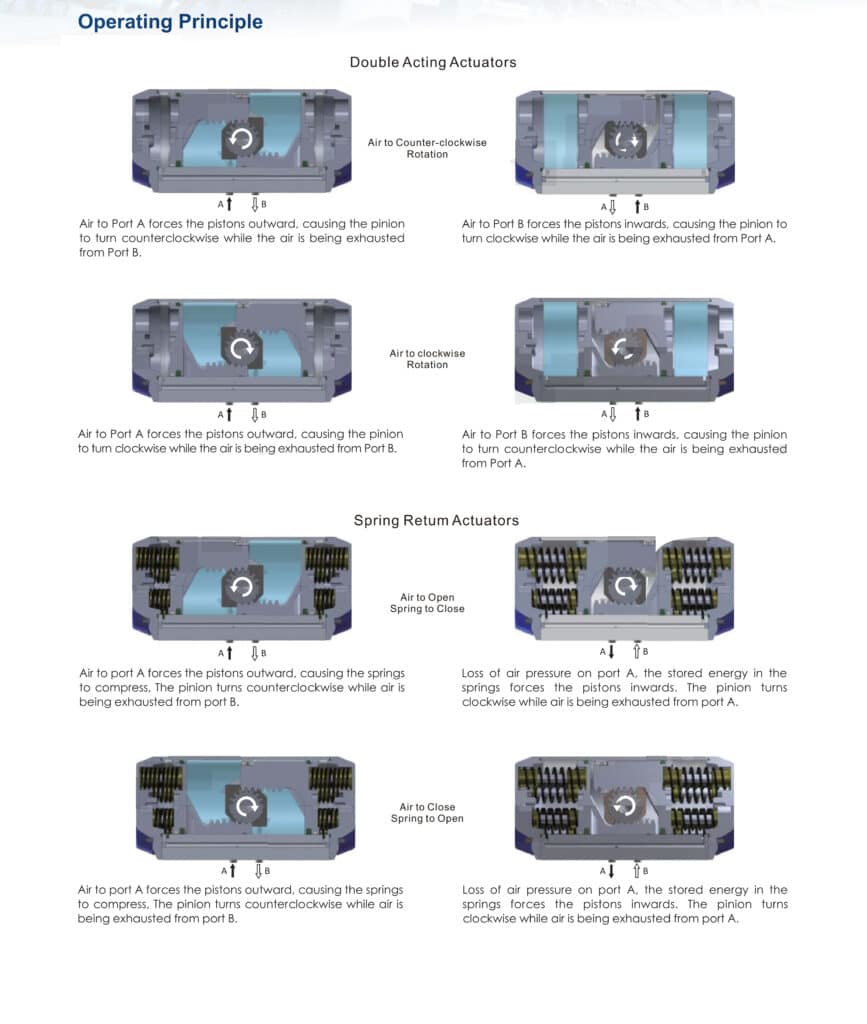
Air strokes one way and compresses a spring pack; on air loss the spring drives the valve to a preset position — fail-closed or fail-open. Choose SR whenever losing air must put the line in a safe state: isolating a feed, closing a dosing line, or protecting downstream equipment. Fail direction is set by the porting and piston orientation — air to port B closes (clockwise), air to port A opens (counter-clockwise), and the pistons can be inverted to reverse it. Specify fail-closed or fail-open when you order.
Sizing a spring-return — the one thing people get wrong. An SR actuator’s torque varies across the stroke, and you must size against its lowest output, not its catalog peak. Two points are critical: the end of the air stroke (spring fully compressed) and the end of the spring stroke (spring extended, driving the valve home). Both must clear the valve’s required torque. For example, an AT-140S with 10 springs delivers, across its air and spring strokes, a minimum of about 172 N·m — comfortably above the 130 N·m a DN150 ball valve needs, so it is safe with margin. Size it against the peak instead and you can end up with an actuator that opens the valve but cannot drive it fully closed on spring power alone.
Because the spring eats into available torque, a spring-return actuator is typically one to two body sizes larger than a double-acting actuator for the same valve — budget for that when you choose fail-safe.
Step 4 — Check air consumption and supply
Once the size is set, confirm the air. Free-air consumption per cycle depends on the cylinder volume and the compression ratio at your supply pressure:
Air per cycle (free air) = cylinder volume × (supply pressure in kPa + 101.3) ÷ 101.3
Multiply by cycles per minute to get flow in L/min.
Practical points that keep a correctly sized actuator working:
- Working pressure: minimum 2.5 bar, maximum 8 bar; the practical sweet spot is 4–7 bar (0.4–0.7 MPa). Keep the air clean, dry and lubricated, with particles below 30 µm.
- Spring-return needs headroom. It must build enough pressure to compress the springs before it will even begin to stroke, so never run an SR actuator near the minimum pressure.
- Do not starve the air path. Size the solenoid valve and tubing so the actuator receives its full air quickly. An undersized air path is the usual cause of slow or creeping motion (see troubleshooting below).
Plastic-valve-specific cautions
Most metal-valve sizing rules carry over, but thermoplastic valves add a few that are worth stating plainly:
- Do not over-size blindly. A hugely oversized actuator can apply enough torque to crack a plastic stem or over-stress the seat. Size to the table with its built-in 1.6× factor — not to the largest actuator “to be safe.”
- The 1.6× covers normal service, not extremes. Add margin — or ask our engineers to calculate it — for high differential pressure, slurries and crystallising media, elevated temperature, and valves that sit idle for long stretches and then have to break free. In those cases the real torque can climb above 1.6× the clean-bench value.
- Temperature. The torque table is for standard conditions. As temperature rises, seat and seal friction (and therefore required torque) tend to increase while the plastic body’s own pressure rating derates. PVDF and CPVC hold up best; UPVC drops off earliest. For hot service, size up or consult us. See our plastic valve material selection guide to match the body to your temperature and chemistry.
- Closing speed and water hammer. A pneumatic valve — especially a fast spring-return — can slam shut in a fraction of a second. On a long liquid line, that abrupt stop is a classic trigger for water hammer, a pressure surge that stresses joints and fittings. The standard fix is to slow the last part of the closure with a flow-control (speed) regulator on the actuator or solenoid exhaust. Sizing and speed are separate settings: size for torque first, then tune closing speed for surge.
Troubleshooting a pneumatic valve
When a correctly sized assembly misbehaves, the cause is almost always air, alignment or the solenoid — not the actuator’s torque rating. Work through these before re-sizing.
| Symptom | Check | Fix |
|---|---|---|
| Valve will not actuate | Solenoid valve and coil (burnt out? dirt-jammed spool?); air-test the actuator alone; debris jamming the valve; hand-override left in manual. | Replace the solenoid or coil and clear debris; replace damaged seals or cylinder; clean out media; return the override lever to the pneumatic position. |
| Slow or creeping action | Supply pressure too low; actuator torque too small for the valve; valve or internals over-tightened; air line blocked or flow too small. | Raise supply to 0.4–0.7 MPa; step up the actuator size; re-assemble and adjust; clear the line and replace the filter element. |
| No feedback signal | Power wiring open or shorted; feedback cam out of position; microswitch failed. | Check the wiring; re-set the cam to the correct position; replace the microswitch. |
Huiya pneumatic valve range
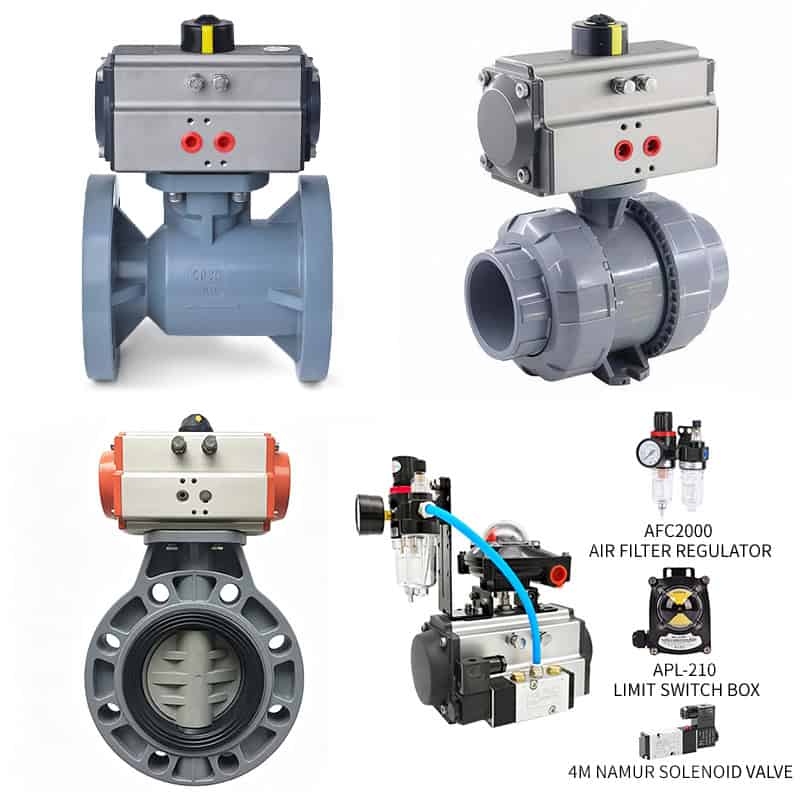
Huiya builds pneumatically actuated valves in all four thermoplastics — UPVC, CPVC, PPH and PVDF — in three body styles, all sized with the torque data above:
- True-union ball valves — PVDF, CPVC, PPH and UPVC pneumatic true union ball valves — serviceable, union-end isolation for dosing and process lines.
- Flanged ball valves — PVDF, CPVC, PPH and UPVC flanged pneumatic ball valves — for larger bore and higher-load automated isolation.
- Butterfly valves — PVDF, CPVC, PPH and UPVC pneumatic butterfly valves — compact, high-flow control from DN40 up to DN600.
New to specifying an automated valve? Start with manual vs pneumatic valves: when to automate to confirm the line needs an actuator, then our complete engineering guide to selecting a pneumatic ball valve for actuator, seat and connection choices.
Frequently asked questions
How do I size a pneumatic actuator for a valve?
Find the valve’s required torque for its type and size, then choose the first actuator whose output at your air supply pressure meets or exceeds that torque. For a fail-safe (spring-return) valve, check the actuator’s lowest stroke torque rather than its peak. With Huiya’s tables it is a two-step lookup — valve safe torque, then actuator output at 5 or 6 bar.
Do I need to add a safety factor to Huiya’s torque table?
No. The table values already include a 1.6× safety factor over the measured valve torque, which covers normal service variation. Adding another factor on top would over-size the actuator. For unusually severe service — high differential pressure, slurry, high temperature, or long idle periods — add margin beyond the table or ask us to calculate it.
Should I choose a double-acting or spring-return actuator?
Use double-acting when the valve does not need a defined position on air loss — it is smaller, cheaper and uses less air. Use spring-return when losing air must move the valve to a safe position (fail-closed or fail-open). Spring-return actuators are usually one to two sizes larger for the same valve because the spring absorbs part of the torque.
What air pressure does a pneumatic actuator need?
These actuators run on 2.5–8 bar, with 4–7 bar (0.4–0.7 MPa) as the practical range. Output torque scales with pressure, so raising the supply from 5 to 6 bar can let a smaller actuator do the job. Keep the air clean, dry and lubricated with particles under 30 µm.
Can an oversized actuator damage a plastic valve?
Yes. Unlike heavy metal valves, thermoplastic stems and seats can be over-stressed by excessive torque. Size the actuator to the valve’s rated torque (which already includes the safety factor) rather than fitting the largest actuator available.
How do I stop a pneumatic valve from causing water hammer?
Slow the closure. A fast-closing pneumatic valve on a long liquid line can create a pressure surge; fitting a flow-control (speed) regulator on the actuator or solenoid exhaust softens the final part of the stroke and prevents the surge. Size the actuator for torque first, then adjust closing speed separately.
Get the actuator sized with the valve
Send us your valve type and size, line medium, differential pressure, temperature and whether you need a fail position — our engineers will spec both the plastic valve and the matched pneumatic actuator, including closing-speed control where surge is a risk. Browse the full pneumatic valve range or contact Huiya for a factory-direct quote.