
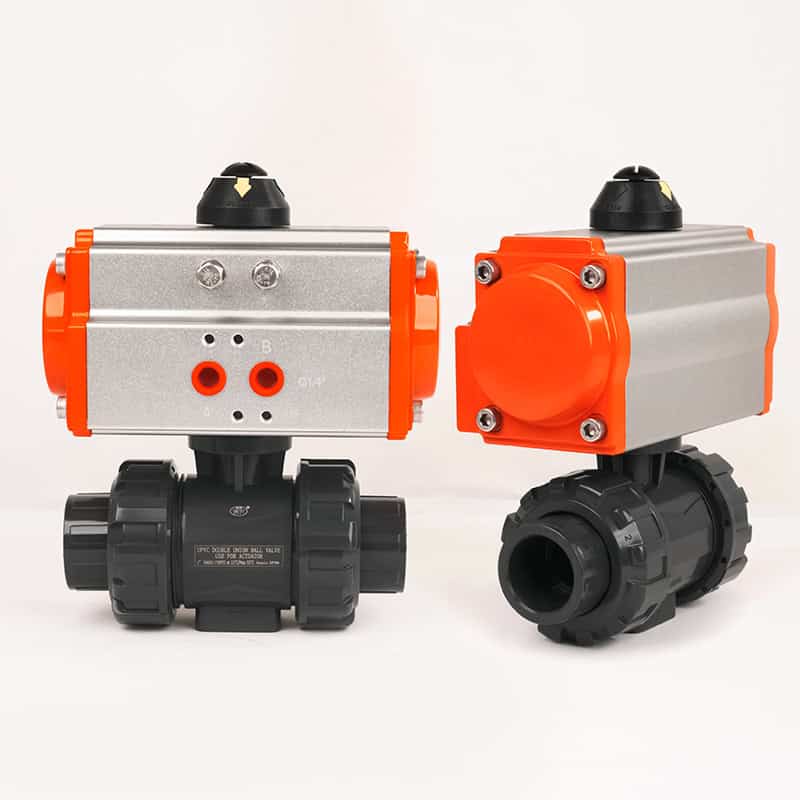
PVC Pneumatic True Union Ball Valve
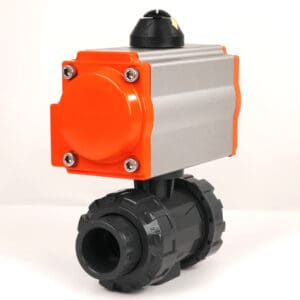
The Huiya PVC pneumatic ball valve — also known as a UPVC ball valve in DIN-standard markets — is a true union, full-port automated valve for ambient-temperature water, chemical dosing, and seawater service. Made from UPVC and rated to 60°C and PN16, it delivers excellent corrosion resistance at the lowest cost of any plastic valve — the smart choice when your media is below 60°C and you don’t need to pay for CPVC or stainless steel. The true union design lets you service the valve without cutting your pipework.
The Cost-Smart Choice for Ambient-Temperature Service
Not every line needs an expensive valve. For water and chemical media below 60°C, UPVC offers the same — or better — corrosion resistance as costlier materials, at a fraction of the price. Where 316L stainless steel would corrode in saltwater or chlorinated water, UPVC is completely immune.
Best-fit applications:
Service Without Cutting Pipes
In lines prone to scaling or algae build-up, the true union design is a lifesaver. Unscrew the two union nuts, remove the central valve body for cleaning or O-ring replacement in about 15 minutes — without shutting down the plant or cutting pipes. UPVC is also far lighter than metal, reducing pipe-support loads and installation labor.
Technical Specifications
| Specification | Detail |
| Valve Type | True union, full-port pneumatic ball valve |
| Body Material | UPVC (rigid PVC / PVC-U) |
| Size Range | DN15–DN100 (1/2″–4″) |
| Bore | Full port |
| Pressure Rating | PN16 (DN15–DN50) / PN10 (DN65–DN100) at ambient |
| Max. Temperature | 60°C (140°F) |
| End Connections | Socket (solvent weld) and threaded — ANSI, DIN, JIS |
| Ball | UPVC |
| Seats | PTFE |
| O-Rings / Seals | EPDM or FKM (FKM required for oxidizers — see below) |
| Actuator | Pneumatic, double-acting or spring-return, aluminum alloy |
Dimensions
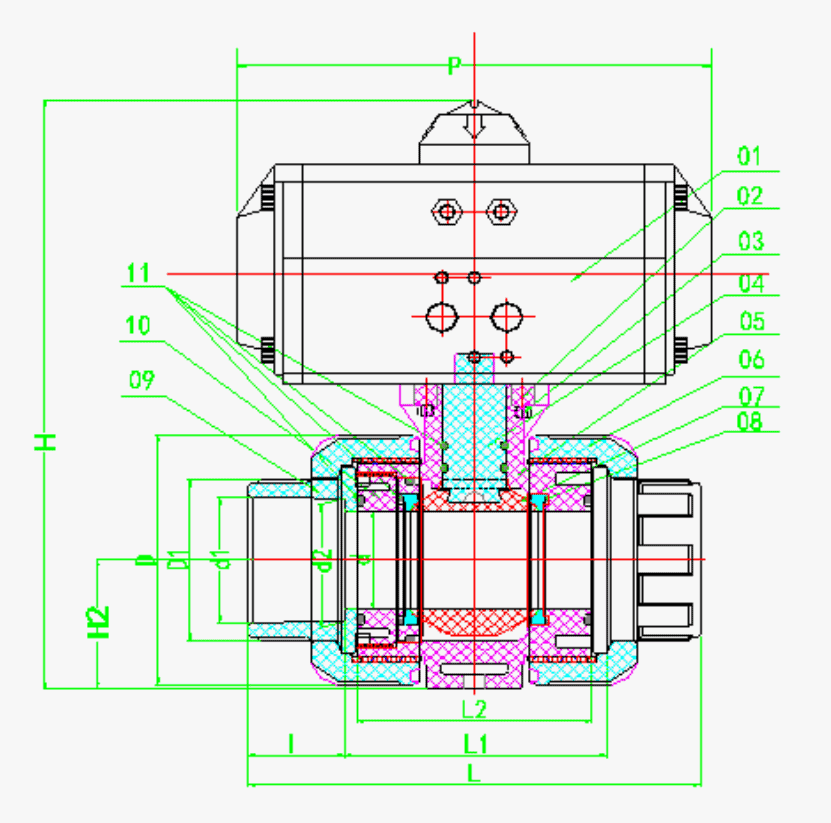
| Size | d | l | d1 | d2 | ||||||
|---|---|---|---|---|---|---|---|---|---|---|
| DIN | JIS | ANSI | CNS | DIN | JIS | ANSI | CNS | |||
| 1/2″ (DN15) | 15 | 23.00 | 20.28 | 22.35 | 21.54 | 22.35 | 19.95 | 21.75 | 21.25 | 21.75 |
| 3/4″ (DN20) | 20 | 26.00 | 25.30 | 26.40 | 26.87 | 26.40 | 24.95 | 25.70 | 26.58 | 25.70 |
| 1″ (DN25) | 25 | 29.00 | 32.30 | 32.40 | 33.65 | 34.50 | 31.95 | 31.70 | 33.28 | 33.90 |
| 1-1/4″ (DN32) | 32 | 32.50 | 40.35 | 38.45 | 42.40 | 42.50 | 39.95 | 37.65 | 42.05 | 41.90 |
| 1-1/2″ (DN40) | 40 | 35.50 | 50.35 | 48.45 | 48.50 | 48.45 | 49.95 | 47.65 | 48.12 | 47.65 |
| 2″ (DN50) | 50 | 38.50 | 63.40 | 60.50 | 60.60 | 60.50 | 62.90 | 59.60 | 60.18 | 59.60 |
| 2-1/2″ (DN65) | 63 | 44.50 | 75.40 | 76.50 | 73.35 | 76.50 | 74.90 | 75.60 | 72.85 | 75.60 |
| 3″ (DN80) | 75 | 51.00 | 90.45 | 89.60 | 89.30 | 89.60 | 89.90 | 88.60 | 88.70 | 88.60 |
| 4″ (DN100) | 90 | 61.50 | 110.45 | 114.50 | 114.75 | 114.60 | 109.90 | 113.60 | 114.10 | 113.60 |
All dimensions in mm. Socket connections available in DIN, JIS, ANSI, and CNS standards. d = nominal size, l = socket depth, d1/d2 = socket diameters.
| Size | D | D1 | L | L1 | L2 | H | H2 |
|---|---|---|---|---|---|---|---|
| 1/2″ (DN15) | 56.0 | 32.0 | 112.0 | 66.0 | 57.0 | 162.0 | 28.7 |
| 3/4″ (DN20) | 65.0 | 37.0 | 120.0 | 68.0 | 59.0 | 174.0 | 32.7 |
| 1″ (DN25) | 76.0 | 45.5 | 136.0 | 68.0 | — | 208.0 | 38.75 |
| 1-1/4″ (DN32) | 87.0 | 55.5 | 150.5 | 85.0 | 76.0 | 214.0 | 44.25 |
| 1-1/2″ (DN40) | 101.0 | 62.0 | 168.0 | 95.5 | 86.5 | 237.0 | 51.5 |
| 2″ (DN50) | 121.0 | 79.0 | 180.0 | 103.0 | 92.0 | 258.0 | 62.0 |
| 2-1/2″ (DN65) | 150.0 | 94.2 | 235.0 | 146.0 | 134.0 | 310.0 | 79.5 |
| 3″ (DN80) | 169.5 | 113.0 | 265.0 | 163.0 | 148.0 | 341.0 | 90.0 |
| 4″ (DN100) | 190.0 | 135.0 | 304.0 | 181.0 | 157.0 | 379.0 | 96.0 |
All dimensions in mm. D = body diameter, L = end-to-end length, H = overall height with actuator. Full dimensional drawings available on request.
Actuator Torque Requirements
| Size | DN15 | DN20 | DN25 | DN32 | DN40 | DN50 | DN65 | DN80 | DN100 |
|---|---|---|---|---|---|---|---|---|---|
| Torque (N·m) | 6 | 8 | 10 | 12 | 15 | 20 | 40 | 45 | 65 |
Design torque values for actuator sizing — these already include a 1.6× safety factor over measured valve torque, so size the actuator directly against them. For scaling, slurry or crystallising media, see how to size a pneumatic actuator for the higher ratios. Our engineering team can confirm the actuator for your operating pressure.
Chemical Compatibility
UPVC offers excellent corrosion resistance for ambient-temperature media:
Excellent for:
Applications
Common Selection Mistakes to Avoid
Quality & Reliability
Handling hotter or more aggressive media? The same true union design is available in CPVC, PPH and PVDF. For larger bores or higher pressure, step up to the PVC flanged ball valve, or the PVC butterfly valve for big-diameter, space-saving isolation. Not sure which material fits your media? Use our free Material Selection Service. View all PVC valves.
Sizing the actuator? See how to size a pneumatic actuator for a plastic valve for torque tables and worked examples, or the complete pneumatic ball valve selection guide for seat and fail-safe choices. Still deciding whether to automate? Read manual vs pneumatic valves: when to automate. To compare PVC against the other bodies, see the plastic valve material selection guide. Browse the full range of pneumatic plastic valves.
Frequently Asked Questions
Q: Is “PVC” the same as “UPVC”?
Yes. UPVC (unplasticized PVC, also written PVC-U) is the rigid PVC used for industrial pipe and valves. North American markets typically call it “PVC”; DIN-standard markets call it “UPVC.” Same material, same valve.
Q: What is the maximum temperature?
60°C (140°F). Above this, UPVC softens and loses pressure rating — for hot media, choose CPVC (93°C) or PPH (85°C).
Q: Can it handle sodium hypochlorite / bleach?
Yes, at ambient temperature — but you must use FKM (Viton) seals, not EPDM. EPDM degrades quickly in free chlorine.
Q: Can it be used with seawater?
Yes — UPVC is completely immune to seawater corrosion, making it ideal for pools, aquariums, and desalination pre-treatment.
Q: Can I service it without cutting the pipe?
Yes — the true union design lets you unscrew the union nuts and remove the valve body for cleaning or seal replacement in about 15 minutes.
Q: Is it full port?
Yes, full port (full bore) — bore matches pipe ID, minimizing pressure drop.
Get a factory-direct quote
Send us your medium, its concentration and temperature, and the line size. Our engineers confirm the right body material, seat and valve type — and reply within 24 hours.