
A troubleshooting guide for plastic ball valves — UPVC, CPVC, PPH and PVDF
A leaking PVC ball valve almost always comes down to one of three things: the valve was glued shut during installation, the true union nut was never fully tightened, or the seat material has aged and worn. The good news is that the first two are installation faults you can fix, and the third is a material choice you can avoid next time. This guide walks through where a PVC ball valve leaks, why it happens, how to fix each case, and when the valve simply needs replacing.
First, find where it leaks — the location tells you the cause. A ball valve can leak in three places: externally at the stem/handle, externally at the pipe connection, or internally through the ball (the valve is shut but fluid still passes). Each has a different fix.
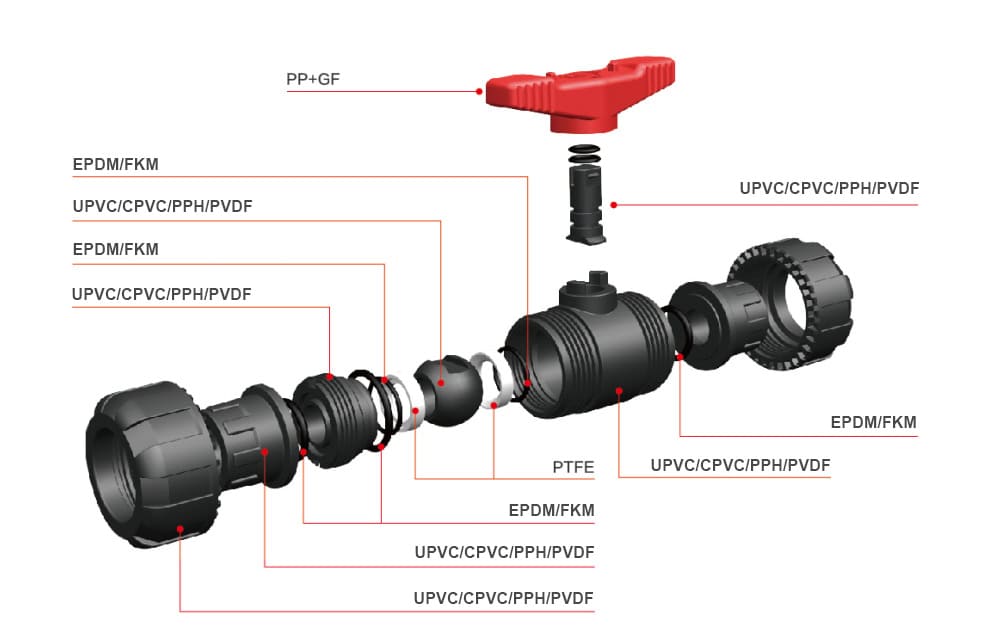
Leak 1 — Internal leak: the valve won’t shut off (glued or worn seat)
This is the most common and most misdiagnosed leak: you turn the handle to “closed”, but fluid keeps flowing through. The seal between the ball and the PTFE seat has failed. There are two usual causes.
Cause A — solvent cement flooded the ball during installation
This is the number-one field failure, and it is entirely avoidable. When a fitter applies too much solvent cement to the socket and pushes the pipe home, the excess cement runs straight down the bore and into the valve body — where it bonds the ball to the PTFE seat. The next time someone turns the handle, the ball tears away from the glued seat, damaging the seat face; from then on the valve leaks internally and never seals again.
- The fix: once the seat is scored, it cannot be un-damaged — the seat (and often the valve) must be replaced. Prevention is the real answer.
- Prevent it: use solvent cement sparingly, apply a thin even coat to the pipe (not a thick pool in the socket), and keep the valve in the fully open position while cementing and curing so any stray cement cannot reach the seat. Better still, on a true union valve, unscrew the end connector and cement the socket away from the valve body, then reassemble — the cement never gets near the ball.
Cause B — the seat has aged and worn (material choice)
If the valve was fine for a while and has gradually started to weep through when closed, the seat has worn. This is far more common on valves built with cheaper elastomer seats: many low-cost ball valves use an EPDM seat, which swells, hardens and degrades over time under continuous chemical exposure, until the ball no longer seals and the leak often shows at the stem as well.
This is exactly why Huiya ball valves use a PTFE seat throughout — PTFE is chemically inert across a far wider range and lasts far longer than EPDM in corrosive service. Our ball is injection-moulded and then precision-ground after moulding, so the ball-to-seat contact is smoother and the seal tighter and more durable. A worn seat means replacement — but choosing PTFE from the start is what prevents the wear in the first place.
The Huiya fix — adjust the seat without replacing the valve
Here is where a true union Huiya valve has a real advantage over a glued or fixed-body valve. Our true union ball valves have an adjustable seat carrier: if the PTFE seat has worn slightly and begun to leak internally, you do not have to replace the valve. Pull off the red handle, reverse it and use it as a wrench to turn the seat carrier and re-take up the clearance against the ball — restoring the seal and stopping the internal leak. It is a two-minute, no-tools adjustment that can add years to a valve that would otherwise be scrapped.
Leak 2 — External leak at the pipe connection (loose union)
If fluid is dripping from the joint where the valve meets the pipe — not from the stem, and not through a closed ball — the connection is not sealing. On a true union ball valve this is usually the simplest fix of all: the union nut was never fully tightened, so the O-ring behind it was never compressed enough to seal.
- The fix: hand-tighten the union nut firmly until the O-ring is properly compressed and the drip stops. Do not over-torque with a tool — plastic threads can crack. If it still weeps, unscrew the union, check the O-ring is seated correctly in its groove and undamaged, lightly lubricate it if compatible with the media, and re-tighten.
- If it is a solvent-welded or threaded connection instead: the joint itself has failed and cannot simply be re-tightened. This is one of the practical advantages of a true union design over a socket/solvent-weld valve — a union joint can be opened, inspected and re-sealed, where a glued joint must be cut out and remade. For the same reason, a true union valve can be removed for service without cutting the pipe at all.
Leak 3 — External leak at the stem or handle
If fluid is escaping from around the stem — under the handle — the stem seal has failed. On a quality valve the stem is sealed by double O-rings (Huiya uses a twin EPDM or FKM O-ring stem seal), which give two independent barriers; a stem leak usually means those O-rings have worn, hardened, or been attacked by an incompatible medium.
- The fix: stem O-rings can be replaced on a serviceable valve. Depressurise and drain the line first, remove the handle and stem, and fit new O-rings in the correct elastomer for your media.
- The deeper cause is often the wrong seal material. If the O-ring keeps failing, it is not matched to the chemistry — for example EPDM in a medium that attacks it. Match the elastomer to the fluid (EPDM and FKM cover different chemical ranges), and check your medium against our chemical resistance checker before you re-seal.
Quick diagnosis table
| Where it leaks | Most likely cause | Fix |
|---|---|---|
| Through the closed valve (internal) | Cement bonded the ball to the seat, or the seat has worn | Adjust the seat carrier (Huiya true union); otherwise replace the seat/valve |
| At the pipe connection | Union nut not fully tightened; O-ring not compressed | Tighten the union; inspect and re-seat the O-ring |
| At the stem / under the handle | Stem O-rings worn or attacked by incompatible media | Replace stem O-rings in the correct elastomer |
When to repair and when to replace
Repair when the problem is a loose union, a worn O-ring, or a slightly worn seat on a true union valve with an adjustable carrier — these are quick, low-cost fixes. Replace when the ball or seat is physically scored (usually from cement damage), when a solvent-welded body is cracked, or when the valve has no serviceable parts. And if a valve keeps leaking after repair, the real fix is usually a material upgrade — a PTFE seat instead of EPDM, and the right stem-seal elastomer for your chemistry — which is how you stop the leak returning rather than chasing it.
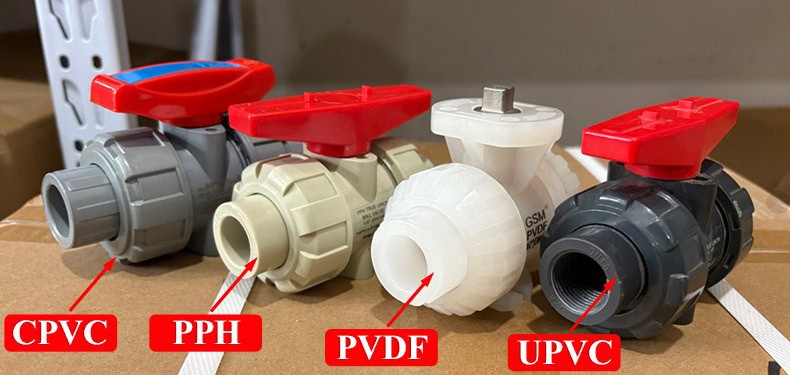
Stop the leak coming back — choose the right valve
Most repeat leaks trace back to two choices made before the valve was ever installed: a cheap elastomer seat, and a body that cannot be serviced. Huiya plastic ball valves are built to avoid both — a PTFE seat throughout for long corrosion life, a precision-ground ball for a tighter seal, a double O-ring stem seal, and a true union body with an adjustable seat carrier so wear can be taken up in minutes instead of scrapping the valve. Explore our UPVC/PVC ball valves and CPVC ball valves, browse the full range of true union ball valves, or read our complete guide to choosing a plastic ball valve. For sizing, see the DN to inch pipe size chart.
Frequently asked questions
Why is my PVC ball valve leaking when closed? The seal between the ball and the PTFE seat has failed. The two usual causes are solvent cement that flooded the valve during installation and bonded the ball to the seat (which scores the seat when the handle is next turned), or an aged, worn seat — most common on cheaper valves with EPDM seats. On a true union valve with an adjustable seat carrier, a slightly worn seat can be re-adjusted; a scored seat must be replaced.
Why is my PVC ball valve leaking from the handle or stem? The stem O-ring seal has worn or been attacked by an incompatible medium. On a serviceable valve the stem O-rings can be replaced — fit the correct elastomer (EPDM or FKM) for your fluid so the leak does not return.
My PVC ball valve leaks at the pipe joint — how do I fix it? On a true union valve, the union nut is usually not tight enough, so the O-ring is not compressed. Hand-tighten the nut until the drip stops; if it persists, open the union and check the O-ring is seated and undamaged. On a solvent-welded joint, the joint has failed and must be cut out and remade.
Can solvent cement ruin a ball valve? Yes — this is the most common installation fault. Too much cement runs into the body and glues the ball to the seat; turning the handle then tears and scores the seat. Always cement with the valve fully open, use cement sparingly, or unscrew the true union end connector and cement it away from the valve body.
Why does my ball valve leak again after I replaced it? Usually the replacement has the same weakness as the original — a cheap EPDM seat that wears in corrosive service, or a stem O-ring in the wrong elastomer. Upgrading to a PTFE seat and matching the seal to your chemistry is what stops the leak returning.
Is a PTFE seat better than an EPDM seat? For corrosion resistance and service life, yes. PTFE is chemically inert across a far wider range and does not swell or harden the way EPDM does under long chemical exposure, so a PTFE-seated ball valve seals longer and leaks less. Huiya ball valves use PTFE seats throughout.
Threaded, socket or true union — which is easiest to service? A true union valve. Its union nuts let you open the connection, inspect and re-seal the O-ring, or remove the whole valve without cutting pipe. A solvent-welded (socket) or threaded joint cannot be re-sealed the same way and generally has to be cut out and remade if it fails.