
A practical selection guide from Huiya’s engineering team, based on 20+ years of supplying plastic valves to chemical, water-treatment, electroplating and mining industries.
Quick Answer: Which Plastic Valve Material Should You Use?
Plastic valve selection comes down to three factors: the chemical, the temperature, and the budget. This guide compares CPVC, UPVC, PVDF and PPH across all three so you can choose the right material with confidence.If you only have 60 seconds, here is the short version:
- UPVC — Lowest cost. Use for water, dilute acids and ambient-temperature corrosive media up to 55°C. Best return on investment for water treatment, irrigation and chlor-alkali at moderate conditions.
- CPVC — The reliable workhorse. Handles most acids, chlorinated compounds and process water up to 100°C. The default choice when UPVC’s temperature ceiling is too low but PVDF would be overkill.
- PPH — Best for strong alkalis and hot caustic solutions up to 85°C. Excellent value for sodium hydroxide service. Not for oxidizers, not for chlorine.
- PVDF — Premium fluoropolymer. The only safe choice for strong oxidizers, organic solvents and high-temperature aggressive media up to 120°C. Costs roughly 16× more than UPVC, but irreplaceable where it is needed.
One sentence rule: Pick the cheapest material that still meets your chemical, temperature and pressure conditions — not the most expensive one you can afford.
The rest of this guide explains exactly how to make that judgment call.
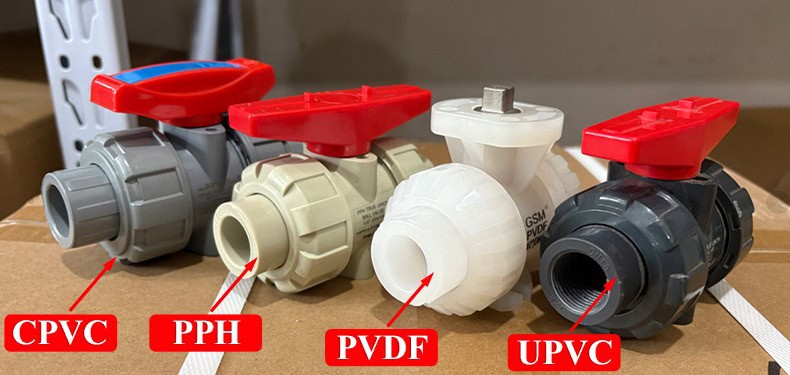
The Four Plastic Valve Materials at a Glance
UPVC (Unplasticized Polyvinyl Chloride)
UPVC is rigid PVC without plasticizers, the most widely used industrial thermoplastic in the world. It is inexpensive, dimensionally stable, and resists a remarkably wide range of acids, bases and salt solutions at ambient temperature. The trade-off is heat — UPVC begins to lose mechanical strength above 55°C, which rules it out of most hot-process applications. For cold water, dilute chemical lines, swimming pools, and ambient-temperature chlor-alkali service, UPVC is unbeatable on cost.
CPVC (Chlorinated Polyvinyl Chloride)
CPVC is UPVC that has been post-chlorinated to raise its chlorine content above 60% (the industry baseline is around 58%; Huiya uses high-chlorine compound for stronger thermal stability). The extra chlorine pushes the continuous service ceiling up to 100°C while preserving most of UPVC’s chemical resistance and adding tolerance for hot chlorinated media. CPVC dominates the chemical-process and water-treatment markets because it covers about 80% of typical industrial duty for roughly five times the cost of UPVC — a near-universal middle ground.
PPH (Homopolymer Polypropylene)
PPH is a semi-crystalline polyolefin valued for its outstanding resistance to alkalis, hot caustic solutions and organic solvents that destroy PVC-family materials. With a service ceiling of 85°C, PPH outperforms both UPVC and CPVC in hot sodium hydroxide, hot detergents and most non-oxidizing chemistries. Its weakness is oxidizers — chlorine, hypochlorite, nitric acid, concentrated sulfuric acid — which attack the polymer backbone. Choose PPH when the process is alkaline or solvent-based, never when it is oxidizing.
PVDF (Polyvinylidene Fluoride)
PVDF is a fluoropolymer, chemically related to PTFE (Teflon) but mechanically stronger and processable into solid pipe and fittings. It is the premium plastic for piping: it handles concentrated sulfuric acid, strong oxidizers, organic solvents, high-purity chemicals and temperatures up to 120°C. Almost no aqueous chemical attacks PVDF below its rating. The cost — roughly 16× UPVC — is the only reason it is not used everywhere. Reserve PVDF for the duties where nothing cheaper survives: ultra-pure semiconductor lines, strong oxidizers, hot aggressive solvents and concentrated acids.
Choosing the body plastic is only half of specifying a valve — the seal elastomer (seat, O-ring, or diaphragm) is a separate decision, usually a choice between EPDM and Viton (FKM). For that side, see our guide on how to choose between EPDM and Viton (FKM) seals.
Once you’ve settled on PVDF for its resistance to oxidizers, halogens and hydrofluoric acid, our PVDF valve selection guide covers picking the body, seal and valve type for your media.Side-by-Side Comparison Table
The table below summarizes the four materials on the parameters that matter for plastic valve selection.
| Property | UPVC | CPVC | PPH | PVDF |
|---|---|---|---|---|
| Max Continuous Temp. | 55°C | 100°C | 85°C | 120°C |
| Pressure Rating | 1.0–1.6 MPa | 1.0–1.6 MPa | 1.0 MPa | 1.0 MPa |
| Relative Cost | 1× (baseline) | ~5× | ~4× | ~16× |
| Strong Acids | Good (cold) | Excellent | Poor (oxidizing) | Excellent |
| Strong Alkalis | Good (cold) | Good | Excellent | Excellent |
| Oxidizers (NaOCl, Cl₂) | Excellent | Excellent | Fails | Excellent |
| Organic Solvents | Fails | Fails | Limited | Excellent |
| Typical Applications | Water treatment, irrigation, pool chemistry, ambient chlor-alkali | Hot chemical lines, copper leaching, electroplating, hot water | Hot caustic, alkaline scrubbers, detergent and food-grade lines | Concentrated acids, semiconductor, high-purity, solvent service |
Pressure ratings shown at ambient temperature. De-rate for higher service temperatures — consult valve datasheets.
Chemical Compatibility: The Most Important Factor
Chemical compatibility is the first filter in plastic valve material selection. Get it wrong and no amount of temperature or pressure headroom will save the system — the polymer will fail. The table below shows how the four materials perform against representative aggressive media, and which material gives the best return on investment for each duty.For the full breakdown of which acids, solvents and halogens PVDF handles, see our PVDF chemical compatibility guide.
| Chemical Media | UPVC | CPVC | PPH | PVDF | Best Choice |
|---|---|---|---|---|---|
| 98% Sulfuric Acid | ✗ Fails | ✗ Fails | ✗ Fails | ✓ Excellent | PVDF (only viable option) |
| 50% Sodium Hydroxide (hot) | ✗ Fails | ✗ Fails | ✓ Excellent | ✓ Excellent | PPH (best ROI) |
| Sodium Hypochlorite (NaOCl, water treatment) | ✓ Excellent | ✓ Excellent | ✗ Fails | ✓ Excellent | UPVC or CPVC (best ROI) |
| Wet Chlorine Gas (ambient) | ✓ Excellent | ✓ Excellent | ✗ Fails | ✓ Excellent | CPVC (safe for warm service too) |
| Dilute HCl (<35%, <55°C) | ✓ Excellent | ✓ Excellent | ✓ Good | ✓ Excellent | UPVC (best ROI) |
| HCl above 80°C | ✗ Fails | ○ Limited | ✗ Fails | ✓ Excellent | PVDF (only safe at high temp) |
| Copper Mining Leach (H₂SO₄ + Cu²⁺) | ○ Limited | ✓ Excellent | ✗ Fails | ✓ Excellent | CPVC (best ROI for SX-EW) |
| Acetone / Benzene / Solvents | ✗ Dissolves | ✗ Dissolves | ○ Limited | ✓ Excellent | PVDF (the only safe choice) |
A few rules of thumb to remember:
- PVC-family materials (UPVC and CPVC) handle oxidizers well but dissolve in organic solvents. Never run acetone, ketones, aromatic hydrocarbons or chlorinated solvents through a PVC line.
- PPH does the opposite: it tolerates many solvents and excels at hot alkalis, but fails on oxidizers — never use PPH for chlorine, hypochlorite, ozone, or concentrated nitric or sulfuric acid.
- When PVC-family fails on temperature and PPH fails on oxidation, PVDF is the bridge — it handles almost anything below 120°C, at a price.
- Compatibility ratings drop sharply with temperature. A material rated “excellent” at 20°C may be only “fair” at 60°C. Always check compatibility at the actual service temperature, not just at ambient.
For a full chemical-resistance matrix across all four materials at multiple concentrations and temperatures, contact our engineering team for the project-specific compatibility chart.
Temperature & Pressure: Where Each Material Hits Its Limit
Each plastic has a continuous service temperature ceiling above which mechanical strength drops, the material softens, and pressure ratings collapse. These are not “destruction” temperatures — they are the temperatures above which the valve cannot be relied on for long-term industrial service.
- UPVC — 55°C. This is the practical limit, not a hard maximum. UPVC’s glass transition is around 80°C, but its pressure rating starts de-rating sharply above 40°C. By 55°C, the material has lost roughly half of its room-temperature strength. For any system that operates above 50°C continuously, move up to CPVC.
- CPVC — 100°C. The chlorine content above 60% (versus ~58% in standard CPVC) gives Huiya’s CPVC a measurably higher heat-distortion temperature than typical industry CPVC. It can handle short-term excursions to 105°C, but for continuous duty 100°C is the conservative ceiling. This single property — being able to run at 80–100°C — is why CPVC dominates chemical-process piping.
- PPH — 85°C. Polypropylene’s crystalline structure gives it good mechanical strength at elevated temperatures, but at 85°C continuous service it is at its limit. Caution: PPH’s failure mode under combined temperature and chemical attack is brittle cracking, not gradual softening — meaning failures tend to be sudden, not gradual (the Guangdong case study below illustrates this).
- PVDF — 120°C. PVDF is the only common engineering plastic that maintains structural integrity and chemical resistance above 100°C. For hot aggressive duties — concentrated sulfuric acid lines, hot HCl, semiconductor wet-process chemistries — PVDF is the standard.
Pressure is the simpler dimension. UPVC and CPVC are available in 1.0 MPa (PN10) and 1.6 MPa (PN16) ratings; PPH and PVDF are typically rated 1.0 MPa (PN10). All ratings de-rate with temperature — at maximum service temperature, the effective pressure rating may be only 40–60% of the room-temperature value. For high-pressure or high-temperature duties combined with aggressive chemistry, consider either thicker-walled SCH 80 piping in PVDF, or step up to fluoropolymer-lined steel.
Cost: What You Actually Pay
Cost ratios are not intuitive in this market. Many engineers assume “if PVDF is the best material, why not just use PVDF everywhere?” The answer is in the price. The chart below shows the approximate price ratios for finished pipe and valves, using UPVC as the baseline.
| Material | Relative Cost | Cost Driver |
|---|---|---|
| UPVC | 1× (baseline) | Mature commodity, highest production volume |
| PPH | ~4× | Higher resin cost, lower production volume than PVC |
| CPVC | ~5× | Additional chlorination step on PVC resin |
| PVDF | ~16× | Fluoropolymer resin, niche production, fluorspar feedstock |
Ratios are indicative for equivalent pipe and valve products; actual ratios fluctuate with resin commodity prices.
A few things to notice in this table:
- PPH is cheaper than CPVC. This is counter-intuitive — most engineers expect PVC-family materials to be the cheapest plastics for piping. In today’s market, polypropylene resin is often less expensive than CPVC, because CPVC requires an additional chlorination step on the PVC base resin. For caustic and alkaline services where both PPH and CPVC would work, PPH is the better economic choice.
- PVDF is roughly 16× more expensive than UPVC. A small 4-inch PVDF butterfly valve can cost more than ten times the equivalent UPVC valve. This is why “use PVDF everywhere” is not an option — on a 500-meter chemical line, the material cost difference runs into the tens of thousands of dollars.
- The right way to think about cost is total cost of ownership. A failed PPH elbow in a sulfuric acid line (see the case study below) is not a few hundred dollars of replacement material — it is shutdown, cleanup, possible injury, and an emergency reorder. The cheapest material that survives the duty is always the most economical. The cheapest material that fails the duty is always the most expensive.
Decision Framework: Pick Your Material in 3 Questions
Most plastic valve material selection problems can be resolved with three questions, in this order:
Question 1 — What is the chemical, at what concentration?
- Strong oxidizer (chlorine, hypochlorite, concentrated nitric, peroxides) → eliminate PPH. Choose UPVC, CPVC or PVDF.
- Concentrated sulfuric acid (above 80%) → only PVDF survives.
- Strong organic solvent (acetone, benzene, ketones, chlorinated solvents) → only PVDF.
- Strong hot alkali (NaOH, KOH at high concentration and temperature) → PPH or PVDF.
- Common acids and salts at moderate concentration → all four work; the next question decides.
Question 2 — What is the maximum continuous temperature?
- Below 55°C → UPVC is usually sufficient. Use it unless chemistry rules it out.
- 55–85°C → CPVC for acidic and oxidizing duties; PPH for alkaline and solvent duties.
- 85–100°C → CPVC is the upper limit for PVC-family; for alkaline duties, switch to PVDF.
- Above 100°C → PVDF is the only standard option.
Question 3 — What is the budget and project lifetime?
- High-volume, low-risk applications (water, wastewater, irrigation): optimize for cost. UPVC where possible.
- Standard chemical-process duties: CPVC is the safest mid-range choice. The 5× cost over UPVC is small insurance against unexpected temperature excursions or chemistry changes.
- Critical, high-risk, or high-purity applications: invest in PVDF. The total system cost is dominated by downtime risk, not material cost.
After running through these three questions, the right material is usually obvious. When two materials both qualify, choose the cheaper one — there is no engineering bonus for over-specifying.
Material is only half of the specification. The flange standard on the valve has to match your existing pipework, and ANSI, DIN and JIS do not interchange.
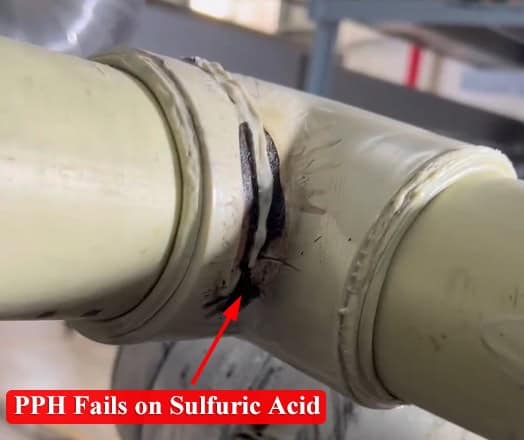
Real-World Case: When PPH Fails on Sulfuric Acid
A chemical processing plant in Guangdong, China, originally specified PPH piping for a 90 wt% sulfuric acid dilution line. The system fed concentrated H₂SO₄ into a storage tank where the acid was diluted with water. PPH was chosen for cost reasons — the engineers believed that with the system rated at ambient inlet temperature, PPH’s 85°C ceiling would be safe.
The problem was the dilution itself. Mixing concentrated sulfuric acid with water is strongly exothermic. The instantaneous in-pipe temperature near the tank inlet rose above 60°C — well within PPH’s nominal temperature rating, but combined with the strong oxidizing chemistry of concentrated H₂SO₄, this was outside PPH’s chemical compatibility window. Sulfuric acid attacks polypropylene through oxidation, and the attack accelerates sharply with temperature.
Within one week of commissioning, PPH elbows downstream of the dilution point began to crack. The failure mode was brittle cracking, not gradual softening — typical of polypropylene under combined chemical and thermal attack. The plant contacted Huiya’s engineering team for material analysis. Our recommendation was straightforward: PPH was the wrong family of polymer for this service. We specified CPVC piping, which handles both concentrated sulfuric acid and elevated temperatures up to 100°C.
The plant switched to CPVC in 2024. The system has now run for over a year with no leaks, no cracking, and no further failures.
The lesson is the same one we repeat to clients every week: PPH and oxidizers do not mix, even when the nominal temperature is within rating. For any sulfuric acid line above ambient, CPVC is the minimum acceptable material; for concentrated acid above 80%, PVDF is the only safe choice.
Application Recommendations by Industry
The table below summarizes Huiya’s standard recommendations by industry, based on the project specifications we see most often.(HF, SC1/SC2 etc.)
| Industry / Application | Recommended Material | Why |
|---|---|---|
| Municipal water treatment — sodium hypochlorite dosing | UPVC (low conc.) / CPVC (warm) | UPVC handles up to ~10% NaOCl at ambient; CPVC for higher concentration or warmer conditions |
| Copper hydrometallurgy — heap leach and SX-EW | CPVC | Sulfuric acid + Cu²⁺ at 40–60°C; CPVC is the industry standard for South American copper |
| Electroplating — acid copper, nickel, chrome baths | CPVC | Mixed acid chemistries at 40–60°C; UPVC is too cold-limited |
| Chlor-alkali — sodium hydroxide handling (hot) | PPH | 50% NaOH at 60–80°C: PPH outperforms PVC-family on cost and reliability |
| Chlor-alkali — chlorine gas and brine | UPVC or CPVC | PVC-family handles wet chlorine; PPH fails on this duty |
| Semiconductor — ultrapure chemicals, HF, SC1/SC2 | PVDF | Purity requirements and aggressive chemistries demand fluoropolymer |
| Concentrated H₂SO₄ above 80% | PVDF | The only plastic that survives concentrated sulfuric acid long-term |
| Pulp and paper — bleaching plant, ClO₂ service | PVDF | Chlorine dioxide is too aggressive for PVC-family at process temperatures |
| Wastewater pre-treatment — mixed acid/alkali neutralization | CPVC | Handles both sides of mixed chemistries; PPH would fail on the oxidizing side |
| Irrigation and water distribution | UPVC | Ambient temperature, low chemistry stress — UPVC is the obvious cost choice |
Frequently Asked Questions
Q: For sodium hypochlorite (NaOCl) dosing in water treatment, should I use UPVC, CPVC, PPH or PVDF?
PPH is not suitable for sodium hypochlorite — it fails on oxidation. For NaOCl below 10% concentration at ambient temperature, both UPVC and CPVC perform well and cost roughly half of PPH or PVDF. For NaOCl above 10% or at temperatures above 60°C, switch to PVDF. This is the standard guidance Huiya gives water-treatment clients.
Q: Can I use UPVC piping above 55°C?
Not for continuous service. UPVC’s pressure rating de-rates sharply above 40°C and the material has lost roughly half its strength by 55°C. For any system where the operating temperature regularly exceeds 50°C, specify CPVC instead — the cost increase is modest compared to the risk of pipe failure.
Q: Why does PPH fail on sulfuric acid even at moderate temperature?
Sulfuric acid is a strong oxidizer, and polypropylene oxidizes when exposed to oxidizing chemicals. The reaction accelerates with both temperature and concentration. Even at 60°C in concentrated H₂SO₄, PPH can crack within days. CPVC, by contrast, contains chlorine, which makes it resistant to oxidation — CPVC handles sulfuric acid up to and beyond 80% concentration at moderate temperatures.
Q: For hydrochloric acid (HCl) lines, which material should I choose?
For HCl below 35% concentration at pipe temperatures below 55°C, all four materials are acceptable, and UPVC gives the best return on investment. If the line operates above 80°C, only PVDF is reliable. Between 55–80°C, CPVC is the practical default.
Q: I see CPVC and PPH have similar prices. Why pick one over the other?
The materials cover almost opposite chemistry windows. CPVC excels at acids and oxidizers (sulfuric acid, hypochlorite, chlorinated water); PPH excels at alkalis (NaOH, KOH) and tolerates many solvents but fails on oxidizers. The choice is determined by chemistry, not cost — they are not interchangeable.
Q: Is PVDF really necessary, or can CPVC handle most chemical applications?
CPVC covers roughly 80% of industrial chemical-process applications and is the workhorse for most chemical, water-treatment and electroplating plants. PVDF becomes necessary only for: concentrated sulfuric acid (above 80%), strong organic solvents, ultra-pure semiconductor chemistries, or any aggressive chemistry above 100°C. Use CPVC by default; reserve PVDF for the duties that demand it.
Q: What’s the difference between CPVC made with high-chlorine resin and standard CPVC?
Standard industrial CPVC has a chlorine content around 58%. Huiya uses compound with a chlorine content above 60%, which raises the heat-distortion temperature and improves resistance to hot oxidizing media. The practical difference is a 5–10°C wider safe operating range and noticeably better long-term performance in elevated-temperature acidic service.
Q: For South American copper mining (heap leaching and SX-EW), what does Huiya recommend?
CPVC is the standard recommendation for SX-EW circuits and leaching pipe networks. The duty is sulfuric acid with dissolved copper ions at moderate temperature (typically 40–60°C), which is well within CPVC’s safe envelope. PVDF would also work but is uneconomic at the line sizes used in mining. UPVC is generally too cold-limited and not recommended for the warmer parts of the circuit.
Conclusion: How to Make the Final Call
After two decades of supplying plastic piping and valves to chemical, water, mining and electroplating customers worldwide, Huiya’s selection philosophy can be summarized in one sentence: choose the cheapest material that meets the chemistry, temperature and pressure of the actual duty — and not a step cheaper.
Most failures we see in the field are not from under-engineering but from misidentified chemistry. PPH in a sulfuric acid line. UPVC running hotter than it should. PVDF specified where CPVC would have done the job at one-third the cost. The right material is rarely the most expensive one — it is the one whose chemistry, temperature, and cost all align with the specific application.
If you have a specific duty in mind — chemical, concentration, temperature, line size, pressure — our engineering team can recommend the correct material and the right valve type (ball, butterfly, diaphragm, check) in the same conversation. We also publish detailed product pages for each duty configuration; if you are evaluating actuated valves for chemical service, our CPVC Pneumatic Butterfly Valve product page covers the full specification range for chemical-process applications.For manual on/off service, see our PPH ball valve, PVDF butterfly valve and CPVC diaphragm valve product pages.
Choosing by application rather than by material? For treatment plants specifically, see our water treatment valve selection guide.For project-specific material selection or to request a chemical-compatibility review for your line, contact Huiya’s engineering team with your process conditions. We respond to most technical inquiries within 24 hours.