
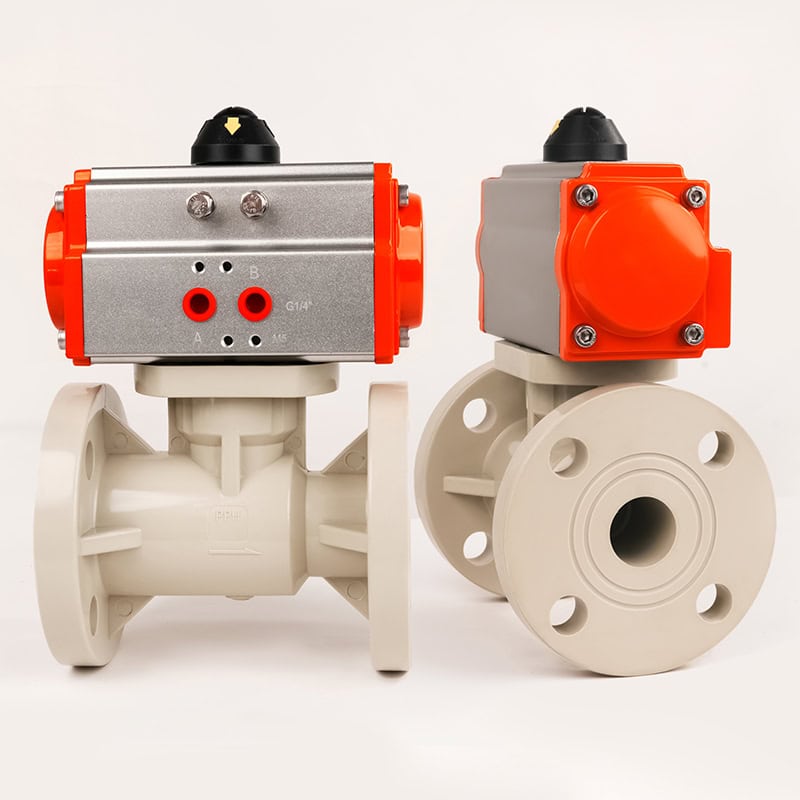
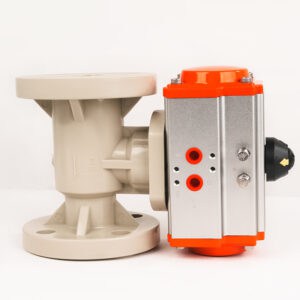
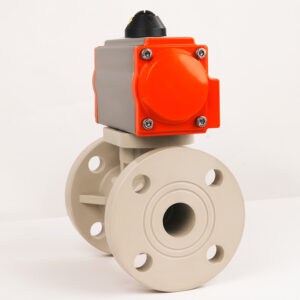
PPH Flanged Pneumatic Ball Valve
The Huiya PPH pneumatic flanged ball valve is a large-bore, full-port automated valve for hot alkaline and corrosive service in chemical, metallurgical, and wastewater applications. Available in ANSI Class 150, DIN PN10, and JIS 10K flange standards and sizes DN15–DN200, its one-piece molded flange eliminates root leakage — the ideal choice for high-vibration automated lines carrying hot caustic, where true union connections can work loose.
One Supplier for Every Flange Standard
Projects in different regions use different flange standards — ANSI in the Americas, DIN across Europe, the Middle East and Southeast Asia, JIS in Japan and Korea. Huiya manufactures this valve in all three, so you specify the standard and we build to it. One supplier for multi-region projects, with consistent quality and lead time.
One-Piece Molded Flange: Zero Root Leakage
In large-diameter automated pipelines (DN100 and above), a pneumatic actuator’s sudden open/close generates significant torque and water hammer. True union nuts can slowly vibrate loose under these forces and leak. This valve’s flange is molded as one piece with the body — no welded or assembled joint at the flange root, no leakage path — so it handles extreme mechanical stress and pipeline vibration with guaranteed zero root leakage. Burst-tested to 4.2 MPa (42 bar) at ambient with no rupture.
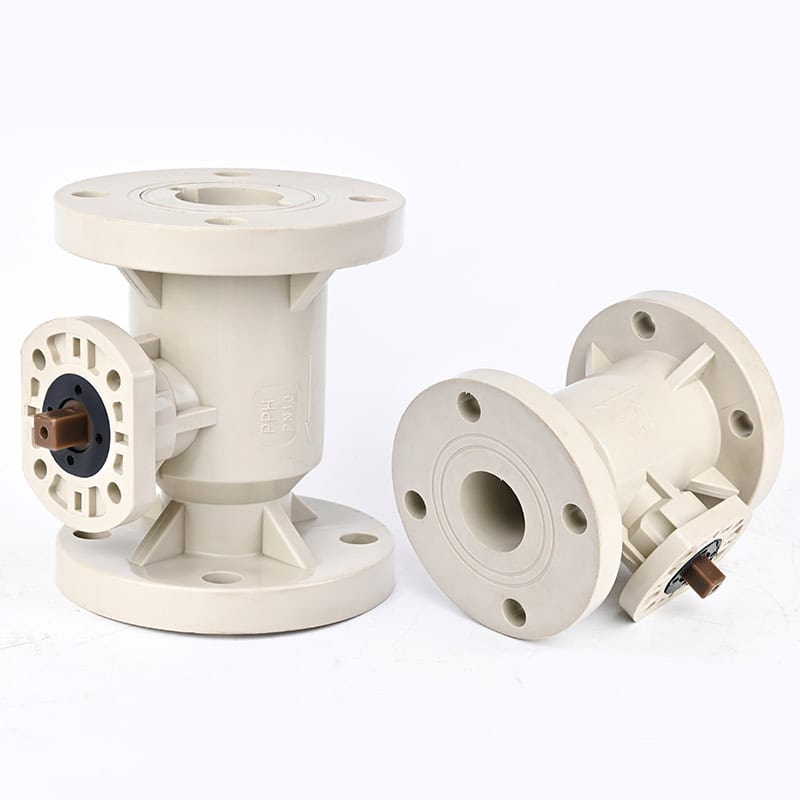
Technical Specifications
| Specification | Detail |
| Valve Type | Flanged pneumatic ball valve, one-piece molded flange |
| Body Material | PPH (polypropylene homopolymer) |
| Size Range | DN15–DN200 (1/2″–8″) |
| Bore | Full port |
| Flange Standards | ANSI Class 150 / DIN PN10 / JIS 10K |
| Sealing Face | Raised face (RF) |
| Pressure Rating | PN10 (1.0 MPa) at ambient temperature |
| Max. Temperature | 85°C (185°F) |
| Ball | PPH |
| Seats & Seals | PTFE |
| Actuator | Pneumatic, double-acting or spring-return, aluminum alloy |
Dimensions
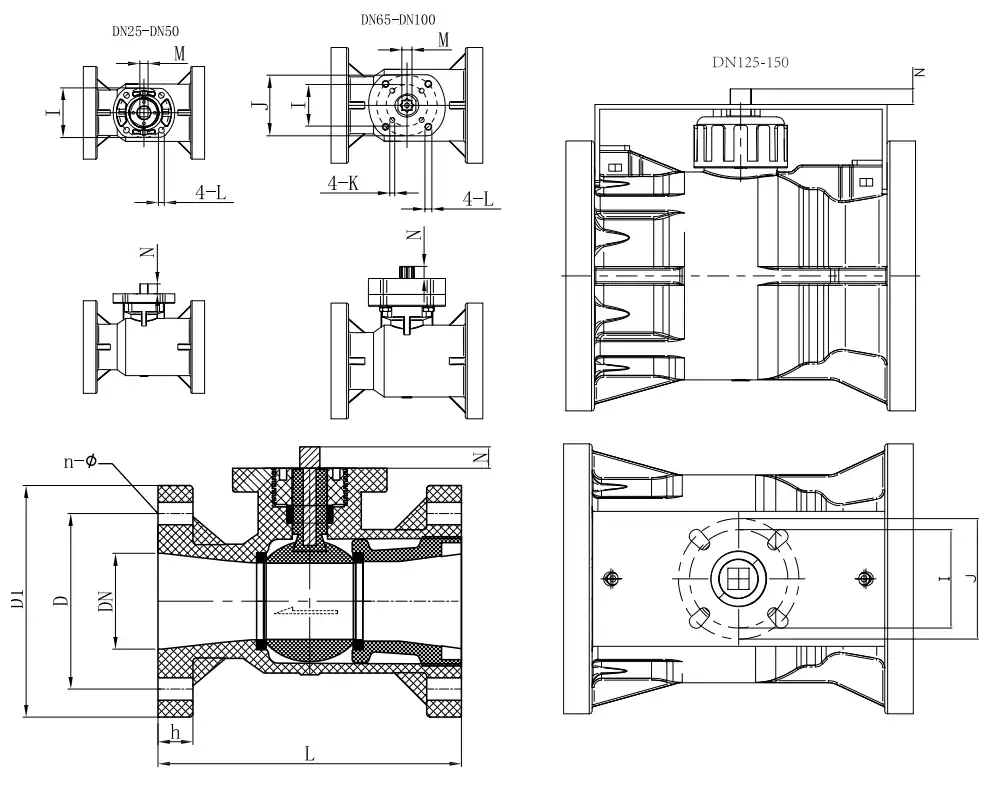
Unlike standard manual valves, our one-piece flanged ball valve features a built-in ISO 5211 mounting pad and a reinforced square stem. This allows you to easily install your own pneumatic or electric actuators without needing extra brackets or couplings.
| DN | D1 | D — Flange OD | L | b | ||
|---|---|---|---|---|---|---|
| DIN | JIS | ANSI | ||||
| 15 | 95 | 65 | 70 | 60 | 100 | 15 |
| 20 | 105 | 75 | 75 | 70 | 120 | 17 |
| 25 | 115 | 85 | 90 | 79 | 140 | 17 |
| 32 | 135 | 100 | 100 | 89 | 160 | 18 |
| 40 | 145 | 110 | 105 | 98 | 165 | 18 |
| 50 | 160 | 125 | 120 | 121 | 180 | 20 |
| 65 | 180 | 145 | 140 | 140 | 220 | 22 |
| 80 | 195 | 160 | 150 | 152 | 250 | 22 |
| 100 | 215 | 180 | 175 | 190 | 280 | 25 |
| 125 | 245 | 210 | 210 | 216 | 325 | 30 |
| 150 | 280 | 240 | 240 | 241 | 355 | 30 |
| 200 | 335 | 295 | 290 | 298 | 405 | 35 |
All dimensions in mm. D1 = flange thickness diameter reference, D = flange outer diameter (varies by standard), L = end-to-end length, b = flange thickness. Bolt count and bolt-hole diameter vary by standard and size; full drilling templates for ANSI Class 150, DIN PN10, and JIS 10K available on request.
Actuator Torque Requirements
| Size | DN15 | DN20 | DN25 | DN32 | DN40 | DN50 | DN65 | DN80 | DN100 |
|---|---|---|---|---|---|---|---|---|---|
| Torque (N·m) | 6 | 8 | 10 | 12 | 15 | 20 | 40 | 45 | 65 |
Design torque values for actuator sizing — these already include a 1.6× safety factor over measured valve torque, so size the actuator directly against them. For scaling, slurry or crystallising media, see how to size a pneumatic actuator for the higher ratios. Our engineering team can confirm the actuator for your operating pressure.
Chemical Compatibility
Full PTFE seats and seals give broad inertness; the PPH body excels in alkaline and organic-acid service:
Excellent for: sodium hydroxide up to 50% (even hot), ammonia, hydrochloric acid (standard), sulfuric acid (<50%), organic acids (acetic, lactic), salt solutions.
Applications
Why Flanged vs True Union?
Choose this flanged valve for larger sizes (to DN200), higher mechanical stress, high-vibration automated lines, or connection to existing flanged pipework — the one-piece flange gives the most leak-resistant connection.
Choose the true union valve for DN15–DN100 and when you need to service the valve without cutting the pipe.
Different chemistry? This flanged ball valve also comes in PVC, CPVC and PVDF. For smaller lines that need frequent service, the PPH true union ball valve removes without cutting the pipe; for large-bore isolation at lower cost, see the PPH butterfly valve. Send us your media and we’ll confirm the right plastic — Material Selection Service. View all PPH valves.
Common Selection Mistakes

Frequently Asked Questions
Q: Which flange standards are available?
ANSI Class 150, DIN PN10, and JIS 10K — specify when ordering. One source for any regional standard.
Q: Why a one-piece molded flange?
No welded/assembled joint at the flange root means no root leakage path — critical for high-vibration automated lines. Burst-tested to 4.2 MPa with no root leakage.
Q: What size range?
DN15 to DN200 (1/2″–8″), full port, PN10.
Q: What’s the maximum temperature?
85°C (185°F). PPH is ideal for hot caustic where chlorinated plastics fail.
Q: Flanged or true union — which should I choose?
Flanged for larger sizes, higher vibration, or flanged pipework. True union for DN15–DN100 with no-cut servicing.
Q: Can it handle sodium hypochlorite?
No — use CPVC or PVDF for hypochlorite and oxidizers. We supply both.
Sizing the actuator? See how to size a pneumatic actuator for a plastic valve for torque tables and worked examples, or the complete pneumatic ball valve selection guide for seat and fail-safe choices. Still deciding whether to automate? Read manual vs pneumatic valves: when to automate. To compare PPH against the other bodies, see the plastic valve material selection guide. Browse the full range of pneumatic plastic valves.
Get a factory-direct quote
Send us your medium, its concentration and temperature, and the line size. Our engineers confirm the right body material, seat and valve type — and reply within 24 hours.