
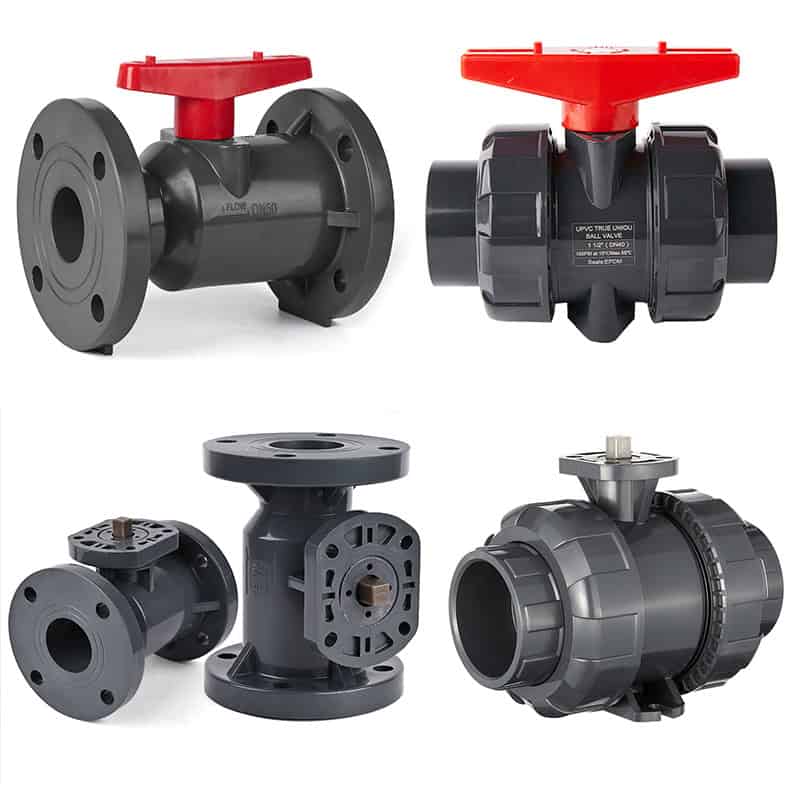
What is a plastic ball valve?
A plastic ball valve is a quarter-turn shut-off valve with a bored ball that rotates inside a thermoplastic body — turn the handle 90°, the bore lines up with the flow and the valve is open; turn it back and the ball seals against two seats to give a positive, bubble-tight close. Because the body, ball and end connectors are moulded from corrosion-resistant plastics rather than metal, a plastic ball valve handles aggressive acids, alkalis, brine and high-purity media that would pit brass, rust steel or seize a metal valve — at a fraction of the weight and cost.
This guide covers how to specify one correctly: the four body materials and where each fits, the connection types (true union, flanged and threaded), manual versus pneumatic actuation, and the seat, seal, pressure and standards that separate a valve that lasts from one that leaks. If you already know your chemistry and just want to match a material, jump to our plastic valve chemical resistance checker; otherwise, read on.
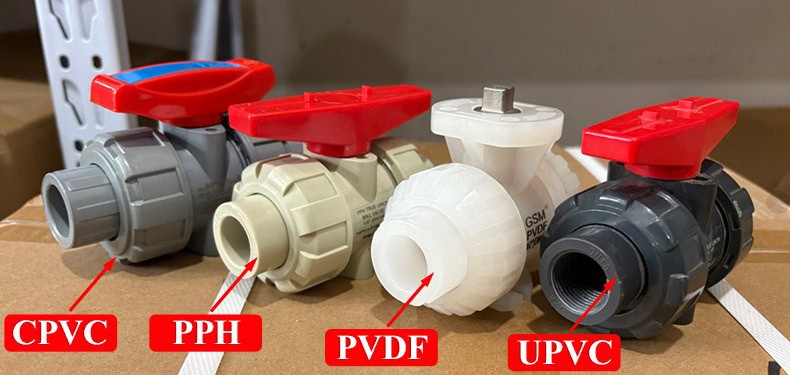
Plastic ball valve body materials: UPVC, CPVC, PPH and PVDF
The body material is the first and most important decision, because it sets the chemical and temperature envelope of the whole valve. Huiya builds ball valves in four thermoplastics, each with a distinct sweet spot:
| Material | Max temperature | Best for | Avoid |
|---|---|---|---|
| UPVC / PVC | ~55 °C | Ambient water, irrigation, seawater, mild chemicals — the low-cost workhorse | Hot fluids, aromatics, ketones |
| CPVC | ~90 °C | Hot water and acidic media — sulfuric and hydrochloric acid, sodium hypochlorite, ferric chloride | Strong hot caustic, solvents |
| PPH | ~85 °C | Strong caustic, alkalis and brine — chlor-alkali and caustic-dosing lines | Strong oxidising acids, chlorine |
| PVDF | ~120 °C | Concentrated acids, halogens (wet/dry chlorine), hydrofluoric acid, high-purity service | Hot concentrated caustic, ketones |
UPVC (also called PVC or rigid PVC) is the economical default for corrosion-free flow control in water and dilute chemicals at ambient temperature. It never rusts or scales and keeps system cost low — see our UPVC ball valves or the full UPVC valve range.
CPVC is the step up when the line runs hot or acidic. It holds pressure to around 90 °C — well beyond UPVC — and resists a wide band of aggressive chemicals, which makes it the value choice for hot-water and chemical-processing duty. Browse our CPVC ball valves and CPVC range.
PPH (polypropylene homopolymer) is the material to specify for strong caustic and alkaline service — sodium and potassium hydroxide, brine and chlor-alkali media that attack lesser plastics. It is usually the most economical body that survives hot caustic. See our PPH ball valves and PPH range.
PVDF (polyvinylidene fluoride, sold as Kynar® and Solef®) covers the widest and most aggressive chemical range — concentrated acids, wet and dry chlorine, hydrofluoric acid and oxidisers — to about 120 °C, with near-zero leaching that suits high-purity and semiconductor lines. Its one clear limit is hot concentrated caustic, where PPH is the better answer. See our PVDF ball valves, the PVDF range, or our detailed PVDF chemical resistance guide.
To weigh all four side by side on temperature, chemistry and cost, see our plastic valve material selection guide.
Connection types: true union, flanged and threaded
Once the material is fixed, the connection determines how the valve joins the pipe and how easily it can be serviced. Huiya offers three.
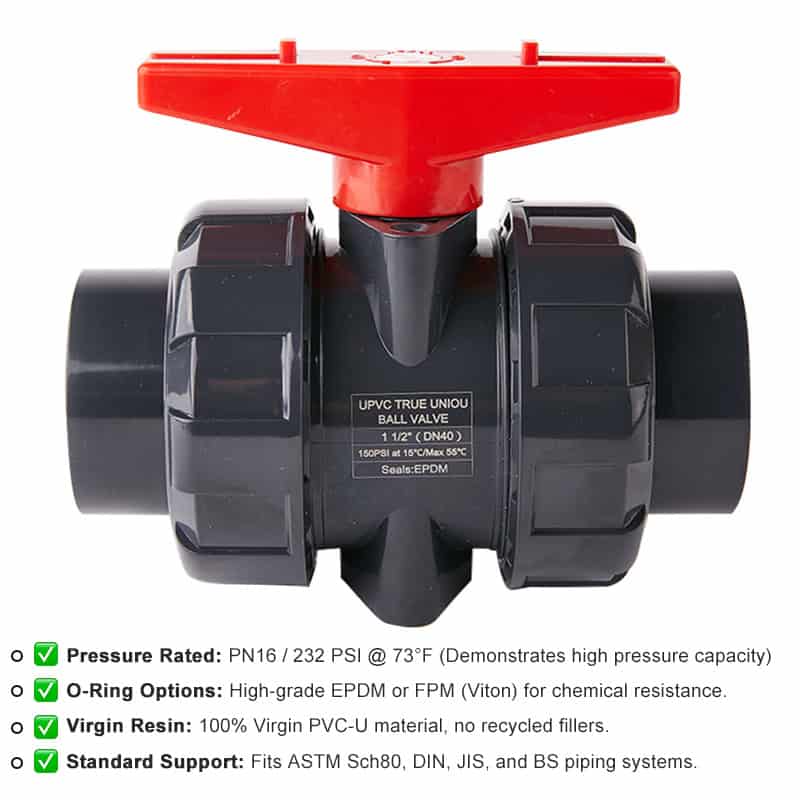
True union ball valves
The true union ball valve is the workhorse for small- and medium-bore lines, DN15 to DN100 (½”–4″). Its double-union body is the key advantage: both end connectors unthread, so the entire valve lifts out for cleaning, seat replacement or inspection without cutting the pipe. Huiya’s true union design goes a step further with an adjustable seat carrier: pull off the red handle and reverse it to use as a wrench, and you can micro-adjust the PTFE seat to compensate for wear and stop internal leakage — extending service life without replacing the valve.
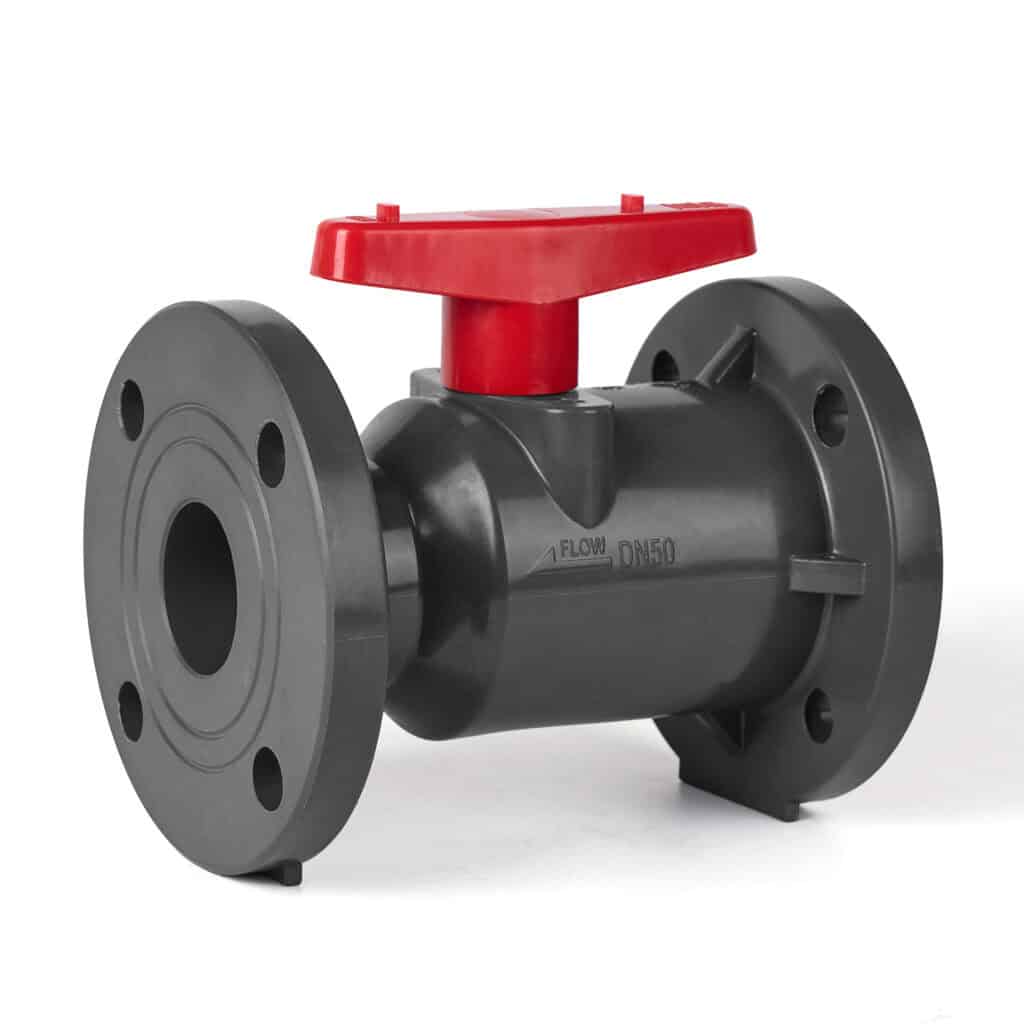
Flanged ball valves
The flanged ball valve is specified for larger-bore, higher-load or already-flanged piping, DN25 to DN200 (1″–8″). Bolted flanges carry more load than threaded or union joints and let the valve be dropped in as a unit. Huiya drills flanges to DIN (PN10/16), ANSI (Class 150) and JIS (10K) patterns, so the valve mates to your existing system worldwide.
Threaded (internal thread) ball valves
For compact installations and smaller lines, an internally threaded (BSP/NPT) connection screws directly onto threaded pipe — the simplest, most space-efficient option where union serviceability or flange loads are not required.
Which to choose? Use true union for small-to-medium lines where fast maintenance matters, flanged for large-bore or high-pressure headers and existing flanged systems, and threaded for compact, lower-duty connections.
Manual or pneumatic: choosing actuation
Every Huiya plastic ball valve is available hand-operated or automated.
Manual valves use a lever handle for direct on/off control — the right choice for isolation points and lines switched infrequently by an operator.
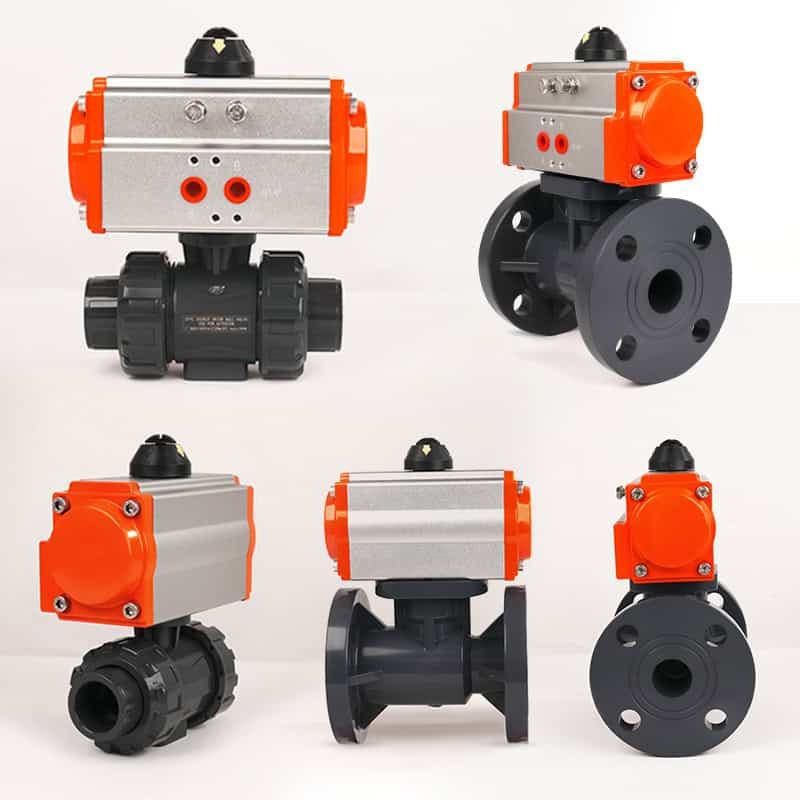
Pneumatic valves pair the valve with a rack-and-pinion actuator for automated dosing, isolation and process control. You can specify double-acting (air opens and closes) or spring-return (air one way, spring fails the valve to a safe open or closed position on air loss). The actuator housing comes in anodised aluminium or, for the most corrosive environments, an all-plastic PA housing that matches the valve’s own corrosion resistance. A full accessory package — solenoid valve, limit-switch box and air-filter regulator (the “triple unit”) — is available for complete automated control. See the full range of pneumatic valves.
Seats, seals, pressure rating and standards
The details below are where reliability is won or lost:
- Ball seats: PTFE, chemically matched to the full range of body materials for a tight, low-torque seal.
- Stem seal: a double O-ring arrangement on the stem (EPDM standard, FPM/FKM optional) — two independent barriers against stem leakage, the most common failure point on lesser valves.
- Pressure rating: PN10, de-rated with rising temperature per the material curve. Every valve is hydrostatic pressure tested at 1.5× rated pressure before it leaves the factory.
- Sizes: true union DN15–DN100 (½”–4″); flanged DN25–DN200 (1″–8″).
- Standards: built to EN ISO 16135, the international standard for thermoplastic ball valves. PVC and CPVC models additionally conform to ASTM F1970 with Schedule 80 socket/thread dimensions to ASTM D2467. Flange drilling available to DIN, ANSI and JIS.
Choosing the correct seat and O-ring for your chemistry matters as much as the body — on some media the elastomer seal, not the plastic, sets the real limit. Confirm both against our chemical resistance checker or ask our engineers.
How to choose a plastic ball valve: a four-step framework
Specifying the right valve comes down to four questions, in order:
- 1. Media & temperature → body material. Match your fluid, concentration and temperature to UPVC, CPVC, PPH or PVDF using the table above and the resistance checker. This is the decision that prevents cracking, swelling and premature failure.
- 2. Size, pressure & existing pipe → connection. Small line needing maintenance access → true union; large-bore or flanged system → flanged; compact/low-duty → threaded.
- 3. Operation → actuation. Operator-switched isolation → manual lever; automated dosing or remote control → pneumatic, double-acting or spring-return for fail-safe.
- 4. Chemistry → seat & seal. Confirm the PTFE seat and EPDM or FPM O-ring suit your media as well as the body does.
Not sure between a ball valve and another pattern? For throttling large diameters, compare our butterfly valves; for the most aggressive or solids-bearing media where the media must be isolated from the stem, see our diaphragm valves. The full range sits under plastic valves.
Why Huiya plastic ball valves
Chemical compatibility charts only hold if the resin behind the valve is what the chart assumes. Huiya moulds every valve from 100% virgin resin — no regrind, no fillers — so the compatibility you look up is the compatibility you get. Our PVDF valves are available in both a domestic virgin grade and genuine Arkema Kynar® resin, depending on your specification and budget.
Every valve is backed by ISO-certified manufacturing, a 12-month quality warranty, and the 1.5× hydrostatic test noted above. Valves ship in DIN metric, ANSI/ASTM and JIS dimensions to suit projects worldwide, direct from the factory.
That combination of quality and price is why engineers switch to Huiya on real projects. A Vietnamese pharmaceutical manufacturer, for example, had been running higher-cost Japanese Sekisui valves; on its phase-two expansion it moved to Huiya’s CPVC pneumatic and PPH valves — at roughly 40% of the incumbent’s price — where they matched the duty exactly and have run reliably since. Tell us your medium, concentration, temperature and line size, and our engineers will recommend the right body, connection, actuation and seat.
Frequently asked questions
Which plastic is best for a ball valve?
It depends on your media and temperature. UPVC suits ambient water and mild chemicals; CPVC handles hot water and acids to ~90 °C; PPH is best for strong caustic and alkalis; and PVDF covers concentrated acids, chlorine and high-purity service to ~120 °C. There is no single “best” — match the material to the duty.
What temperature can a plastic ball valve handle?
By material: UPVC to about 55 °C, PPH to about 85 °C, CPVC to about 90 °C, and PVDF to about 120 °C. Pressure rating de-rates as temperature rises, so specify against your actual operating temperature.
True union or flanged — which should I choose?
Choose a true union ball valve for small- to medium-bore lines (DN15–100) where you want to remove the valve for maintenance without cutting the pipe. Choose flanged (DN25–200) for large-bore or higher-pressure lines and systems already built on flanges.
Can plastic ball valves be automated?
Yes. Huiya plastic ball valves accept a rack-and-pinion pneumatic actuator in double-acting or spring-return (fail-safe) configuration, with optional solenoid, limit-switch box and filter regulator for full automated control.
What pressure rating do plastic ball valves have?
Huiya plastic ball valves are rated PN10 and hydrostatically tested at 1.5× rated pressure before shipment. Allowable working pressure decreases as temperature increases, following each material’s curve.
Are plastic ball valves chemically resistant?
Yes — that is their main advantage over metal. Resistance depends on the specific body material, plus the PTFE seat and EPDM/FPM O-ring. Check your exact medium in our chemical resistance checker, or send us the details for confirmation.