
A design guide for plastic diaphragm valves — UPVC, CPVC, PPH and PVDF
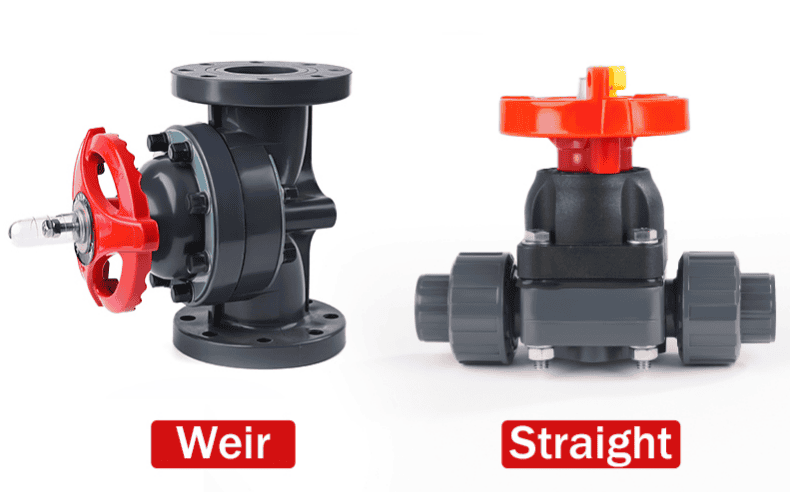
A diaphragm valve comes in two body designs — weir and straight-through — and the choice decides how long the valve lasts and what it can handle. The short version: the weir type (the classic Saunders design) suits the large majority of duties — corrosive, clean, dosing and mild-slurry service — because its diaphragm travels only a short distance to close, which means a tighter seal and much longer diaphragm life. The straight-through (full-bore) type is only needed for heavy slurries and viscous media. This guide explains the one structural difference between them, why it makes the weir design last so much longer, and where each one fits.
The one structural difference: the weir
Everything comes down to a raised weir inside the body.
- Weir type — a raised weir (a saddle) is moulded into the valve body. To close, the diaphragm only has to travel the short distance down onto the top of that weir.
- Straight-through type — there is no weir; the bore runs smooth and full. To close, the diaphragm has to stretch all the way down across the entire bore.
That difference in diaphragm stroke — short on a weir valve, long on a straight-through — is what drives everything else about the two designs.
Why the weir design lasts longer
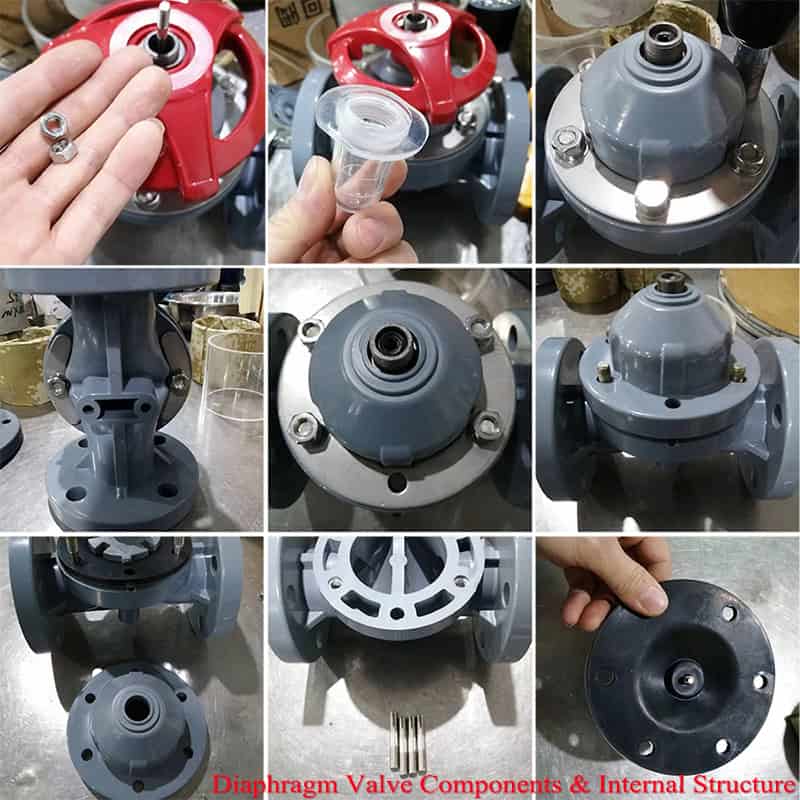
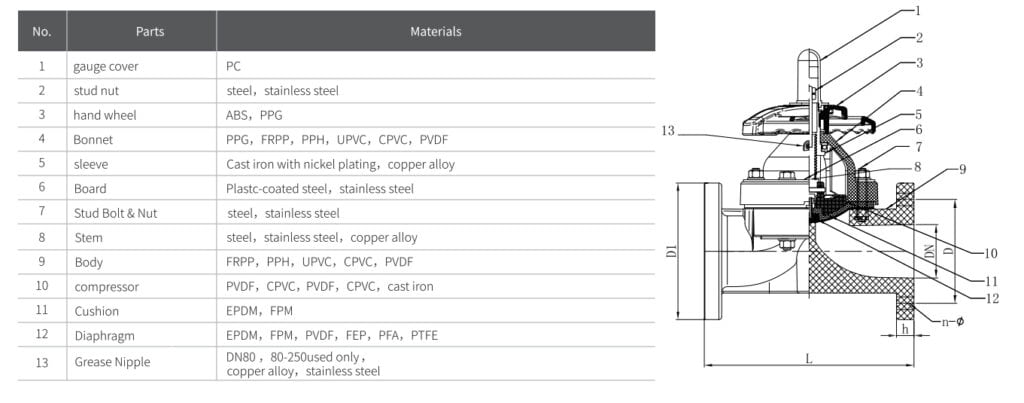
The diaphragm is the part that wears, and what wears it is flexing. On a weir valve, the short stroke means the diaphragm flexes only a little on every open-close cycle, so it suffers far less mechanical fatigue. The result is a longer diaphragm life and a more consistent seal — which matters most on lines that cycle frequently or run on automatic actuators.
On a straight-through valve, the diaphragm stretches across the full bore every single cycle. That large, repeated deformation fatigues the diaphragm quickly, and on high-cycle duty the diaphragm is the first thing to fail. You buy the full bore at the cost of diaphragm life.
Weir vs straight-through — side by side
| Weir type | Straight-through | |
|---|---|---|
| Diaphragm stroke | Short | Long (full bore) |
| Diaphragm life on cycling | Long — low fatigue | Shorter — high fatigue |
| Shut-off | Tight, bidirectional | Tight, but more diaphragm stress |
| Throttling | Good | Fair |
| Solids / slurry | Mild slurries and solids-laden liquids | Heavy slurries, viscous and fibrous media |
| Flow (Cv) | Slightly lower (weir raises the seat) | Highest (full bore) |
| Best for | Corrosive, clean, dosing and general service | Heavy-slurry / viscous duty only |
The takeaway: for the vast majority of corrosive, clean-water and dosing duties, the weir design wins on diaphragm life and seal reliability. The straight-through is a specialist — reach for it only when you genuinely need a full, unobstructed bore for heavy solids.
Case: a chlor-alkali plant in the Philippines
A chlor-alkali producer had process chemicals that crystallise inside the pipe, which ruled out a ball valve — crystals foul the ball and seat and stop it closing. They started with straight-through UPVC union diaphragm valves. But the line was cycled often, and the straight-through design’s one weakness showed itself: the diaphragm’s full-bore stroke is large, and under repeated heavy stretching the EPDM cracked and began to leak.
Huiya’s engineers recommended switching to weir diaphragm valves — the raised weir gives a very short stroke — fitted with a dual-layer EPDM + PTFE diaphragm, where the short stroke sharply reduces the mechanical fatigue on the PTFE face. The line has since run stably for two years.
The lesson is the rule above, proven in the field: on frequently-cycled service, diaphragm stroke is what kills the diaphragm — and the weir’s short stroke is the fix.
Flow capacity (Cv) of weir diaphragm valves
Because the weir raises the seat into the flow path, a weir valve has a slightly lower flow coefficient (Cv) than a full-bore valve — that is the small trade you make for its longevity. Our weir diaphragm valve Cv at 100% open:
| DN | Cv (100% open) | DN | Cv (100% open) |
|---|---|---|---|
| 15 | 5.4 | 65 | 76.5 |
| 20 | 6.3 | 80 | 103.5 |
| 25 | 7.2 | 100 | 166.5 |
| 32 | 8.1 | 125 | 270 |
| 40 | 23.4 | 150 | 360 |
| 50 | 43.2 | 200 | 630 |
On the great majority of water and chemical lines this is more than adequate. Where you truly need a full, unobstructed bore — heavy slurry or viscous media — that is the straight-through’s job, not the weir’s.
Why Huiya builds weir-type diaphragm valves
We focus on the weir (Saunders) design because it covers the large majority of real duties — corrosive chemicals, ultrapure and clean service, chemical dosing and mild slurries — with the longest diaphragm life and the tightest seal, and it pairs perfectly with our dual-layer diaphragm. We build them in UPVC, CPVC, PPH and PVDF: union type DN15–DN50 and flanged type DN25–DN200, rated PN10, with a rising-handwheel or a pneumatic actuator.
For the full picture — how a diaphragm valve works, the dual-layer diaphragm options, materials, sizing, and when to choose a diaphragm valve over a ball or butterfly valve — see our complete diaphragm valve guide. Also deciding on the body and lining material? Compare how to select the diaphragm valve material, weigh all four plastics in our plastic valve material selection guide, and check your exact medium in the chemical resistance checker. Browse the full range of plastic diaphragm valves — UPVC, CPVC, PPH and PVDF — or request a quote.
Frequently asked questions
What is a weir-type diaphragm valve? It is the classic Saunders design, with a raised weir (a saddle) inside the body that the diaphragm closes onto. The diaphragm only travels a short distance, which gives a tight seal and a long diaphragm life. It suits corrosive, clean, dosing and mild-slurry service.
What is the difference between a weir and a straight-through diaphragm valve? A weir valve has a raised seat, so the diaphragm has a short stroke; a straight-through valve has a smooth full bore, so the diaphragm must stretch across the whole bore to close. The weir lasts longer and seals tighter; the straight-through passes heavy solids better.
Why does a weir diaphragm valve last longer? Because the diaphragm flexes only a short distance on each cycle, it suffers far less mechanical fatigue than the full-bore stroke of a straight-through valve — so it lasts longer, especially on frequently-cycled or automated lines.
Can a weir diaphragm valve handle slurry? It handles mild slurries and solids-laden liquids well, because it has no ball or seat cavity for particles to jam. For heavy, dense or fibrous slurries that need a full unobstructed bore, a straight-through valve is the correct choice.
Can a weir diaphragm valve throttle? Yes. It regulates flow well at partial opening and, unlike a ball valve, does not wear a seat when held part-open.
Which has higher flow, weir or straight-through? The straight-through has a higher flow coefficient because of its full bore. A weir valve’s Cv is slightly lower — the raised weir is the trade for its much longer diaphragm life — but it is more than adequate for most water and chemical service.
— Andy Xia, Huiya Engineering Team