
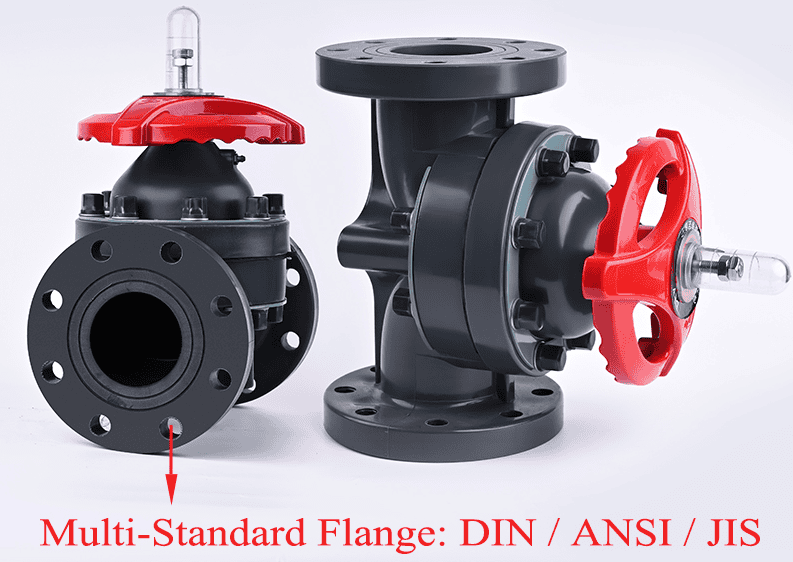
A practical guide to plastic, corrosion-resistant diaphragm valves — UPVC, CPVC, PPH and PVDF
A diaphragm valve controls flow with a flexible diaphragm that is pressed down onto a weir (a raised saddle) inside the valve body. Lift the diaphragm and fluid flows; press it onto the weir and the line shuts off. The important part is what the diaphragm also does: it completely separates the process fluid from the stem and bonnet. That single feature is why diaphragm valves succeed where other valves fail — in dirty, abrasive or slurry-laden fluids that jam a ball valve’s stem, and in ultra-corrosive or high-purity media where any leak path or dead space is unacceptable. This guide explains how they work, the weir design, how to pick the diaphragm and body material, sizing, and when to choose a diaphragm valve over a ball or butterfly valve.
A diaphragm valve is a valve that controls flow by pressing a flexible diaphragm down onto a weir inside the body, sealing the line while completely isolating the process fluid from the stem and bonnet. Because there is no stem packing and no dead space, it handles dirty, abrasive and slurry-laden fluids that jam a ball valve, and ultra-corrosive or high-purity media where any leak path is unacceptable.
How a diaphragm valve works
A diaphragm valve is operated by a handwheel or actuator that drives a compressor down onto a flexible diaphragm, pressing it against the weir to seal. Because the diaphragm sits between the fluid and the working parts, there is no stem packing and no gland — so there is no path for the fluid to leak out to atmosphere, and no crevice or dead space where fluid can stagnate or solids can collect.
Huiya builds the weir type — the classic Saunders pattern, where a raised weir inside the body gives the diaphragm a short stroke to close. That short stroke is why weir valves seal tighter and last longer than the straight-through (full-bore) alternative, which is only needed for heavy slurries and viscous media. For the full comparison, see weir vs straight-through diaphragm valves.
Why choose a diaphragm valve
Four properties set diaphragm valves apart, and they matter to both the engineer specifying the valve and the buyer costing its lifecycle:
- No leak path, no packing. The fluid never touches the stem, so there is nothing to leak out and nothing to contaminate the media. This makes diaphragm valves the natural choice for toxic, aggressive or high-purity duties.
- Handles solids and slurries. There is no ball, seat pocket or stem cavity for particles to jam or abrade. A smooth bore closing onto a diaphragm shrugs off suspended solids and mild slurries that quickly destroy ball valves.
- Throttles well. A diaphragm valve regulates flow at partial opening — like a butterfly valve, and unlike a ball valve, which wears its seat when held part-open.
- Clean and crevice-free. No dead space means the valve is easy to keep clean and drains fully — important for ultrapure water, food-grade and pharmaceutical-style service.
The dual-layer diaphragm — where Huiya is different
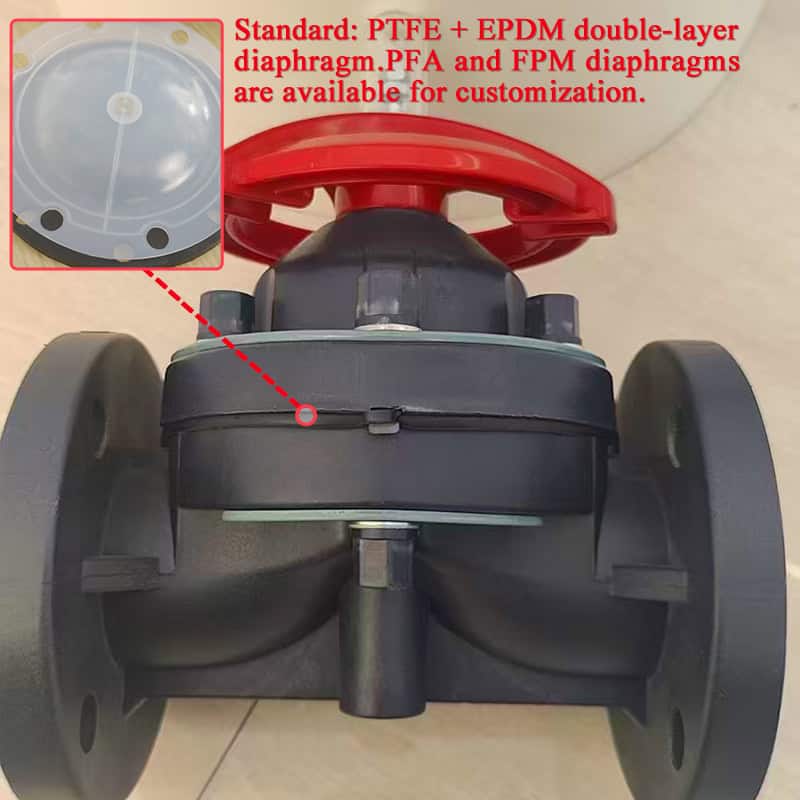
The diaphragm is the heart of the valve, and a thin single-layer diaphragm is the most common failure point in the field. Ours are dual-layer (two-ply): a wetted face chosen for chemical inertness, bonded to a backing layer that provides mechanical strength and — just as importantly — a second chemical barrier. We offer three combinations:
| Diaphragm | Wetted face | Backing | Best for |
|---|---|---|---|
| EPDM + PTFE | PTFE (inert) | EPDM (flex, cycle life) | General workhorse — water, dilute-to-moderate acids and alkalis, mild slurries |
| FKM + PTFE | PTFE (inert) | FKM / Viton (HF-resistant) | Hydrofluoric acid, hot and strong acids |
| EPDM + F46 | F46 / FEP (ultra-low permeation) | EPDM (high-cycle flex) | High-purity gas, ultrapure water, nitrogen purge lines |
Why the backing layer matters: aggressive molecules such as hydrofluoric acid (HF) are small enough to slowly permeate a single PTFE layer. If the layer behind it is cheap EPDM, the HF attacks it, the backing swells and ruptures, and the acid then corrodes the stem and actuator. A FKM backing resists HF instead of failing, and an F46 (FEP) face has an even tighter molecular structure than PTFE for the lowest gas and moisture permeation. The two cases at the end of this guide show both principles in the field.
A dual-layer diaphragm uses a PTFE face bonded to an EPDM backing: the PTFE resists the chemical, the EPDM provides the spring force and seal. Single-layer PTFE cracks under repeated flexing; single-layer EPDM permeates in HF and strong acid. The two-layer construction avoids both failure modes.
Body materials and temperature
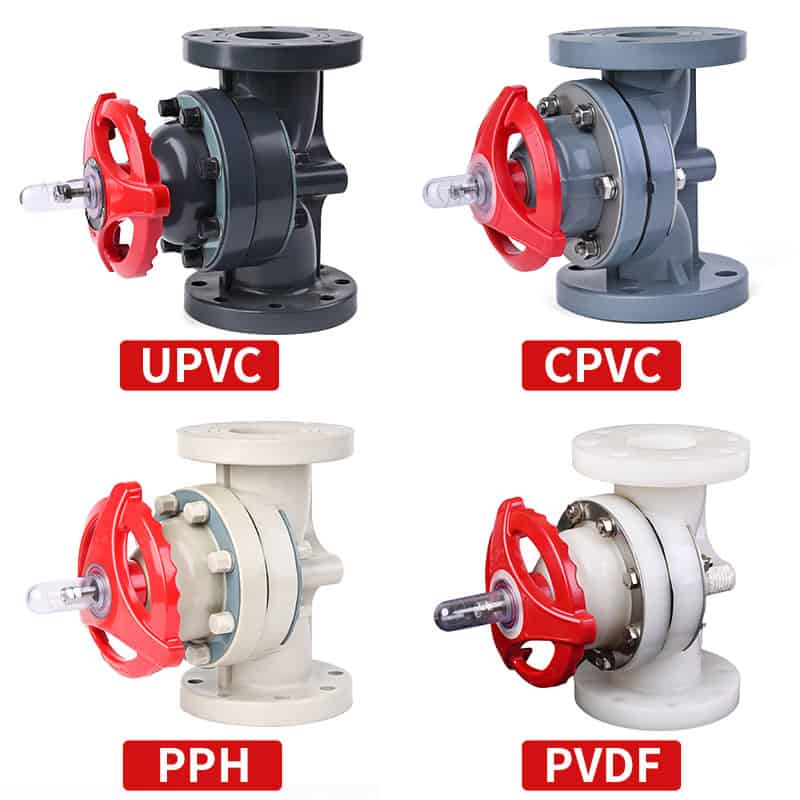
The diaphragm handles the chemistry at the sealing face; the body sets the temperature ceiling and the overall chemical envelope. We build the body in four plastics:
- UPVC — to about 55 °C. Ambient-temperature water and mild chemicals; the value choice.
- PPH — to about 85 °C. Strong caustic and alkalis, good all-round chemical service.
- CPVC — to about 90 °C. Hot water, hot acids and chlorinated media.
- PVDF — to about 120 °C. The most aggressive acids, HF, halogens and high-purity service.
Match the body to your medium and temperature, and the diaphragm to the specific chemistry. To weigh the four plastics side by side, see our plastic valve material selection guide; for PVDF specifically, our PVDF chemical compatibility guide lists what it resists and where it is limited; and to check your exact medium, use our chemical resistance checker. For the two design choices in depth, see weir vs straight-through bodies and how to select the diaphragm material.
In practice: UPVC diaphragm valves for general water treatment and dilute chemical dosing to 60 °C; CPVC where the same duty runs hot to 90 °C; PPH for concentrated alkalis and mild slurries; and PVDF for strong acids, HF, solvents and high-purity duty. To match a specific chemical and temperature, see our plastic valve material selection guide.
The diaphragm and seal material — EPDM or Viton (FKM), and whether the face is PTFE or FEP — depends on your medium and temperature. Our EPDM vs Viton (FKM) seal selection guide walks through the choice with a chemical-resistance table.
Sizes, connections and pressure
- Union type: DN15–DN50. Compact, and the union ends let you remove the valve for service without cutting into the pipe.
- Flanged type: DN25–DN200. For larger lines and wherever a flange standard is specified — available to ANSI, DIN and JIS.
- End connections by material: solvent-weld socket for UPVC and CPVC; butt (heat) fusion for PPH and PVDF.
- Rated PN10 and sealing bidirectionally. For size conversion, see our DN to inch pipe size chart.
Manual or pneumatic
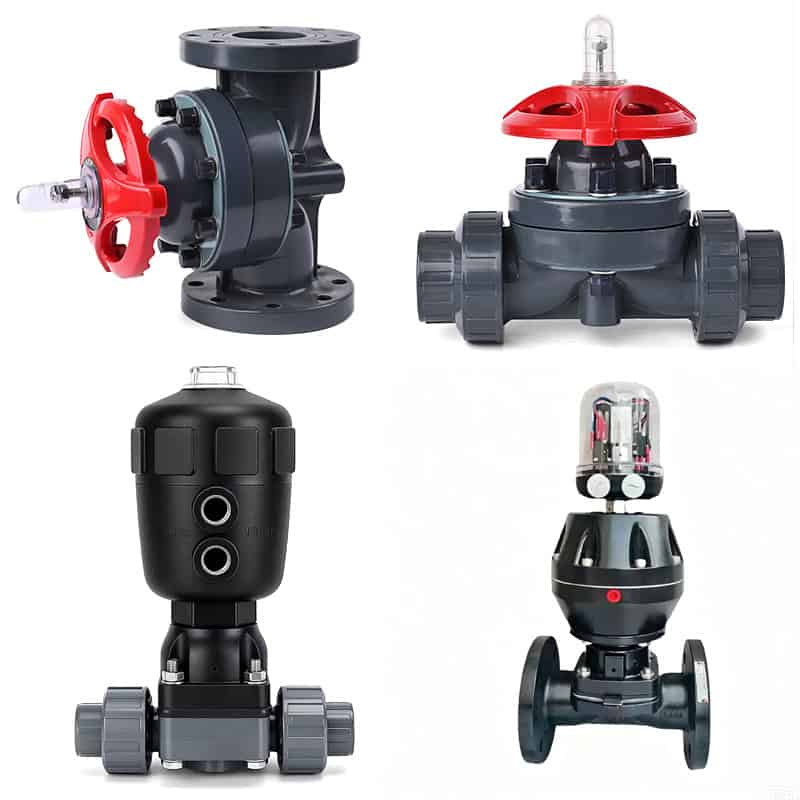
Diaphragm valves can be hand-operated with a handwheel, or automated. For automation, choose a single-acting (spring-return, fail-safe) or double-acting pneumatic actuator, in aluminum-alloy or all-plastic construction, with an air filter-regulator-lubricator (FRL) set added where needed. Diaphragm valves are particularly good for automated dosing and high-cycle service, because seal integrity does not depend on stem packing that can wear or leak.
Diaphragm valve vs ball valve vs butterfly valve
The three plastic valve types solve different problems:
| Diaphragm | Ball | Butterfly | |
|---|---|---|---|
| Best for | Slurries, corrosives, high purity, throttling | Clean fluids, tight on/off, small–mid bore | Large bore, light weight, cost |
| Solids / slurry | Excellent — no cavity to jam | Poor — particles jam and abrade | Fair |
| Throttling | Yes | No (wears seat) | Yes |
| Leak path at stem | None (no packing) | Stem seal | Stem seal |
| Size range | DN15–DN200 | DN15–DN100 | DN25–DN500 |
| Pressure drop (open) | Higher (weir) | Near-zero (full bore) | Moderate |
In short: choose a diaphragm valve for solids-laden, ultra-corrosive, toxic or high-purity duty and for throttling; a ball valve for clean, full-bore, bubble-tight on/off; a butterfly valve for large-diameter lines where weight and cost dominate. For the ball-versus-butterfly decision in detail, see our guide on ball valve vs butterfly valve.
Case 1 — Uruguay iron-ore mine: when slurry destroyed the ball valves
An iron-ore operation in Uruguay was moving a particle-laden process fluid through its pipework on ball valves. The valves kept failing: solids worked their way into the ball and stem, abrading and jamming them until they no longer sealed. Huiya recommended replacing them with ANSI flanged diaphragm valves in a CPVC body — about 60% more corrosion-resistant than the metal valves it replaced, and stable in the plant’s strong acid-and-alkali service. The diaphragms were EPDM + PTFE, given a special vulcanization for ageing resistance. The result: a service life of 8–10 years, at least three fewer replacement cycles than the previous valves, and a large cut in lifecycle equipment cost.
The lesson is the reason diaphragm valves outlast ball valves on dirty duty: there is no stem or seat cavity for particles to jam — the diaphragm simply closes onto the weir, solids and all.
Case 2 — Taiwan semiconductor fab: HF permeation and the dual layer
A Tier-1 wafer fab was running 40% hydrofluoric acid with trace nitric acid at 60–80 °C through its mixed-acid recovery line. Its original single-layer PTFE diaphragm valves triggered cleanroom toxic-gas alarms within three months: HF had micro-permeated the thin PTFE, attacked the cheap EPDM backing behind it (which swelled and ruptured), and then corroded the stem and aluminum actuator. Each unplanned shutdown cost the fab about $45,000.
Huiya supplied dual-layer PVDF diaphragm valves, configured by line: FKM + PTFE on the HF and acid-recovery lines, where the FKM backing resists any HF that gets through the PTFE face; and EPDM + F46 on the surrounding ultrapure-water and nitrogen purge lines, where the F46 (FEP) face gives the lowest possible gas and moisture permeation. The outcome over 18 months of continuous operation: zero leaks and zero alarms, diaphragm life extended from three months to over two years, an 85% reduction in maintenance, and more than $120,000 saved in avoided downtime.
The lesson: on HF and high-purity service the backing layer is a safety barrier, not a detail. For the chemistry behind HF service, see our hydrofluoric acid valve guide and our PVDF diaphragm valve.
Huiya plastic diaphragm valves
We manufacture weir-type diaphragm valves in UPVC, CPVC, PPH and PVDF — union type DN15–DN50 and flanged type DN25–DN200 (ANSI, DIN and JIS), rated PN10, manual or pneumatic, with the dual-layer diaphragm available in EPDM + PTFE, FKM + PTFE or EPDM + F46. Everything ships factory-direct, MOQ 20 pieces, about 7 days for standard items, with a 12-month warranty. Tell us your medium, its concentration, temperature, line size and whether the duty is on/off or throttling, and our engineers will specify the body and diaphragm — and flag any permeation or slurry risk before it becomes a problem.
Browse the full range of plastic diaphragm valves — UPVC, CPVC, PPH and PVDF — or request a quote.
Frequently asked questions
What is a diaphragm valve used for? A diaphragm valve controls flow — both on/off isolation and throttling — for corrosive, dirty or slurry-laden, and high-purity liquids. Because a flexible diaphragm isolates the fluid from the stem and bonnet, there is no leak path to atmosphere and no crevice where fluid can stagnate or solids can collect.
How does a diaphragm valve work? A handwheel or actuator pushes a compressor down onto a flexible diaphragm, pressing it against a weir in the body to shut off flow; lifting it opens the line. The diaphragm seals the working parts away from the process fluid.
What is a weir-type diaphragm valve? It is the classic (Saunders-type) design, with a raised weir that the diaphragm closes onto. The weir gives a short stroke, long diaphragm life and a tight bidirectional seal, and suits general, corrosive and mild-slurry service.
Can a diaphragm valve be used for throttling? Yes. It regulates flow well at partial opening and, unlike a ball valve, does not wear a seat when held part-open.
Diaphragm valve or ball valve for slurry? A diaphragm valve. It has no ball, seat pocket or stem cavity for particles to jam or abrade, so it lasts far longer than a ball valve on solids-laden fluids.
What diaphragm material should I choose? EPDM + PTFE is the general-purpose choice; FKM + PTFE is for hydrofluoric acid and hot, strong acids; EPDM + F46 (FEP) is for high-purity gas and ultrapure water where permeation must be minimal.
What is the temperature limit of a plastic diaphragm valve? It is set by the body material: UPVC to about 55 °C, PPH to about 85 °C, CPVC to about 90 °C, and PVDF to about 120 °C.
Why use a dual-layer diaphragm? A single-layer diaphragm can be slowly permeated by aggressive media such as HF, after which the backing is attacked and the stem and actuator corrode. A dual-layer diaphragm adds a chemically-resistant backing as a second barrier, protecting the valve and greatly extending diaphragm life.
— Andy Xia, Huiya Engineering Team