
PVDF Diaphragm Valve
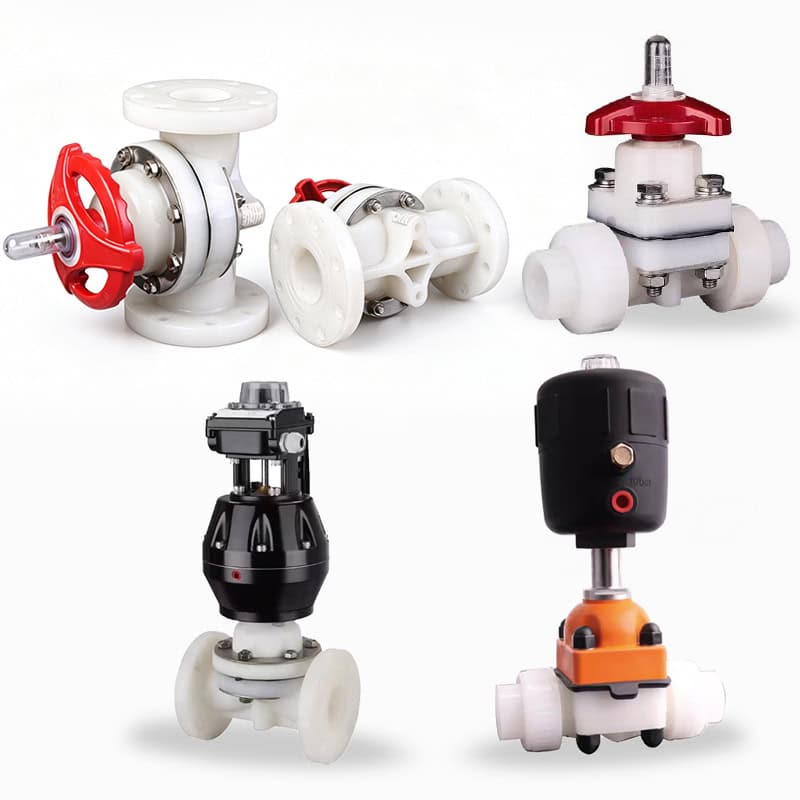
PVDF diaphragm valves handle the media that defeat other plastics — concentrated acids, halogens, and high-purity fluids — while the diaphragm design keeps the flow path free of dead space, packing, and contamination. We build ours from 100% virgin PVDF and offer them in true union, flanged, and pneumatic configurations for chemical processing, semiconductor, and water-treatment duties.
A diaphragm valve isolates the working media behind a flexible diaphragm, so no stem packing ever contacts the fluid and there is no crevice to trap or contaminate it. In PVDF, that makes it one of the most reliable choices for aggressive corrosive service and for ultrapure applications where leaching and particle generation must be near zero.
PVDF chemical compatibility
PVDF resists a wide range of high-concentration acids, halogens, and oxidizers. The table summarises typical ratings — ◎ excellent, ○ limited, × not recommended — across temperature.
| Media | Rating |
|---|---|
| Sulfuric acid 98% | ◎ 20–80 °C (○ at 100 °C) |
| Hydrofluoric acid 40–55% | ◎ 20–100 °C |
| Hydrochloric acid 35% | ◎ 20–120 °C |
| Chlorine gas (wet / dry) | ◎ 20–120 °C |
| Hydrogen peroxide 35–50% | ◎ 20–100 °C |
PVDF is not suited to some strong polar solvents, esters, ketones, and certain amines, which can swell or attack the polymer. Acetone, butyl acetate, THF, and aniline, for example, are only limited at 20 °C and not recommended at 40 °C and above. For a specific medium and temperature, send us the details or see our PVDF chemical resistance guide.
Why our PVDF diaphragm valves
- 100% virgin PVDF. We use only new resin — never regrind — with imported Arkema Kynar® or Solvay Solef® grades available. The result is high purity, resistance to embrittlement, and effectively zero leaching for ultrapure service.
- No-glue chemical joining. Connections are made by socket fusion or infrared (IR) butt welding, so the joint fuses at the molecular level and is as strong as the pipe itself — eliminating the leak paths of a bonded or threaded joint.
- Double-diaphragm design, low compression set. The diaphragm assembly delivers a tight, durable seal, and the body distributes closing pressure evenly. That lowers the required closing torque and keeps flow regulation stable and repeatable.
- No dead space, no packing wear. The diaphragm seals the media completely, so there is no stem packing to wear and nowhere for media to stagnate or contaminate the line.
- Customisable. Bonnet, compressor, stem, bolts, and diaphragm can all be specified — for example 304 or 316 stainless steel stems and fasteners.
Diaphragm material options
The diaphragm is the key wetted part. We offer several combinations, selected to your media:
| Diaphragm | Best suited to |
|---|---|
| EPDM + PTFE | Acetone, alcohols, alkalis, ambient water |
| FKM + PTFE | Oils, aromatics, strong acids, high temperature |
| EPDM + FEP (F46) | High-pressure gas, pure water, anti-permeation duty |
Configurations
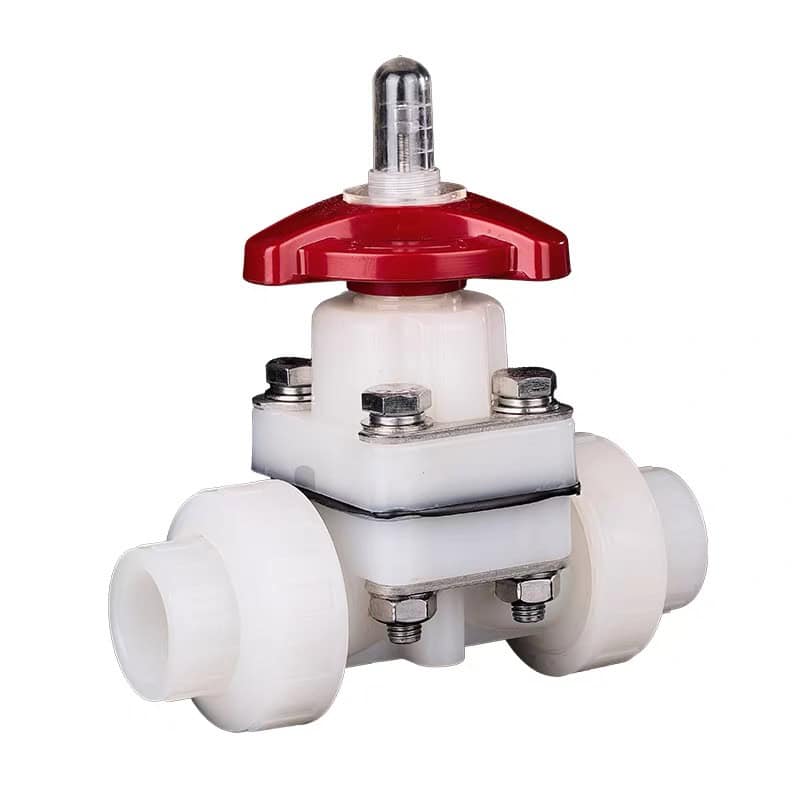
True union PVDF diaphragm valve
A compact, manually operated valve in DN15–DN50 (1/2″–2″) with union end connectors. The unions let you unscrew and lift the valve straight out for cleaning or replacement without cutting pipe — ideal for skid-mounted dosing systems and instrument panels where space is tight and maintenance is frequent.
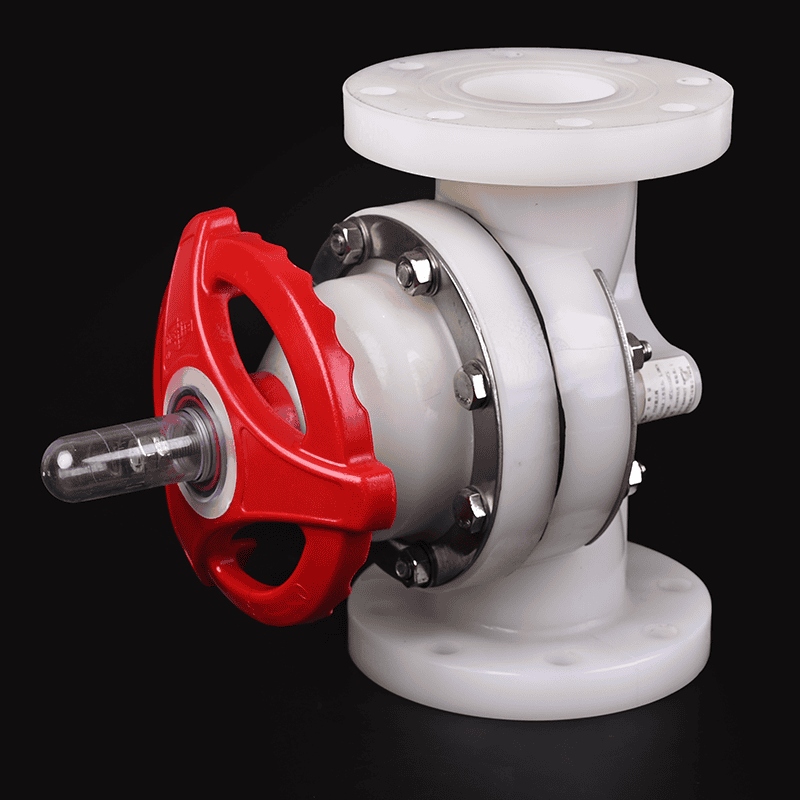
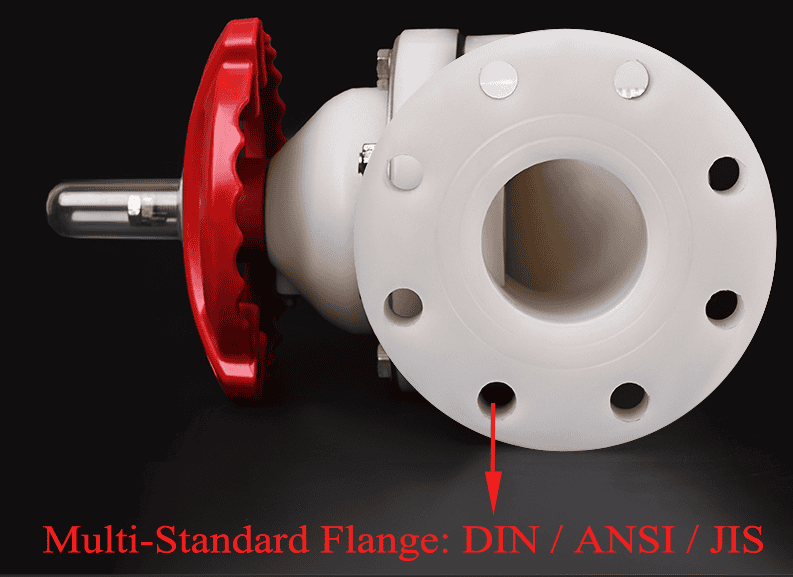
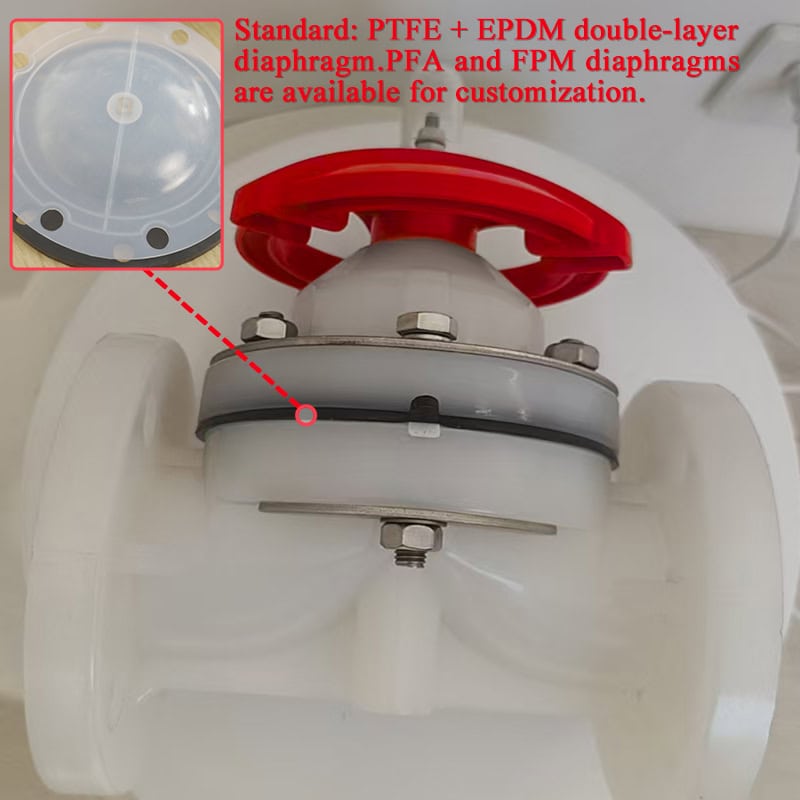
Flanged PVDF diaphragm valve
Available in DN15–DN150 (1/2″–6″) to ANSI, DIN, or JIS flange standards. The bolted flange gives far greater structural strength against pipe stress, vibration, and thermal movement, and is the standard choice on larger-bore and permanent process lines. Compared with the true union version, the flanged valve offers higher pressure capability and better tolerance to pipe misalignment, at the cost of more weight and a more involved removal.
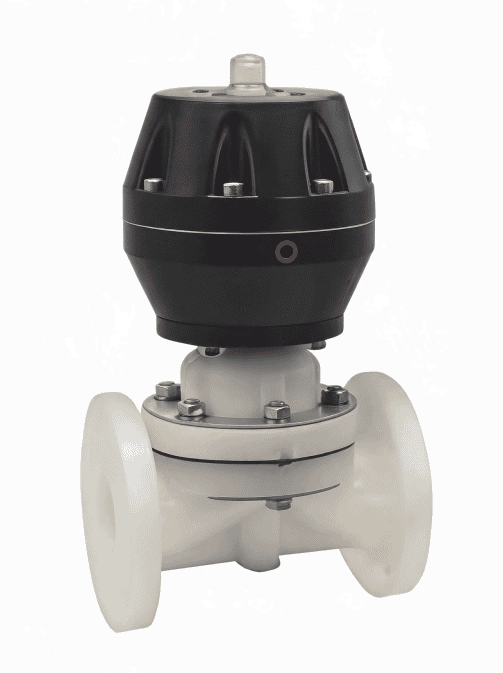
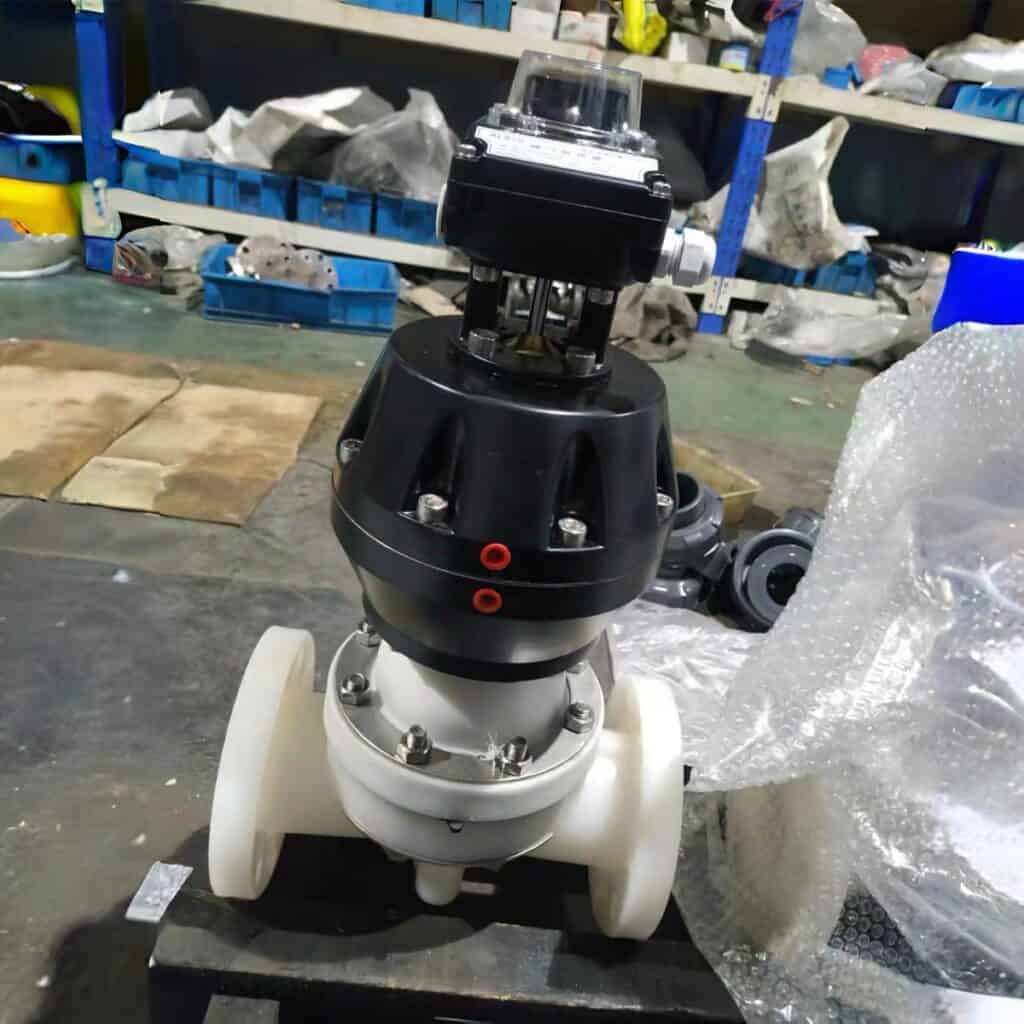
Pneumatic PVDF diaphragm valve
The same valve in DN15–DN150 with a corrosion-resistant all-plastic actuator, in double-acting or spring-return (fail-safe) action. An adjustable closing-stroke stop protects the diaphragm and extends its life, and the valve accepts the usual control accessories — solenoid valve, limit switch / position feedback, positioner, and air filter regulator — for automated dosing and emergency-shutdown duties.
Specifications
| Body material | PVDF (100% virgin; Arkema Kynar® / Solvay Solef® option) |
| Size range | DN15–DN150 (1/2″–6″); true union DN15–DN50 |
| Pressure rating | PN10 (derates with temperature) |
| Max temperature | ~120 °C |
| Body design | Weir type |
| Diaphragm | EPDM + PTFE / FKM + PTFE / EPDM + FEP |
| Connection | True union / flanged (ANSI / DIN / JIS) |
| Operation | Manual / pneumatic (double-acting or spring-return) |
| Stem & bolts | 304 or 316 stainless steel option |
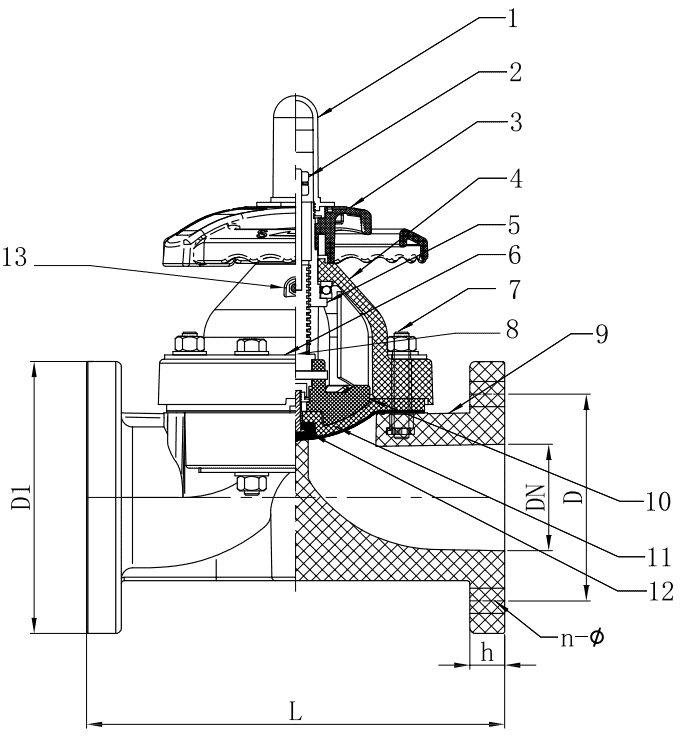
| No. | Parts | Materials |
|---|---|---|
| 1 | Gauge Cover | PC |
| 2 | Stud Nut | Steel, Stainless Steel |
| 3 | Hand Wheel | ABS, PPG |
| 4 | Bonnet | PVDF |
| 5 | Sleeve | Cast Iron with Nickel Plating, Copper Alloy |
| 6 | Board | Plastic-coated Steel, Stainless Steel |
| 7 | Stud Bolt & Nut | Steel, Stainless Steel |
| 8 | Stem | Steel, Stainless Steel, Copper Alloy |
| 9 | Body | PVDF |
| 10 | Compressor | PVDF |
| 11 | Cushion | EPDM, FPM |
| 12 | Diaphragm | EPDM, FPM, PVDF, FEP, PFA, PTFE |
Flanged Diaphragm Valve — Dimensions (mm) 法兰隔膜阀 产品尺寸表
| DN | D1 (mm) | D (mm) | L (mm) | h (mm) | n | φ (mm) | |||||||||||
|---|---|---|---|---|---|---|---|---|---|---|---|---|---|---|---|---|---|
| HG/DIN | JIS | ANSI | HG/DIN | JIS | ANSI | HG | DIN | JIS | ANSI | HG/DIN | JIS | ANSI | HG/DIN | JIS | ANSI | ||
| 15 | 95 | 95 | 95 | 65 | 70 | 60 | 125 | 130 | 110 | 110/108 | 14 | 4 | 4 | 4 | 14 | 15 | 16 |
| 20 | 105 | 100 | 100 | 75 | 75 | 70 | 135 | 150 | 120 | 120/150 | 16 | 4 | 4 | 4 | 14 | 15 | 16 |
| 25 | 115 | 125 | 125 | 85 | 90 | 79 | 145 | 160 | 130 | 130/150 | 16 | 4 | 4 | 4 | 14 | 15 | 16 |
| 32 | 135 | 135 | 135 | 100 | – | 89 | 160 | 180 | 142* | 160 | 16 | 4 | 4 | 4 | 18 | 19 | 16 |
| 40 | 145 | 145 | 145 | 110 | 105 | 98 | 180 | 200 | 180 | 180/176 | 16 | 4 | 4 | 4 | 18 | 19 | 16 |
| 50 | 160 | 160 | 160 | 125 | 120 | 121 | 210 | 230 | 210 | 210/202 | 18 | 4 | 8 | 4 | 18 | 19 | 19 |
| 65 | 180 | 180 | 180 | 145 | 140 | 140 | 250 | 290* | 250 | 250 | 22 | 4 | 8 | 4 | 18 | 19 | 19 |
| 80 | 195 | 195 | 195 | 160 | 150 | 152 | 300 | 310 | 280 | 280/264* | 25 | 8 | 8 | 4 | 18 | 19 | 19 |
| 100 | 215 | 220 | 220 | 180 | 175 | 190 | 350 | 350 | 340 | 340/329* | 25 | 8 | 8 | 8 | 18 | 19 | 19 |
| 125 | 255 | 255 | 255 | 210 | 210 | 216 | 400 | 400 | 410 | 410 | 30 | 8 | 8 | 8 | 18 | 22 | 22 |
| 150 | 280 | 280 | 280 | 240 | 240 | 241 | 460 | 480 | 480 | 480 | 30 | 8 | 8 | 8 | 22 | 23 | 22 |
| 200 | 340 | 340 | 340 | 295 | 290 | 298 | 575 | 600* | 570 | 570 | 38 | 8 | 12 | 8 | 22 | 23 | 22 |
| 250 | 395 | 395 | 395 | 350 | 355 | 362 | 685 | 730* | 680 | 680 | 38 | 12 | 12 | 12 | 25 | 25 | 26 |
| 300 | 480 | 480 | 480 | 400 | 400 | 432 | 790 | – | – | – | 40 | 12 | 16 | 12 | 22 | 25 | 26 |
D1 = flange OD; D = bolt-circle dia. (PCD); L = face-to-face length; h = flange thickness; n = number of bolt holes; φ = bolt-hole dia. Values given per flange standard (HG / DIN / JIS / ANSI). * non-standard — confirm the bolt pattern when ordering. A “/” in the ANSI column shows two reference values. DN300 L is listed for HG only. DN32 D (JIS) was not legible in the source image — please confirm from your drawing.
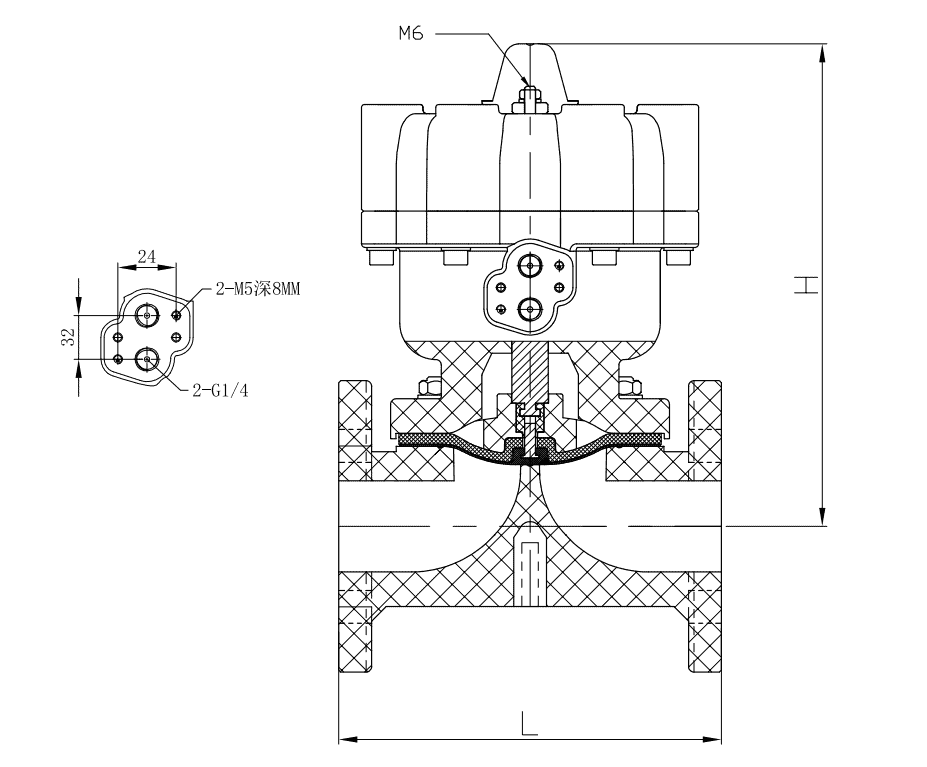
Pneumatic Diaphragm Valve — Dimensions (mm) 气动隔膜阀 产品尺寸表
| DN (mm) | 15 | 20 | 25 | 32 | 40 | 50 | 65 | 80 | 100# | |
|---|---|---|---|---|---|---|---|---|---|---|
| H | 157 | 160 | 163 | 165 | 260 | 265 | 380 | 395 | 441 | |
| L | HG | 125 | 135 | 145 | 160 | 180 | 210 | 250 | 300 | 350 |
| DIN | 130 | 150 | 160 | 180 | 200 | 230 | 290* | 310 | 350 | |
| JIS | 110 | 120 | 130 | 142* | 180 | 210 | 250 | 280 | 340 | |
| ANSI | 110/108 | 120/150 | 130/150 | 160 | 180/176 | 210/202 | 250 | 280/264* | 340/329* | |
H = overall height; L = face-to-face length per flange standard (HG / DIN / JIS / ANSI). # DN100 uses a plastic pneumatic actuator — media pressure must not exceed 0.6 MPa. * non-standard dimension. A “/” in the ANSI row shows two reference face-to-face values. For more sizes, see the flanged diaphragm valve page.
Pneumatic Actuator — Parameters 执行器参数表
| DN (mm) | 15 | 20 | 25 | 32 | 40 | 50 | 65 | 80 | 100 | |
|---|---|---|---|---|---|---|---|---|---|---|
| Operating pressure (MPa) | 0.4–0.6 | |||||||||
| Air consumptionNL per open & close | Double acting0.4 MPa air | 1.25 | 1.25 | 1.29 | 1.29 | 4.35 | 4.8 | 23.8 | 24.5 | 26.1 |
| Air to open / NC0.5 MPa air | 0.55 | 0.55 | 0.59 | 0.59 | 2.08 | 2.37 | 9.2 | 9.8 | 11.6 | |
| Air to close / NO0.4 MPa air | 0.75 | 0.75 | 0.79 | 0.79 | 2.63 | 2.82 | 8.4 | 8.7 | 12 | |
| Air supply bore | RC 1/4 | |||||||||
Air consumption is per open/close cycle (NL). NC = single-acting, spring-return, normally closed (air opens). NO = single-acting, spring-return, normally open (air closes).
Convert sizes: DN to inch pipe size chart
Typical applications
PVDF diaphragm valves are specified where corrosion resistance and purity both matter: semiconductor and ultrapure-water (UPW) systems and strong-acid cleaning lines, mixed-acid transfer and dosing in chemical processing, and exhaust scrubbers and chlor-alkali service. To weigh PVDF against the other thermoplastics, see our plastic valve material selection guide,See also our PVDF butterfly valve and PVDF ball valve or explore our full range of PVDF valves.
New to diaphragm valves? See how they work in our plastic diaphragm valve guide, why the weir design lasts longer, and how to match the right diaphragm material (EPDM, PTFE or F46) to your medium.
Other diaphragm valve materials: UPVC (ambient water, value choice), CPVC (hot water and acids to ~90 °C) and PPH (strong caustic and alkalis). Browse the full range of plastic diaphragm valves.
Why buy PVDF diaphragm valves from Huiya
Our PVDF diaphragm valves are built for the most aggressive acids, halogens, and ultrapure service, supplied factory-direct — so you get the right configuration, competitive pricing, and a fast reply with no trading-company markup.
- ✅ Factory-direct — our own 2,000+ m² plant in Zhejiang, no middleman
- ✅ 100% virgin branded resin, fully traceable; produced at an ISO 9001-certified facility; material test reports on request
- ✅ Low MOQ — 20 pieces; samples available; OEM / custom welcome
- ✅ Fast lead time — about 7 days standard, 14 days custom
- ✅ 12-month warranty
Get a factory-direct quote
Send us your medium, its concentration and temperature, and the line size. Our engineers confirm the right body material, seat and valve type — and reply within 24 hours.
Frequently asked questions
What is a PVDF diaphragm valve used for?
PVDF diaphragm valves are used for highly corrosive and high-purity service — concentrated acids, halogens, and ultrapure water — in chemical processing, semiconductor and electronics, water and wastewater treatment, and chlor-alkali plants. The diaphragm design suits dosing, throttling, and on/off control of aggressive or contamination-sensitive media.
Is PVDF compatible with sulfuric acid and hydrofluoric acid?
Yes. PVDF handles 98% sulfuric acid (excellent to ~80 °C) and 40–55% hydrofluoric acid (excellent to ~100 °C), along with 35% hydrochloric acid, wet or dry chlorine, and 35–50% hydrogen peroxide. It is not recommended for ketones, esters, and some amines — such as acetone, butyl acetate, and THF — especially above 40 °C.
What is the maximum operating temperature of a PVDF diaphragm valve?
The PVDF body is rated to about 120 °C. As with all thermoplastics, the allowable pressure falls as temperature rises, so confirm the pressure–temperature point for your duty.
Can a PVDF diaphragm valve be pneumatically actuated?
Yes. We supply pneumatic PVDF diaphragm valves with a corrosion-resistant all-plastic actuator in double-acting or spring-return (fail-safe) action, with optional solenoid valve, limit switch, positioner, and air filter regulator for automated or emergency-shutdown duties.
Should I choose a true union or flanged PVDF diaphragm valve?
Choose true union (DN15–DN50) for small-bore lines and skid or panel installations where you want to remove the valve without cutting pipe. Choose flanged (DN15–DN150) for larger-bore or permanent lines that need higher pressure capability and greater resistance to pipe stress and vibration.
Which diaphragm material should I select — EPDM, PTFE, or FKM?
It depends on the media. We pair a PTFE face with EPDM or FKM backing: EPDM + PTFE suits alkalis, alcohols, acetone, and ambient water; FKM + PTFE suits oils, aromatics, strong acids, and high temperatures; EPDM + FEP suits high-pressure gas, pure water, and anti-permeation duty.
Is PVDF suitable for ultrapure water and semiconductor applications?
Yes. Because we use 100% virgin PVDF — with Arkema Kynar® or Solvay Solef® grades available and no regrind — the valves offer high purity and effectively zero leaching, making them suitable for ultrapure-water (UPW) systems and electronic-grade chemical lines.
What sizes, pressure rating, and minimum order apply?
Sizes run from DN15 to DN150 (1/2″–6″), rated PN10, with a minimum order of 20 pieces and OEM/custom configurations available. Send us your media and operating conditions for a quotation.