
Ball Valve vs Butterfly Valve: Which to Use
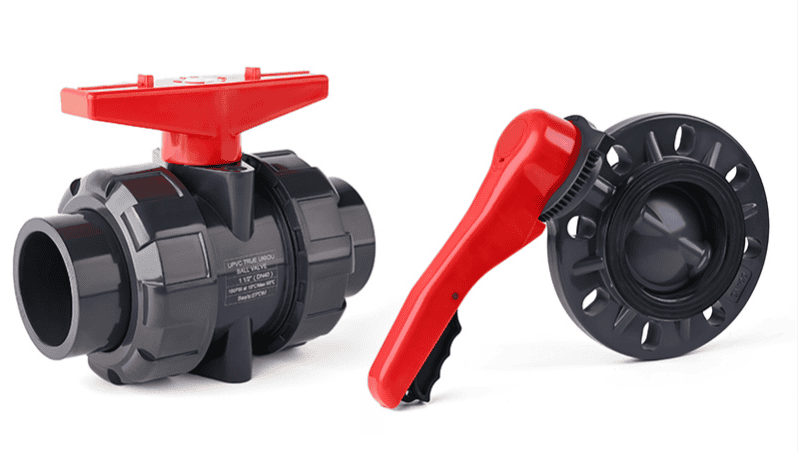
For plastic, corrosion-resistant piping — UPVC, CPVC, PPH and PVDF
The short answer: a ball valve gives you bubble-tight, bidirectional shut-off and is the economical choice on small-to-mid-bore lines, while a butterfly valve is lighter, cheaper, and able to throttle — and it is the only practical option once the pipe gets large. In plastic corrosion-resistant piping the dividing line sits at about DN80 (3 inches): at DN80 and above, a butterfly valve is usually the better choice; below it, a ball valve. The rest of this guide explains why, so both the engineer specifying the valve and the buyer costing it can make the same call with confidence.
At a glance
| Ball valve | Butterfly valve | |
|---|---|---|
| Best for | Tight on/off isolation, small–mid bore | Large bore, light weight, flow regulation |
| Shut-off | Bubble-tight, bidirectional | Tight (PTFE-seated), bidirectional |
| Throttling (part-open control) | No — wears the seat | Yes |
| Pressure drop (fully open) | Near-zero (full bore) | Higher — disc stays in the flow |
| Size range (Huiya) | DN15–DN100 | DN25–DN500 |
| Weight in large bore | Heavy (solid ball) | Light (thin disc) |
| Relative cost at DN100 | Baseline (1.0) | About 0.3 — a third of the ball |
| Pressure rating | PN10 | PN10 |
| Seat / liner | PTFE seat | PTFE seat + EPDM or FKM liner |
| Actuation | Manual or pneumatic | Manual or pneumatic |
How each one works
Both are quarter-turn valves — a 90° handle move takes them from open to closed. A ball valve uses a bored ball; when the bore lines up with the pipe it runs full-open with almost no restriction, and a 90° turn seats the ball against a PTFE ring for a tight seal. A butterfly valve uses a disc on a shaft that rotates inside the pipe; it is compact and mounts between two flanges (wafer or lug style — see our note on wafer vs lug), which is why it saves so much space and weight in larger sizes.
Shut-off vs throttling — the functional split
This is the difference that decides most projects.
A ball valve is an on/off device. Its PTFE seat gives an excellent bidirectional seal (“bidirectional” = it holds pressure from either direction), but it is not built to sit half-open. Run partly open to regulate flow and the high-velocity stream cuts across the seat and erodes it; before long the valve no longer closes fully. If the line only ever opens and closes, that is exactly what a ball valve is for.
A butterfly valve is happy to throttle — hold a partial opening to regulate flow — because the disc is designed to work anywhere in its travel. Huiya’s PTFE-seated butterfly still gives a tight shut-off, so you get regulation without giving up sealing. The one trade-off is pressure drop: the disc always sits in the flow path, so even fully open a butterfly valve loses a little more pressure than a full-bore ball valve. On most water, wastewater and chemical-transfer lines that loss is negligible; on a line where every millibar counts, the full-bore ball wins.
Size and weight — why big lines go butterfly
Our ball valves run DN15–DN100; our butterfly valves run DN25–DN500. Above DN100 the choice is made for you — a plastic ball valve simply is not practical at that scale, while butterfly valves carry on to DN500. The reason is physical: a ball is a solid part that grows heavy and bulky with bore, whereas a disc stays thin and light. In large bore that lighter valve means less dead weight on the pipe, less stress on supports, and far easier handling and installation. This is the engineering basis for the common “3 inches and up” rule of thumb — and DN80 is 3 inches.
Cost — the procurement view
Weight and part count also drive price. At DN100 a butterfly valve costs roughly a third of an equivalent ball valve, and the gap widens as size increases. On top of the unit price, the lighter valve lowers the total installed cost — smaller supports, less lifting gear, less labor — which is where the real savings show up on large headers and mains. The flip side holds at the small end: below about DN65 a ball valve is inexpensive and delivers the tight, reliable shut-off that dosing and instrument lines need, so there is no reason to over-think it there.
The dividing line
- DN15–DN65 — ball valve. Tight bidirectional shut-off, economical small bore.
- DN80–DN100 — either, usually butterfly. Both are available; choose butterfly for cost and weight, or a ball valve if you need absolute bubble-tight isolation or full-bore, low-pressure-drop flow.
- Above DN100 (to DN500) — butterfly valve. The practical (and often only) option at large bore.
- Need to regulate flow? Butterfly. Need bubble-tight isolation or a full-bore path? Ball.
A real project: when the wrong valve was the ball
A power plant in Peru ran a flue-gas-desulfurization (FGD) zero-liquid-discharge wastewater system on ANSI UPVC piping, fitted throughout with true-union ball valves. The duty, though, called for daily flow regulation — the valves were frequently held half-open. That is throttling, and on a ball valve it is destructive: after a period in service the PTFE seats had worn and the valves would no longer close completely. Huiya’s engineering team reviewed the line and recommended a heavy-duty 4-inch (DN100) butterfly valve in its place. It has since cycled more than 15,000 times, open to close, without a leak.
The lesson is the rule above in practice: a ball valve half-open will wear its seat; regulation is a butterfly’s job. Match the valve’s function to the duty, not just the size.
Where gate and globe valves fit
For completeness: a gate valve is a slow on/off isolation valve (not for throttling), and a globe valve throttles well but carries a high pressure drop and a bulky body. In corrosion-resistant plastic piping, ball and butterfly valves cover the large majority of on/off and regulating duties, which is why this comparison is the one that matters most for UPVC, CPVC, PPH and PVDF lines. For slurries or ultra-corrosive service, a third type often wins — see diaphragm valve vs ball valve.
Torque and actuation
For sizing an actuator or gearbox, here is the reference safety torque (N·m) across our range. Ball valves below DN40 need under ~10–12 N·m.
| DN | Ball valve (N·m) | Butterfly valve (N·m) |
|---|---|---|
| 40 | 15 | 30 |
| 50 | 20 | 35 |
| 65 | 40 | 40 |
| 80 | 45 | 45 |
| 100 | 65 | 55 |
| 125 | — (ball to DN100) | 80 |
| 150 | — | 130 |
For any high-cycle industrial automation, our pneumatic true union ball valve offers exceptional reliability. Both valve types are rated PN10 and seal bidirectionally. Either can be automated: choose a single-acting (spring-return, fail-safe) or double-acting actuator, in aluminum-alloy or all-plastic construction, with an air filter-regulator-lubricator (FRL) set added where needed. For actuator selection on automated lines, see our pneumatic ball valve selection guide.
Huiya plastic ball and butterfly valves
We manufacture both types in UPVC, CPVC, PPH and PVDF, from 100% virgin branded resin. Our true union ball valves run DN15–DN100 with PTFE seats, and our plastic butterfly valves run DN25–DN500 with a PTFE seat and EPDM or FKM liner. Everything ships factory-direct — MOQ 20 pieces, about 7 days for standard items, with a 12-month warranty. If you are choosing between the two, the deciding factors are your line size, whether the valve must only isolate or also regulate, and your medium and temperature (which set the body material — see our plastic valve material selection guide). Send us those and our engineers will recommend the right valve, size and configuration, and request a quote.
For a full breakdown of ball valve options, see our plastic ball valve selection guide; to compare the whole range, browse our butterfly valves and all plastic valves.
Frequently asked questions
What is the main difference between a ball valve and a butterfly valve? A ball valve uses a bored ball for bubble-tight on/off isolation and full-bore flow, while a butterfly valve uses a disc that can also throttle and is much lighter and cheaper in large sizes. Ball valves suit small-to-mid bore isolation; butterfly valves suit large bore and flow regulation.
Which is better, a ball valve or a butterfly valve? Neither is universally better — it depends on the duty. Use a ball valve for tight isolation on small-to-mid-bore lines, and a butterfly valve for large-bore service, flow regulation, or where weight and cost matter.
When should I use a butterfly valve? Use a butterfly valve for pipes of about DN80 (3 inches) and larger, for throttling or flow-regulation duty, and where light weight and lower cost are priorities — for example on water, wastewater and large chemical-transfer headers.
When should I use a ball valve? Use a ball valve when you need bubble-tight, bidirectional shut-off, a full-bore low-pressure-drop path, or an economical valve on small-to-mid-bore lines (roughly DN65 and below), for on/off service such as dosing and isolation.
At what pipe size should I switch from a ball valve to a butterfly valve? As a rule of thumb, around DN80 (3 inches). From DN80 up, a butterfly valve is usually lighter, cheaper and easier to install; above DN100 it is typically the only practical choice, since plastic ball valves are generally made only up to DN100.
Is a butterfly valve cheaper than a ball valve? Yes, especially in larger sizes. At DN100 a butterfly valve costs roughly a third of an equivalent ball valve, and the gap grows as diameter increases — plus its lighter weight reduces installation cost.
Can a ball valve be used for throttling? It should not be. Holding a ball valve part-open erodes the PTFE seat, so it eventually fails to seal. For any flow-regulation duty, use a butterfly valve.
What are the disadvantages of a butterfly valve? Because the disc always sits in the flow path, a butterfly valve has a slightly higher pressure drop when fully open and, in general-purpose designs, can seal less tightly than a ball valve — though a PTFE-seated butterfly closes tightly. It also cannot be “pigged” (mechanically cleaned through the bore).
What are the disadvantages of a ball valve? A ball valve is on/off only: it throttles poorly and wears its seat if held part-open, it can trap or be fouled by slurries, and in large bore it becomes heavy and expensive compared with a butterfly valve.
— Andy Xia, Huiya Engineering Team