
Viton (FKM) vs EPDM Seals: How to Choose
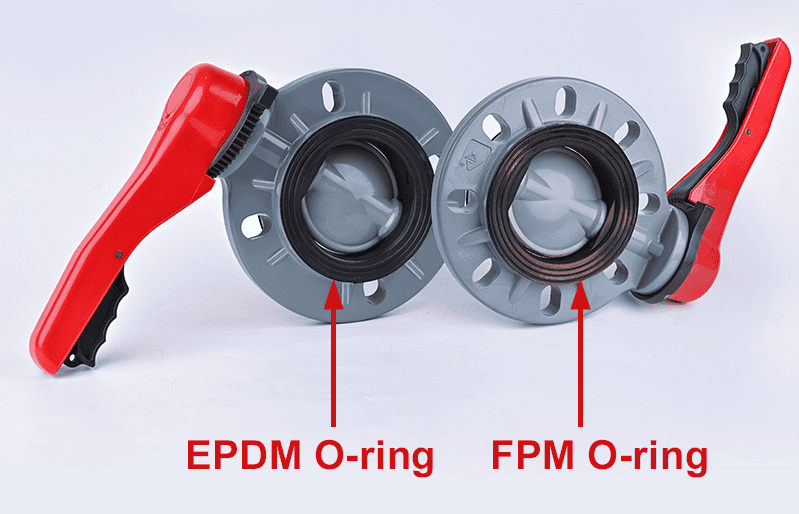
Viton vs EPDM is the seal decision behind most plastic-valve specs, and the short answer is that the two have almost opposite chemical strengths. Choose EPDM for water, steam, acids, alkalis, ketones, and alcohols. Choose Viton (FKM) for oils, fuels, hydrocarbons, aromatics, and chlorinated solvents. In a plastic valve, check the body plastic’s temperature limit first — it usually caps the seal’s rating before the seal itself does.
When you specify a plastic corrosion-resistant valve, you make two separate material decisions: the body plastic (UPVC, CPVC, PPH, or PVDF) and the seal elastomer — the seat, O-ring, or diaphragm that actually touches your fluid. This guide covers the seal decision, where the choice almost always comes down to EPDM vs Viton (FKM). It’s driven by chemical compatibility and temperature, and getting it wrong means a valve that leaks or swells within weeks.
First, a naming point that matters, because these terms get mixed up constantly. Viton is a registered brand of FKM (fluoroelastomer, or fluorocarbon rubber); the same material family is designated FPM under ISO. So Viton = FKM = FPM — one material, three names. EPDM is ethylene propylene diene monomer rubber, a completely different family. They are not interchangeable, and in practice their chemical strengths are near-mirror opposites.
The one rule to remember: they are opposites
Almost everything else follows from a single idea: what EPDM can’t handle, FKM usually can — and the reverse is just as true. EPDM’s weakness is oils, fuels, and hydrocarbons; FKM shrugs those off. FKM’s weakness is ketones, strong caustics, and steam; EPDM handles those well. Here are three pairs straight from real compatibility data:
| Medium | EPDM | Viton (FKM) | Which one holds up |
|---|---|---|---|
| Acetone (a ketone) | Recommended | Not recommended | EPDM |
| Toluene (an aromatic) | Not recommended | Recommended | Viton (FKM) |
| Sodium hydroxide 30% (caustic) | Recommended | Not recommended | EPDM |
Because they cover for each other, the practical question is never “which seal is better?” It’s “which one matches my fluid and temperature?”
EPDM vs Viton (FKM) at a glance
| Property | EPDM | Viton (FKM) |
|---|---|---|
| Full name | Ethylene propylene diene monomer | Fluoroelastomer (fluorocarbon rubber) |
| Standard code (ASTM D1418 / ISO) | EPDM | FKM / FPM |
| Typical temperature range* | approx. −45 °C to +150 °C | approx. −20 °C to +200 °C |
| Strong with | Water, steam, acids, alkalis, ketones, alcohols, oxygenated solvents | Oils, fuels, hydrocarbons, aromatics, chlorinated solvents, strong oxidizers, concentrated acids |
| Weak with | Oils, fuels, hydrocarbons, aromatics, chlorinated solvents | Steam and hot water, ketones, esters, amines, strong caustics, some organic acids |
| Relative cost | Low | High (several times EPDM) |
*Elastomer limits. In a plastic valve the body plastic almost always sets a lower ceiling — see the temperature section below.
Chemical compatibility: the deciding factor
For most applications the fluid decides the seal. The quick-reference table below covers the media buyers ask about most, grouped by chemical family so the pattern is easy to see. Ratings mean: Yes = recommended, Limited = usable but temperature- or concentration-dependent (verify), No = not recommended. (These map to ◎ / ○ / × on our full chemical-resistance chart.)
| Medium | EPDM | Viton (FKM) | Notes |
|---|---|---|---|
| Water (potable / process) | Yes | Yes | Both fine to ~80 °C; confirm potable-water certification for drinking-water use |
| Steam & hot condensate | Yes | No | EPDM is the standard steam elastomer; standard-grade FKM is not recommended for steam |
| Sulfuric acid, dilute (≤50%) | Yes | Yes | FKM holds to higher temperature; EPDM weakens above ~80 °C at 50% |
| Sulfuric acid, concentrated (70–90%) | No | Yes | FKM recommended; both fail at ~98% / oleum |
| Hydrochloric acid (≤25%) | Yes | Yes | FKM better when hot; at 37% both are limited |
| Nitric acid | No | Yes | Oxidizing acid — EPDM is attacked; FKM preferred (dilute to moderate) |
| Acetic acid | Yes | Limited | EPDM preferred; FKM weakens with concentration and temperature |
| Sodium / potassium hydroxide (caustic) | Yes | No | Strong caustics attack FKM — use EPDM |
| Ammonia (gas or solution) | Yes | No | Classic EPDM application; FKM not suitable |
| Salt solutions (chlorides, sulfates, nitrates) | Yes | Yes | Nearly all inorganic salt solutions are fine for both |
| Hydrogen peroxide | Limited | Yes | FKM better; both fail at high concentration / temperature |
| Sodium hypochlorite (bleach) | Limited | Yes | FKM handles hypochlorite better than EPDM |
| Gasoline, diesel, kerosene | No | Yes | Petroleum fuels — EPDM is not suitable |
| Mineral, paraffin & vegetable oils | No | Yes | Oils swell EPDM; FKM recommended |
| Benzene, toluene, xylene (aromatics) | No | Yes | Aromatics — EPDM fails; FKM recommended |
| Trichloroethylene, perchloroethylene | No | Yes | Chlorinated solvents — FKM only |
| Acetone & ketones (e.g. cyclohexanone) | Yes | No | Ketones swell FKM badly — use EPDM |
| Esters (ethyl / methyl acetate) | Limited | No | EPDM better; both are marginal for many esters |
| Alcohols (ethanol, IPA, glycerol) | Yes | Yes | Both fine; for methanol, EPDM is the safer choice |
| Amines (e.g. dimethylamine, triethanolamine) | Yes | Limited | Amines attack FKM — EPDM generally preferred |
This is a working subset. Concentration and temperature shift several of these ratings, so for anything borderline — or any fluid not listed — check the full 216-chemical resistance chart, or send us the medium, concentration, and temperature and we’ll confirm the seal.
Temperature: why the valve body caps the seal
Here’s the point most seal guides miss. On paper, FKM’s biggest advantage is heat — it runs to about 200 °C versus roughly 150 °C for EPDM. But in a plastic valve, the body plastic softens long before the seal does, so the body sets the real ceiling:
| Body plastic | Max service temperature | What it means for the seal |
|---|---|---|
| UPVC | ~55 °C | Every seal option is well within range on temperature — choose purely on chemistry. FKM’s heat resistance is wasted here, so don’t pay for it unless the chemistry needs it. |
| PPH | ~85 °C | EPDM and FKM are both comfortable — choose on chemistry. |
| CPVC | ~100 °C | Approaching EPDM’s comfortable limit; for continuous hot service, FKM (or a PTFE-faced diaphragm) adds margin. |
| PVDF | ~120 °C | FKM and fluoropolymer faces are preferred for continuous hot duty; standard EPDM is near its practical limit. |
So the correct order is: pick the body plastic first — it sets your temperature ceiling and is often the binding constraint — then pick the seal by chemistry within that ceiling. If you haven’t settled the body plastic yet, start with our plastic valve body material selection guide.
Seal choice matters most in dosing and disinfection lines — for the full application picture, see our water treatment valve guide.What this means for your valve type
Ball valves and butterfly valves
Here the seat and O-ring are bare EPDM or FKM, and your fluid contacts the elastomer directly. That makes the choice a straight chemical-compatibility decision — use the table above. In short: EPDM for water, acids, alkalis, and oxygenated fluids; FKM for oils, fuels, hydrocarbons, and solvents. Both options are available on our plastic ball valves and butterfly valves.
Diaphragm valves (a different logic)
Diaphragm valves use a two-layer diaphragm, and this changes the decision. The wetted face is a fluoropolymer — either F46 (FEP) or PTFE — and the backing is EPDM or FKM. Your fluid only ever touches the fluoropolymer face, which is chemically near-universal, so the EPDM-vs-FKM backing choice is not about the fluid’s chemistry. You choose along two axes:
- Face — PTFE vs F46 (FEP): PTFE gives the highest chemical resistance and temperature but is stiffer, tends to cold-flow, and has a shorter flex life — best for the most aggressive media, the highest temperatures, or less frequent cycling. FEP (F46) is more flexible with better flex-fatigue life and a tighter seal, at a slightly lower temperature ceiling — best for frequent cycling and moderate temperatures.
- Backing — EPDM vs FKM: choose mainly by temperature (and as a second line of defense against slow permeation). FKM backing suits higher-temperature service on CPVC or PVDF bodies; EPDM backing is fine and lower-cost for common water, acid, and alkali service within its temperature range.
The four combinations we offer on our plastic diaphragm valves are EPDM+F46, EPDM+PTFE, FKM+F46, and FKM+PTFE. For construction detail, see our diaphragm valve guide. The takeaway: don’t pick a diaphragm backing the way you’d pick a ball-valve seat — here the face handles the chemistry.
How to choose, step by step
- Identify your medium and its concentration (e.g. 30% sulfuric acid, diesel fuel, 10% caustic).
- Note your maximum operating temperature.
- Choose the body plastic — it sets the temperature ceiling. Use the body-material guide linked above.
- Choose the seal: for a ball or butterfly valve, match the seat/O-ring to your medium using the compatibility table. For a diaphragm valve, choose the face by chemistry and cycling duty, and the backing by temperature.
- Cross-check the full chart. Concentration and temperature move the borderline cases; when in doubt, verify against the full chemical-resistance chart or ask us to confirm.
FAQ
Is Viton the same as FKM (and FPM)?
Yes. Viton is a brand of FKM, the fluoroelastomer family. FPM is the ISO designation for the same material. All three names refer to the same rubber.
Which seal is better overall, EPDM or Viton?
Neither — they are complementary. What EPDM can’t handle, FKM usually can, and vice versa. The medium and temperature decide, not the material’s “quality.”
Can Viton (FKM) handle acetone or other ketones?
No. Ketones such as acetone and MEK swell FKM badly. Use EPDM for ketone service.
Does EPDM handle steam and hot water?
Yes — EPDM is the standard choice for steam and hot water. Standard-grade FKM is not recommended for steam.
Which seal should I use for caustic (sodium or potassium hydroxide)?
EPDM. Strong caustics attack FKM, so it is not suitable for concentrated hydroxide service.
Which seal is right for oils, fuels, and solvents?
Viton (FKM). EPDM is not suitable for petroleum oils, fuels, aromatics, or chlorinated solvents — these swell and degrade it.
Which seal is best for drinking water?
Both EPDM and FKM work with potable water; EPDM is common and lower-cost. Confirm the potable-water certification your market requires.
Is Viton more expensive than EPDM?
Yes, substantially. Don’t specify FKM unless your chemistry or temperature requires it — on a room-temperature UPVC valve running water, FKM’s advantages are wasted and you’d be paying for nothing.
For a diaphragm valve, does the EPDM vs FKM choice still matter?
Less than you’d expect. The wetted PTFE or FEP face handles the chemistry; you choose the EPDM or FKM backing mainly by temperature.
Bottom line
EPDM and Viton (FKM) are near-opposites: EPDM for water, steam, acids, alkalis, and oxygenated fluids; FKM for oils, fuels, hydrocarbons, and solvents. In a plastic valve, settle the body plastic first because it sets the temperature ceiling, then match the seal to your fluid — bare elastomer for ball and butterfly valves, fluoropolymer-faced diaphragm for diaphragm valves. If you tell us your medium, concentration, and temperature, we’ll confirm the right body-and-seal combination. Request a quote or spec check.