
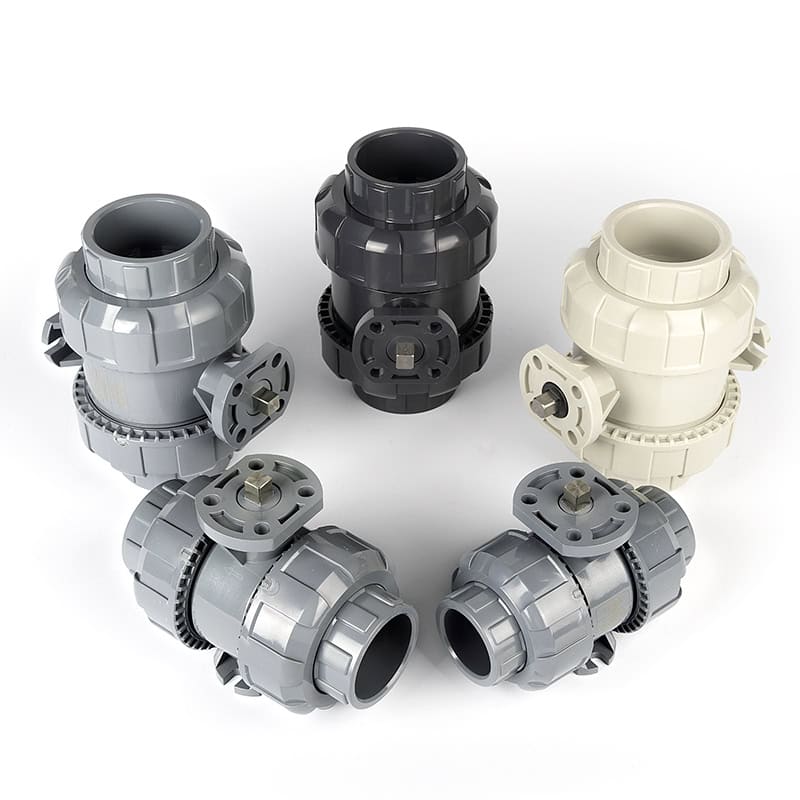
A hydrofluoric acid valve has to do two jobs at once: resist one of the most aggressive chemicals in industry, and never leak — because hydrofluoric acid (HF) is also acutely dangerous to people. That makes material selection a safety decision, not just a performance one. This guide compares the plastics used for HF service, explains the temperature trap that catches the wrong choice, and shows why the seat matters as much as the body.
Why HF is so demanding
Hydrofluoric acid is unusual. It attacks glass and silica, etches many metals, and degrades plastics that shrug off other strong acids. It is also highly toxic and penetrates skin, so a leaking valve is not just a process problem — it is a safety emergency. The cost of getting the material wrong is therefore much higher than with an ordinary acid, which is exactly why HF service deserves careful, conservative material selection.
Hydrofluoric acid valve materials compared
| Material | HF resistance | Notes |
|---|---|---|
| PVDF | Excellent | Resists HF across concentrations to high temperature — the standard plastic for HF |
| PP / PPH | Good | A solid lower-cost option within temperature limits |
| PTFE | Excellent | Used as the seat, diaphragm face, or lining — not a structural body |
| UPVC / PVC | Limited | Only cold, dilute HF; not for concentrated or warm service |
| CPVC | Limited | Not suitable for hot HF, despite its ~90 °C water rating |
The takeaway is clear: for anything beyond cold, dilute HF, PVDF is the body material of choice, with PP/PPH as a lower-cost option inside its limits. PVC and CPVC are the materials to avoid for warm or concentrated HF — and that is where the most common and most dangerous mistake happens. For the full ratings by concentration and temperature, see our plastic valve chemical resistance chart. If you are also handling other highly aggressive media, you can verify precise temperature and concentration limits using our interactive PVDF chemical resistance chart.
The temperature trap
The mistake almost always comes from reading a temperature rating as if it covers every chemical.
A chemical plant in Mexico needed to handle 50% hydrofluoric acid at 70 °C. Their engineer first specified a CPVC valve, reasoning that CPVC is rated to about 90 °C, so 70 °C looked safe. It was not. CPVC is not suitable for hydrofluoric acid above roughly 60 °C — its 90 °C rating is for benign service like hot water, not for hot HF. After they spoke with us, our engineer Andy flagged the problem and recommended a PVDF diaphragm valve instead: a PVDF body with a PTFE-faced diaphragm, both of which resist HF. That change avoided a leak, a costly failure, and a serious safety incident.
The rule this illustrates applies to every material: a temperature rating only holds for media the polymer is already compatible with. Always check resistance at your actual concentration and temperature.
Do not forget the seat
A valve’s chemical limit is set by every wetted part, not just the body — and for HF the seat or seal is where people slip up. Among the common sealing materials:
- PTFE — excellent with HF; the safest choice, used as a ball-valve seat or a diaphragm face.
- EPDM — good HF resistance; an acceptable elastomer seat for HF.
- FKM / Viton — poor with HF; hydrofluoric acid attacks fluoroelastomers, so Viton seats are the wrong choice for HF even though Viton is excellent for many other acids.
This is why the Mexico job used a PVDF diaphragm valve: the PTFE-faced diaphragm gives an HF-safe sealing surface on a PVDF body. A PVDF ball valve with a PTFE seat works for the same reason. If a butterfly valve is used, the seat must be EPDM or PTFE — never FKM.
Our recommendation for HF
- Hot or concentrated HF: a PVDF body with a PTFE-faced diaphragm — our PVDF diaphragm valve — is the safest, most reliable choice.
- General HF isolation: a PVDF ball valve with a PTFE seat.
- Cold, dilute HF: more materials become workable, but PVDF remains the conservative pick.
- Avoid PVC/CPVC for warm or concentrated HF, and avoid FKM/Viton seats on any HF duty.
A safety note
Because HF is hazardous, treat material selection as part of your safety case: confirm compatibility at your real concentration and temperature, account for stress and any mixed media, and follow your site’s HF handling and PPE procedures. When in doubt, choose the more conservative material — the cost difference is small next to the cost of a leak.
How we help
We build HF-service valves from 100% virgin PVDF with PTFE-faced diaphragms and PTFE seats. Tell us your HF concentration, temperature, and line size, and our engineers will confirm the right material, seat, and valve type — and flag any temperature trap before it becomes a problem. Explore our PVDF valves or request a quote.
— Andy Xia, Huiya Engineering Team