
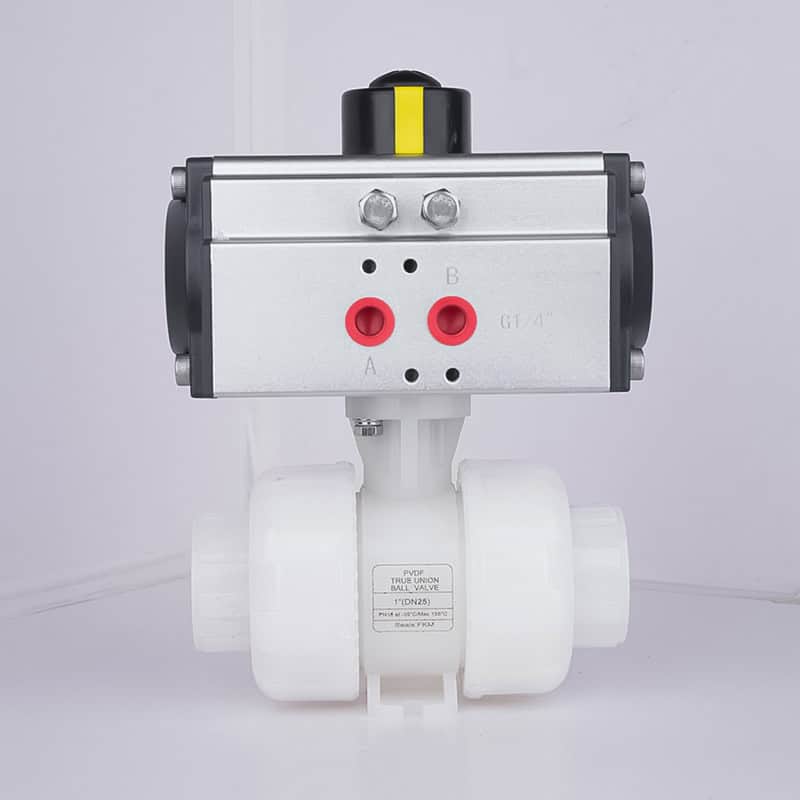
PVDF Pneumatic True Union Ball Valve
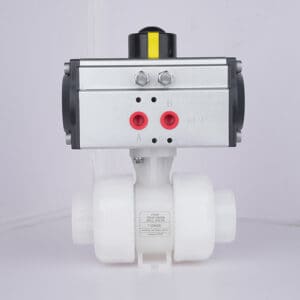
When a line carries 98% sulfuric acid, hydrofluoric acid, aqua regia or 18 MΩ ultra-pure water, an ordinary plastic valve is a failure waiting to happen. The Huiya PVDF pneumatic true union ball valve is built for exactly these duties — a two-piece automated shut-off valve moulded from 100% virgin PVDF (polyvinylidene fluoride), rated for continuous service up to 120°C, and resistant to the concentrated acids, halogens, oxidisers and solvents that destroy UPVC, CPVC and PPH. Its true union body lets you remove the valve for service without cutting and re-fusing the pipe — a decisive advantage on PVDF systems, where every joint is thermally welded, not glued.
At a Glance
- Body & ball: 100% virgin PVDF (Arkema Kynar® / Solvay or domestic grade)
- Size range: DN15–DN100 (1/2″–4″)
- Pressure rating: PN10 (de-rates with temperature)
- Max temperature: up to 120°C
- Seat: PTFE — Seals: FKM or EPDM (matched to media)
- Actuation: pneumatic (double-acting / spring-return) or manual
- Connections: socket / butt fusion or threaded
- Standards: ANSI / DIN / JIS
Choose Your PVDF Grade — Pay for the Purity You Need
Not every project needs the same resin, so we mould two virgin-PVDF grades:
Imported virgin PVDF — Arkema Kynar® / Solvay. The premium choice for semiconductor ultra-pure water, zero-tolerance acid lines and any duty where resin purity and zero ion-leaching are critical. Tight molecular-weight control, proven long-term stress and chemical stability, Material Test Report (MTR) available.
Quality domestic virgin PVDF. A cost-effective option for corrosive-service projects that need genuine PVDF resistance without imported-resin pricing.
Both grades are 100% virgin — never recycled or reprocessed. Recycled PVDF has broken polymer chains: lower burst strength, higher stress-cracking risk, and impurity leaching that ruins ultra-pure water yields.
Key Features
- 100% virgin PVDF body and ball — imported (Arkema / Solvay) or domestic grade
- Continuous service up to 120°C (media-specific limits apply)
- Resists 98% and fuming sulfuric acid, 70% nitric, 40–55% hydrofluoric acid, aqua regia, halogens and chlorinated/aromatic solvents
- True union, two-piece body — service the valve without cutting or re-fusing the pipe
- Full-port bore for unrestricted, low-pressure-drop flow
- Pneumatic actuator (double-acting or spring-return); manual lever version available
- PTFE seat; FKM or EPDM seals matched to your chemistry
- Thermally fused or threaded ends (PVDF is not solvent-cemented)
- ANSI, DIN and JIS dimensions
Technical Specifications
- Body / ball: virgin PVDF (Arkema / Solvay or domestic)
- Seat: PTFE | Seals & O-rings: FKM or EPDM (media-matched)
- Size: DN15–DN100 (1/2″–4″)
- Pressure: PN10 (de-rates with temperature)
- Temperature: up to 120°C
- Actuation: pneumatic; manual option
- Standards: ANSI / DIN / JIS
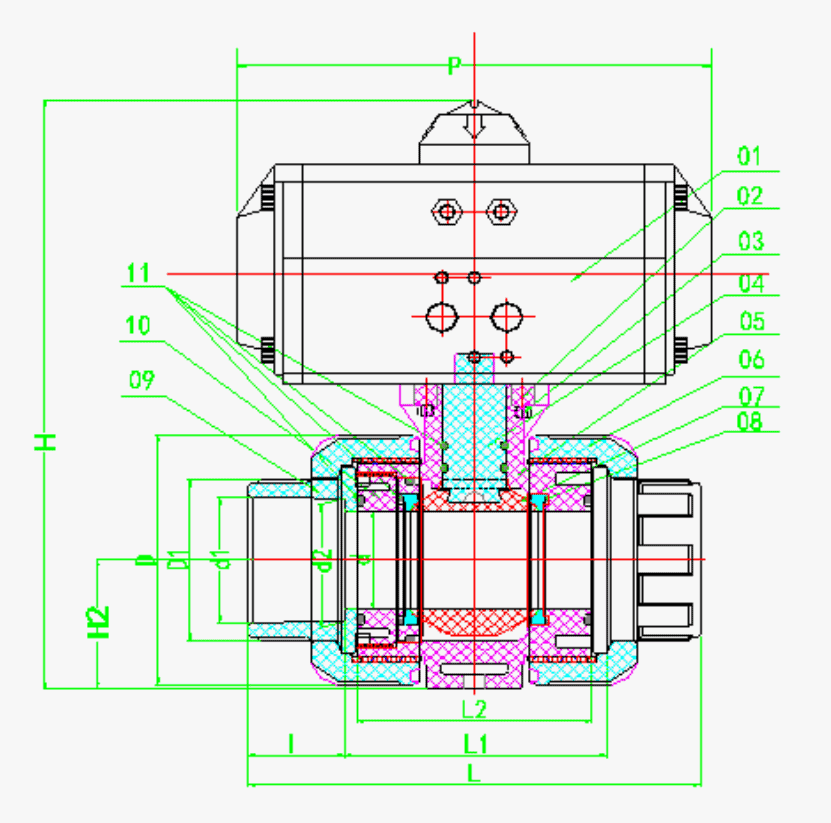
Socket Dimensions (mm)
| Size | d | l | d1 | d2 | ||||||
|---|---|---|---|---|---|---|---|---|---|---|
| DIN | JIS | ANSI | CNS | DIN | JIS | ANSI | CNS | |||
| 1/2″ (DN15) | 15 | 23.00 | 20.28 | 22.35 | 21.54 | 22.35 | 19.95 | 21.75 | 21.25 | 21.75 |
| 3/4″ (DN20) | 20 | 26.00 | 25.30 | 26.40 | 26.87 | 26.40 | 24.95 | 25.70 | 26.58 | 25.70 |
| 1″ (DN25) | 25 | 29.00 | 32.30 | 32.40 | 33.65 | 34.50 | 31.95 | 31.70 | 33.28 | 33.90 |
| 1-1/4″ (DN32) | 32 | 32.50 | 40.35 | 38.45 | 42.40 | 42.50 | 39.95 | 37.65 | 42.05 | 41.90 |
| 1-1/2″ (DN40) | 40 | 35.50 | 50.35 | 48.45 | 48.50 | 48.45 | 49.95 | 47.65 | 48.12 | 47.65 |
| 2″ (DN50) | 50 | 38.50 | 63.40 | 60.50 | 60.60 | 60.50 | 62.90 | 59.60 | 60.18 | 59.60 |
| 2-1/2″ (DN65) | 63 | 44.50 | 75.40 | 76.50 | 73.35 | 76.50 | 74.90 | 75.60 | 72.85 | 75.60 |
| 3″ (DN80) | 75 | 51.00 | 90.45 | 89.60 | 89.30 | 89.60 | 89.90 | 88.60 | 88.70 | 88.60 |
| 4″ (DN100) | 90 | 61.50 | 110.45 | 114.50 | 114.75 | 114.60 | 109.90 | 113.60 | 114.10 | 113.60 |
All dimensions in mm. Socket connections available in DIN, JIS, ANSI and CNS standards. d = nominal bore, l = socket depth, d1/d2 = socket diameters.
Valve Dimensions (mm)
| Size | D | D1 | L | L1 | L2 | H | H2 |
|---|---|---|---|---|---|---|---|
| 1/2″ (DN15) | 56.0 | 32.0 | 112.0 | 66.0 | 57.0 | 162.0 | 28.7 |
| 3/4″ (DN20) | 65.0 | 37.0 | 120.0 | 68.0 | 59.0 | 174.0 | 32.7 |
| 1″ (DN25) | 76.0 | 45.5 | 136.0 | 68.0 | — | 208.0 | 38.75 |
| 1-1/4″ (DN32) | 87.0 | 55.5 | 150.5 | 85.0 | 76.0 | 214.0 | 44.25 |
| 1-1/2″ (DN40) | 101.0 | 62.0 | 168.0 | 95.5 | 86.5 | 237.0 | 51.5 |
| 2″ (DN50) | 121.0 | 79.0 | 180.0 | 103.0 | 92.0 | 258.0 | 62.0 |
| 2-1/2″ (DN65) | 150.0 | 94.2 | 235.0 | 146.0 | 134.0 | 310.0 | 79.5 |
| 3″ (DN80) | 169.5 | 113.0 | 265.0 | 163.0 | 148.0 | 341.0 | 90.0 |
| 4″ (DN100) | 190.0 | 135.0 | 304.0 | 181.0 | 157.0 | 379.0 | 96.0 |
All dimensions in mm. D = body diameter, L = end-to-end length, H = overall height with actuator. Full dimensional drawings available on request.
Operating Torque
| Size | DN15 | DN20 | DN25 | DN32 | DN40 | DN50 | DN65 | DN80 | DN100 |
|---|---|---|---|---|---|---|---|---|---|
| Torque (N·m) | 6 | 8 | 10 | 12 | 15 | 20 | 40 | 45 | 65 |
Design torque values for actuator sizing — these already include a 1.6× safety factor over measured valve torque, so size the actuator directly against them. For scaling, slurry or crystallising media, see how to size a pneumatic actuator for the higher ratios. Our engineering team can confirm the actuator for your operating pressure.
Chemical Resistance — What PVDF Handles
This is the reason to specify PVDF. The table summarises performance against media that defeat other plastics. For the full media-by-media table with concentrations, temperatures and seal advice, see our PVDF Chemical Resistance Guide. (◎ excellent · 〇 limited · × not suitable)
| Media | UPVC / CPVC | PPH | PVDF | Seal |
|---|---|---|---|---|
| 98% Sulfuric acid | 〇 | × | ◎ | PTFE / FKM |
| Fuming sulfuric acid | × | × | ◎ | PTFE / FKM |
| 70% Nitric acid (to 100°C) | × | × | ◎ | PTFE / FKM |
| 40–55% Hydrofluoric acid | × | 〇 | ◎ | PTFE / FKM |
| Aqua regia (to 100°C) | × | × | ◎ | PTFE / FKM |
| Sodium hypochlorite (high conc.) | 〇 | 〇 | ◎ | FKM |
| Chlorine / bromine / ozone | × | × | ◎ | FKM |
| Aromatic solvents (benzene, toluene, xylene) | × | 〇 | ◎ | FKM |
| Chlorinated solvents (TCE, carbon tet.) | × | × | ◎ | FKM |
| Hot 50% sodium hydroxide | × | 〇 | ◎ | EPDM |
| 18 MΩ ultra-pure water | leaches ions | — | ◎ inert | EPDM |
Not suitable for: ketones (acetone, cyclohexanone), THF, certain ethers (diethyl ether) and strong amines (DMF, aniline, dimethylamine). For these media, ask our engineers about an alternative material.
Get the Seal Right — PVDF + FKM vs PVDF + EPDM
A PVDF valve is only as good as its weakest elastomer. The body resists almost everything; the seals do not. Match them to your media.
PVDF + FKM (Viton) — strong acids, oxidisers and halogens. Fuming and 98% sulfuric, 70%+ nitric, aqua regia and hydrofluoric acid; sodium hypochlorite, chlorine, bromine, ozone; aromatic and chlorinated solvents.
PVDF + EPDM — hot alkalis and polar media. Boiling 50% sodium hydroxide and other hot strong alkalis; hot ultra-pure water and low-pressure steam; certain amines and pyridine. FKM saponifies and fails in hot alkali — putting FKM there is the single most common PVDF valve mistake.
The ball seat is PTFE on both builds. Tell us your media and we specify the seal for you.
Why True Union Matters More on PVDF
On PVDF this feature pays for itself. PVDF cannot be solvent-cemented like PVC — every joint is thermally fused (socket or IR butt welding), which needs equipment, trained operators and downtime. With a true union valve you simply back off the two union nuts and lift the valve out for seal replacement or inspection: no cutting, no re-fusing, no draining and re-welding a live acid line. One serviceable valve can save hours of fusion work and a full shutdown — and keep technicians clear of hazardous media.
Avoid These Three Costly PVDF Mistakes
1. Premium body, wrong seal. Buyers spend on a PVDF body for hot caustic, then accept standard FKM seals — which saponify and dissolve in hot alkali within months. Rule: hot alkali → PVDF + EPDM; strong acid/halogen → PVDF + FKM.
2. Trying to glue PVDF. Crews used to UPVC/CPVC look for “PVDF cement.” There is none — PVDF’s ultra-low surface energy rejects all adhesives, which blow off under pressure. PVDF must be socket-fused or IR butt-welded. We supply welding parameters and temperature curves.
3. Cheap “PVDF” that’s actually recycled. Reprocessed resin has broken chains — it stress-cracks under heat and pressure and leaches impurities into ultra-pure water. We mould only virgin resin and provide an MTR on request.
Proven in the Field
Semiconductor ultra-pure water, Shanghai. A UPW system built with Huiya virgin-PVDF pipe, fittings and valves has held resistivity steady at 18.25 MΩ·cm since 2024 — designed and installed by Huiya, fully IR-fusion jointed, and pressure-tested to 1.5× design pressure.
Mixed-acid line, East China electronics-chemicals plant. A PVDF line carrying HF-bearing mixed acid (rated for 10 years) embrittled and leaked in year three, forcing a full-line shutdown and a seven-figure loss. Analysis traced it to impure resin with unstable molecular-weight distribution. After re-piping with Huiya valves moulded from Arkema PVDF, the line has run leak-free.
Applications & Industries
Semiconductor and high-purity ultra-pure water (UPW) loops; concentrated-acid dosing and transfer; electroplating and surface treatment; chlor-alkali and oxidiser handling; fine-chemical and pharmaceutical reactor feed and discharge lines; and any corrosive service where purity or chemical aggressiveness rules out cheaper plastics.
Installation & Jointing
PVDF is thermally fused, not glued. Joints are made by socket fusion or IR butt welding to controlled temperature and time. Used correctly, the result is a homogeneous, leak-proof joint as strong as the pipe itself. We provide welding parameters and temperature curves with every order, and the true union ends let you isolate the valve later without disturbing those welds.
Frequently Asked Questions
Can it handle 98% sulfuric or hydrofluoric acid?
Yes — virgin PVDF resists 98% and fuming sulfuric, 70% nitric and 40–55% HF, with a PTFE seat and FKM seals. Confirm your media and temperature and we specify the exact build.
Imported or domestic PVDF — which should I choose?
Imported Arkema/Solvay for semiconductor UPW, zero-tolerance acids and high-purity duty; domestic virgin PVDF for cost-sensitive corrosive service. Both are 100% virgin resin.
Why does the resin grade matter so much?
Recycled/reprocessed PVDF has broken polymer chains — lower strength, stress-cracking risk and impurity leaching. We mould only virgin resin and provide an MTR on request.
Can I service the valve without cutting the pipe?
Yes — that’s the point of true union. Back off the union nuts and remove the valve; no thermal re-fusion needed.
How is PVDF joined to the pipework?
By socket fusion or IR butt welding — never solvent cement. We supply the welding parameters.
Pneumatic or manual?
Both — a pneumatic actuator for automated on/off, or a manual lever.
Why Buy from Huiya
- Two virgin-PVDF grades (imported Arkema/Solvay or domestic) — never recycled
- Material Test Report (MTR) on request
- Custom seal configuration matched to your exact media
- Complete PVDF system — matching pipe, fittings and valves from one factory
- ANSI / DIN / JIS to your market
- Welding parameters and engineering support included
- Factory-direct pricing, flexible MOQ
Less aggressive media? The same true union ball valve is available in PPH for hot alkalis, CPVC for hot acids and PVC for cooler water service — often at lower cost. For large-bore or high-vibration lines, see the PVDF flanged ball valve; for big-diameter, space-saving isolation, the PVDF butterfly valve. Check your chemistry against our PVDF Chemical Resistance Guide, or ask our engineers via the Material Selection Service. View all PVDF valves.
Prefer manual operation? See our manual PVDF ball valve — or read manual vs pneumatic valves: when to automate if the line’s automation case is still open. Compare connection types — true union and flanged — or read our plastic ball valve selection guide. For actuator sizing, see the pneumatic ball valve guide and browse all pneumatic valves.
Sizing the actuator? See how to size a pneumatic actuator for a plastic valve for torque tables and worked examples, or the complete pneumatic ball valve selection guide for seat and fail-safe choices. Still deciding whether to automate? Read manual vs pneumatic valves: when to automate. To compare PVDF against the other bodies, see the plastic valve material selection guide. Browse the full range of pneumatic plastic valves.
Get a factory-direct quote
Send us your medium, its concentration and temperature, and the line size. Our engineers confirm the right body material, seat and valve type — and reply within 24 hours.