
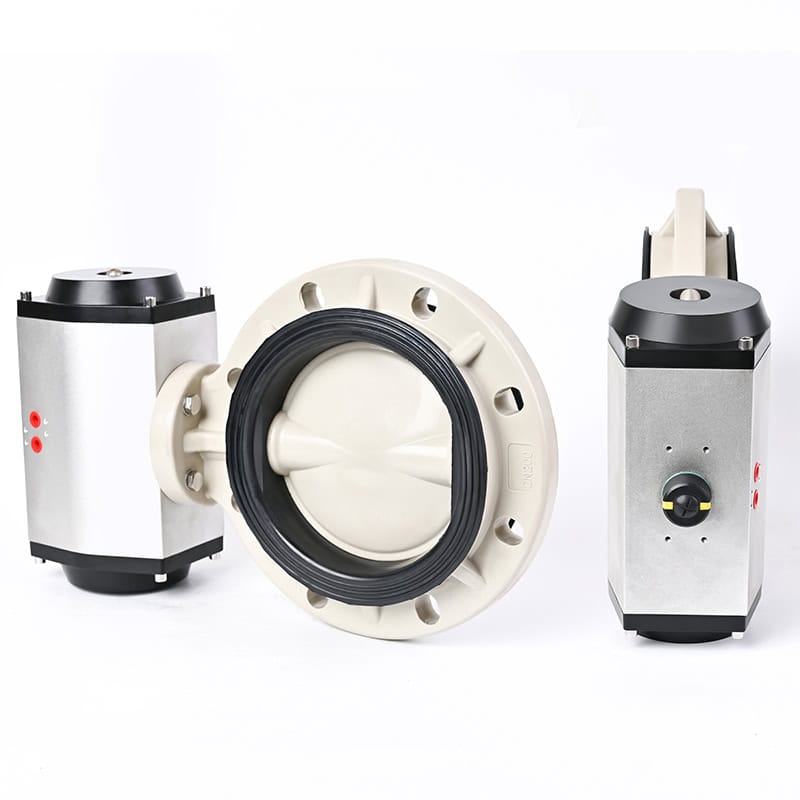
PPH Pneumatic Butterfly Valve
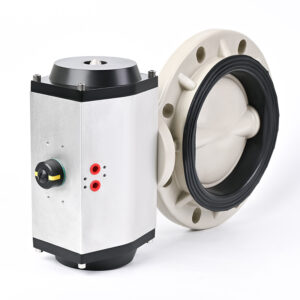
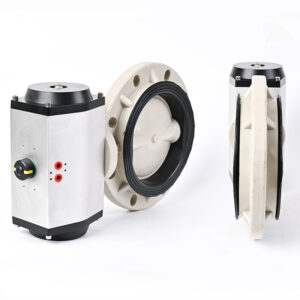
The Huiya PPH pneumatic butterfly valve is a large-bore automated valve for hot alkaline and corrosive media up to 85°C — built for the high-flow lines where caustic, effluent, and process slurries demand a material that won’t soften or corrode. Made from polypropylene homopolymer (PPH) in sizes DN40 to DN1000, its wafer-style body with a universal slotted-hole flange fits ANSI, DIN, and JIS bolt patterns — one valve for piping systems anywhere in the world.
Universal Flange: Fits ANSI, DIN & JIS
Most butterfly valves require you to commit to one flange standard. This valve’s slotted (elongated) bolt holes accommodate the bolt circle diameters of ANSI Class 150, DIN, and JIS standards at once — so one valve mounts to all three. That eliminates the risk of ordering the wrong standard and lets distributors and contractors standardize inventory across regions.
Benefits:
Why PPH for Alkaline & High-Flow Service
For large-diameter lines carrying hot caustic, alkaline effluent, or corrosive process water, PPH offers the right balance: it handles sodium hydroxide up to 50% at elevated temperature, resists organic acids, and stays mechanically rigid up to 85°C — where UPVC would soften and deform. A butterfly valve gives compact, economical flow control at large sizes, making PPH butterfly valves a cost-effective backbone for alkaline and effluent mains.
Technical Specifications
| Specification | Detail |
| Valve Type | Wafer-type pneumatic butterfly valve, universal slotted flange |
| Body Material | PPH (polypropylene homopolymer) |
| Size Range | DN40–DN1000 |
| Flange Compatibility | Universal — ANSI Class 150, DIN, JIS (slotted holes) |
| Pressure Rating | PN10 (1.0 MPa) at ambient temperature |
| Max. Temperature | 85°C (185°F) |
| Disc | PPH |
| Seat | EPDM or FKM (selected by media) |
| Stem | Reinforced square stem (stainless steel core) |
| Actuator | Pneumatic, double-acting or spring-return, aluminum alloy |
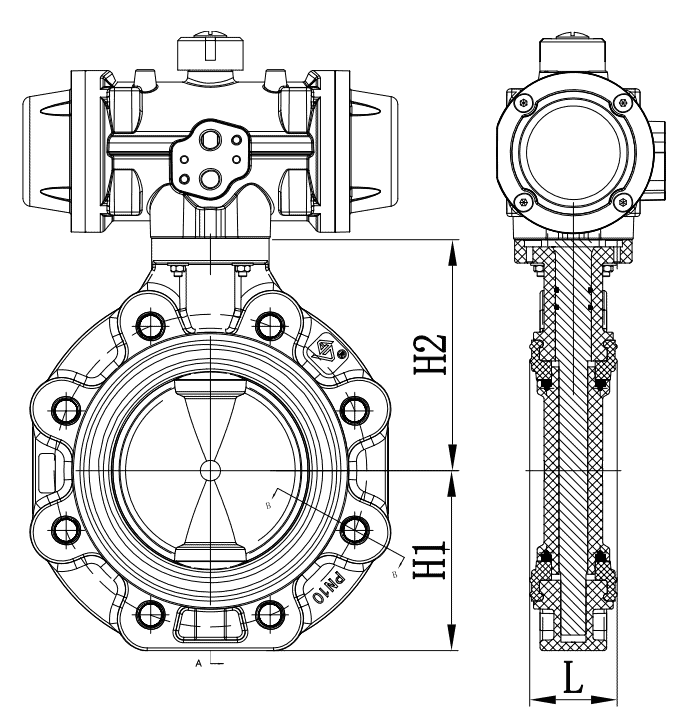
Dimensions
| DN | H1 | H2 | L |
|---|---|---|---|
| 40 | 86 | — | 38 |
| 50 | 80 | 108 | 40 |
| 65 | 88 | 118 | 45 |
| 80 | 98 | 130 | 47 |
| 100 | 112 | 145 | 56 |
| 125 | 126 | 162 | 62 |
| 150 | 138 | 177 | 67 |
| 200 | 165 | 210 | 86 |
| 250 | 204 | 260 | 105 |
| 300 | 238 | 270 | 120 |
| 350 | 266 | 300 | 130 |
| 400 | 308 | 350 | 140 |
| 450 | 320 | 370 | 152 |
| 500 | 345 | 400 | 155 |
| 600 | 405 | 460 | 175 |
| 700 | 491 | 560 | 205 |
| 800 | 545 | 620 | 240 |
| 1000 | 683 | 750 | 305 |
All dimensions in mm. H1 = height to stem center, H2 = overall height with actuator, L = face-to-face. Universal slotted flange fits ANSI Class 150, DIN, and JIS bolt patterns. Full flange drilling data available on request.
Actuator Torque Requirements
| DN | 40 | 50 | 65 | 80 | 100 | 125 | 150 | 200 | 250 | 300 |
|---|---|---|---|---|---|---|---|---|---|---|
| N·m | 30 | 35 | 40 | 45 | 55 | 80 | 130 | 200 | 400 | 600 |
Design torque values for actuator sizing, safety factor included. Larger sizes (to DN1000) available — contact us for torque data. See how to size a pneumatic actuator for the full method.
Chemical Compatibility
PPH disc and body excel in alkaline and organic-acid service; seat is EPDM or FKM by media.
Excellent for: sodium hydroxide up to 50% (even hot), ammonia, organic acids, hydrochloric acid (standard), dilute sulfuric acid, salt solutions and alkaline effluent.
Applications
Large-bore flow control on alkaline and corrosive lines:
Why a Butterfly Valve?
For large diameters, butterfly valves are more compact, lighter, and more economical than ball valves, and they offer good throttling control. At DN200 and above, a PPH butterfly valve is usually the most cost-effective choice for on/off and modulating duty on alkaline and corrosive lines.
Carrying acids or solvents rather than alkalis? The same butterfly valve is available in PVC, CPVC and PVDF. For tight isolation or full-bore flow, the PPH true union ball valve suits serviceable lines and the PPH flanged ball valve handles higher pressure. Tell us your media and temperature for a free material recommendation — Material Selection Service. View all PPH valves.
Sizing the actuator? See how to size a pneumatic actuator for a plastic valve for torque tables and worked examples, or the complete pneumatic ball valve selection guide for seat and fail-safe choices. Still deciding whether to automate? Read manual vs pneumatic valves: when to automate. To compare PPH against the other bodies, see the plastic valve material selection guide. Browse the full range of pneumatic plastic valves.


Frequently Asked Questions
Q: Does one valve really fit ANSI, DIN, and JIS?
Yes — the slotted (elongated) bolt holes accommodate all three bolt patterns, so a single valve mounts to ANSI Class 150, DIN, or JIS flanges. No need to specify standard when ordering.
Q: What size range and temperature?
DN40 to DN1000, up to 85°C (185°F). PPH stays rigid at temperatures where UPVC softens.
Q: Why choose PPH over UPVC for hot lines?
UPVC loses most of its strength above 60°C and creeps/deforms. PPH stays mechanically rigid to 85°C, so the stem won’t twist and the seat won’t deform — essential for hot effluent and caustic.
Q: Is this a wafer or lugged butterfly valve?
This is a wafer-type butterfly valve, designed to mount between two pipe flanges. The slotted bolt holes fit ANSI Class 150, DIN, and JIS bolt patterns, so the same valve works with any of the three flange standards.
Q: Can it handle sodium hypochlorite?
No — use CPVC or PVDF for hypochlorite and oxidizers. We supply both.
Q: What seat material should I choose?
EPDM for alkalis and most general media; FKM (Viton) for higher-temperature or specific chemical needs. Tell us your media and we’ll specify.
Get a factory-direct quote
Send us your medium, its concentration and temperature, and the line size. Our engineers confirm the right body material, seat and valve type — and reply within 24 hours.