
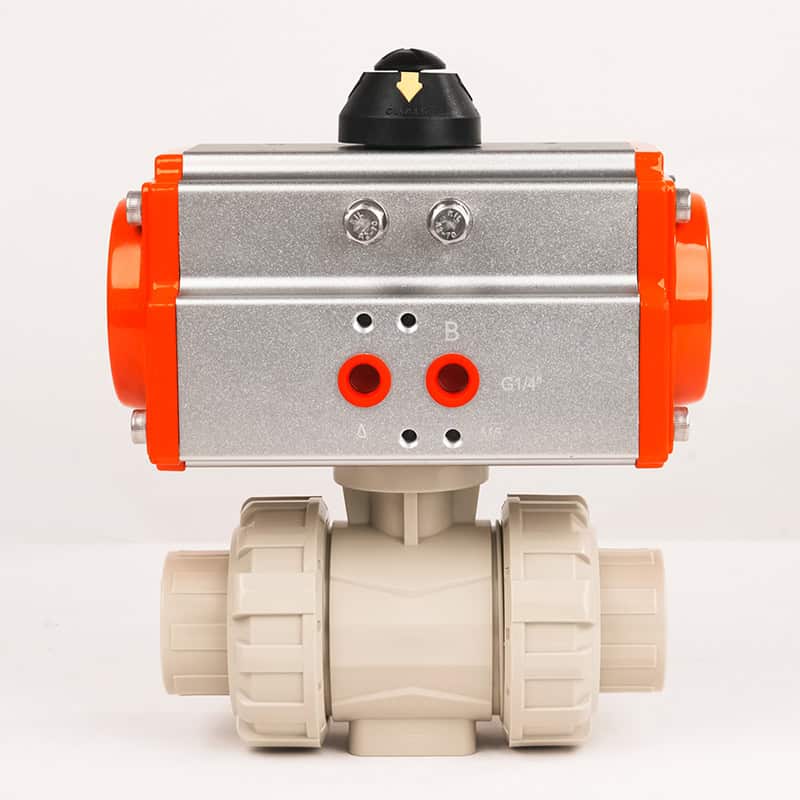
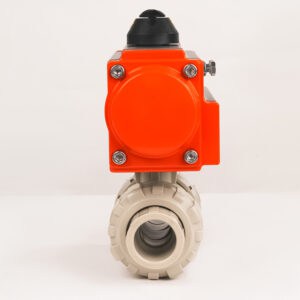
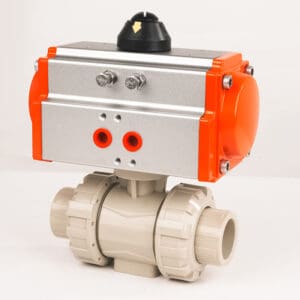
PPH Pneumatic True Union Ball Valve
The Huiya PPH pneumatic ball valve is a true union, full-port automated valve engineered for hot alkaline and corrosive fluids — the applications where PVC, CPVC, and even PVDF reach their limits. Built from polypropylene homopolymer (PPH) and rated to 85°C, it is the material of choice for caustic soda, ammonia, dilute acids, and chemical dosing lines. The true union design lets you service the valve without cutting into your pipework.
Why PPH for Alkaline Service
Material selection for valves is about matching the polymer to the chemistry — and alkalis are where PPH excels. CPVC and PVC are excellent for hot acids and chlorinated media, but they are not suited to strong hot caustic. PVDF dominates strong acids and solvents, but degrades in hot concentrated alkali. PPH is the specialist for hot alkaline duty, handling sodium hydroxide up to 50% concentration at elevated temperature where chlorinated and fluorinated plastics fail.
This isn’t about one material being “better” — it’s about using the right material for the chemistry. For hot caustic, ammonia, and many organic acids, PPH delivers the longest service life at the lowest cost.
Best-fit applications:
Service Without Cutting Pipes
In scaling or crystallizing media, valves need frequent cleaning. The true union design lets operators simply unscrew the two union nuts and slide the valve body out for cleaning or service — without cutting the pipe or waiting for fusion joints to cool. The ball, PTFE seats, stem, and O-rings can each be inspected or replaced individually.
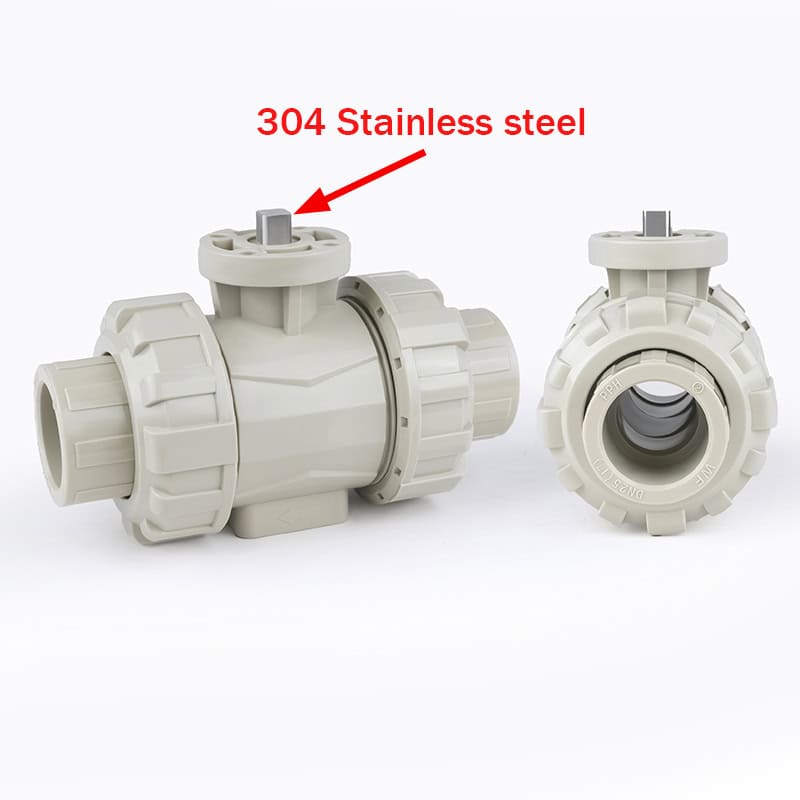
Technical Specifications
| Specification | Detail |
| Valve Type | True union, full-port pneumatic ball valve |
| Body Material | PPH (polypropylene homopolymer) |
| Size Range | DN15–DN100 (1/2″–4″) |
| Bore | Full port |
| Pressure Rating | PN10 (1.0 MPa) at ambient temperature |
| Max. Temperature | 85°C (185°F) |
| End Connections | Socket fusion or butt fusion, DIN metric |
| Ball | PPH |
| Seats | PTFE |
| O-Rings / Seals | EPDM or FKM (selected by media) |
| Actuator | Pneumatic, double-acting or spring-return, aluminum alloy |
Dimensions
| Size | d | l | d1 | d2 | ||||||
|---|---|---|---|---|---|---|---|---|---|---|
| DIN | JIS | ANSI | CNS | DIN | JIS | ANSI | CNS | |||
| 1/2″ (DN15) | 15 | 23.00 | 20.28 | 22.35 | 21.54 | 22.35 | 19.95 | 21.75 | 21.25 | 21.75 |
| 3/4″ (DN20) | 20 | 26.00 | 25.30 | 26.40 | 26.87 | 26.40 | 24.95 | 25.70 | 26.58 | 25.70 |
| 1″ (DN25) | 25 | 29.00 | 32.30 | 32.40 | 33.65 | 34.50 | 31.95 | 31.70 | 33.28 | 33.90 |
| 1-1/4″ (DN32) | 32 | 32.50 | 40.35 | 38.45 | 42.40 | 42.50 | 39.95 | 37.65 | 42.05 | 41.90 |
| 1-1/2″ (DN40) | 40 | 35.50 | 50.35 | 48.45 | 48.50 | 48.45 | 49.95 | 47.65 | 48.12 | 47.65 |
| 2″ (DN50) | 50 | 38.50 | 63.40 | 60.50 | 60.60 | 60.50 | 62.90 | 59.60 | 60.18 | 59.60 |
| 2-1/2″ (DN65) | 63 | 44.50 | 75.40 | 76.50 | 73.35 | 76.50 | 74.90 | 75.60 | 72.85 | 75.60 |
| 3″ (DN80) | 75 | 51.00 | 90.45 | 89.60 | 89.30 | 89.60 | 89.90 | 88.60 | 88.70 | 88.60 |
| 4″ (DN100) | 90 | 61.50 | 110.45 | 114.50 | 114.75 | 114.60 | 109.90 | 113.60 | 114.10 | 113.60 |
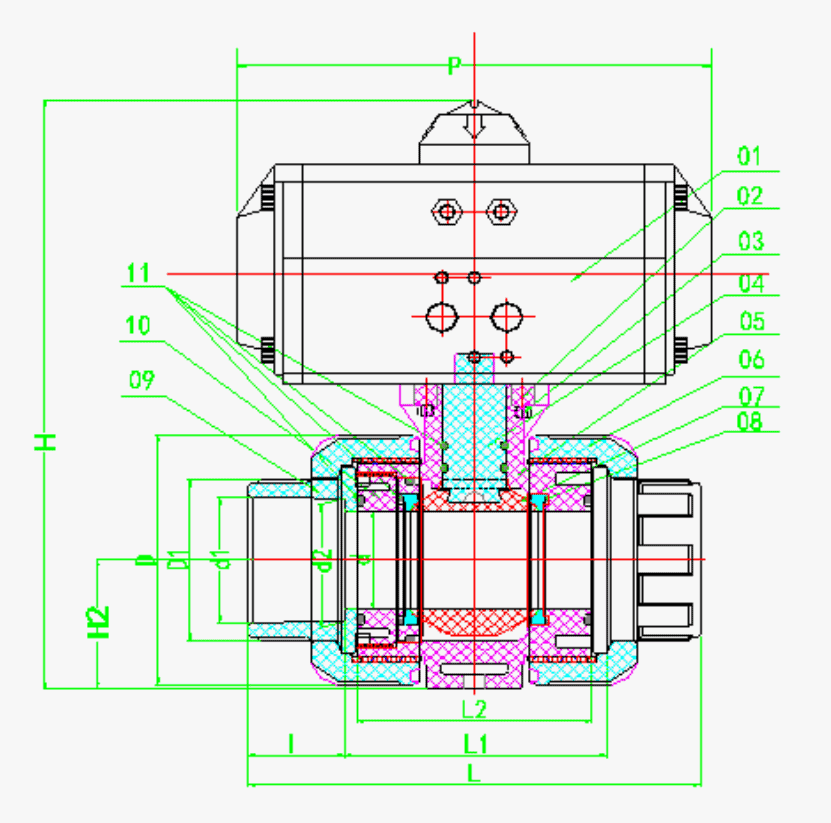
All dimensions in mm. Socket connections available in DIN, JIS, ANSI, and CNS standards. d = nominal size, l = socket depth, d1/d2 = socket diameters.
| Size | D | D1 | L | L1 | L2 | H | H2 |
|---|---|---|---|---|---|---|---|
| 1/2″ (DN15) | 56.0 | 32.0 | 112.0 | 66.0 | 57.0 | 162.0 | 28.7 |
| 3/4″ (DN20) | 65.0 | 37.0 | 120.0 | 68.0 | 59.0 | 174.0 | 32.7 |
| 1″ (DN25) | 76.0 | 45.5 | 136.0 | 68.0 | — | 208.0 | 38.75 |
| 1-1/4″ (DN32) | 87.0 | 55.5 | 150.5 | 85.0 | 76.0 | 214.0 | 44.25 |
| 1-1/2″ (DN40) | 101.0 | 62.0 | 168.0 | 95.5 | 86.5 | 237.0 | 51.5 |
| 2″ (DN50) | 121.0 | 79.0 | 180.0 | 103.0 | 92.0 | 258.0 | 62.0 |
| 2-1/2″ (DN65) | 150.0 | 94.2 | 235.0 | 146.0 | 134.0 | 310.0 | 79.5 |
| 3″ (DN80) | 169.5 | 113.0 | 265.0 | 163.0 | 148.0 | 341.0 | 90.0 |
| 4″ (DN100) | 190.0 | 135.0 | 304.0 | 181.0 | 157.0 | 379.0 | 96.0 |
All dimensions in mm. D = body diameter, L = end-to-end length, H = overall height with actuator. Full dimensional drawings available on request.
Actuator Torque Requirements
| Size | DN15 | DN20 | DN25 | DN32 | DN40 | DN50 | DN65 | DN80 | DN100 |
|---|---|---|---|---|---|---|---|---|---|
| Torque (N·m) | 6 | 8 | 10 | 12 | 15 | 20 | 40 | 45 | 65 |
Design torque values for actuator sizing — these already include a 1.6× safety factor over measured valve torque, so size the actuator directly against them. For scaling, slurry or crystallising media, see how to size a pneumatic actuator for the higher ratios. Our engineering team can confirm the actuator for your operating pressure.
Chemical Compatibility
PPH’s strength is alkaline and organic-acid resistance:
Excellent for:
Applications
Quality & Reliability
PPH is built for hot alkalis — but if your line carries hot acids, chlorinated water or concentrated acids instead, the same valve is available in CPVC, PVC and PVDF. For high-pressure or large-bore service, choose the PPH flanged ball valve; for cost-effective large-diameter isolation, the PPH butterfly valve. Tell us your media and temperature and we’ll confirm the right material — Material Selection Service. View all PPH valves.
Engineering Notes & Common Mistakes

Frequently Asked Questions
Q: Why choose PPH over CPVC or PVDF for my valve?
For hot caustic and alkaline media, PPH outperforms both — and costs less. CPVC is the choice for hot acids and chlorinated media; PVDF for strong acids and solvents; PPH for hot alkalis. Tell us your media and we’ll confirm the right one.
Q: What is the maximum temperature for a PPH ball valve?
85°C (185°F) for continuous service. For hot caustic specifically, PPH holds up where chlorinated plastics fail.
Q: Can I service this valve without cutting the pipe?
Yes — loosen the two union nuts, slide the valve body out, service or replace the ball/seats/O-rings, and reconnect. No pipe cutting, ideal for scaling or crystallizing media that need regular cleaning.
Q: What end connections are available?
Socket fusion or butt fusion, DIN metric standard.
Q: Can this valve handle sodium hypochlorite?
No — sodium hypochlorite is a strong oxidizer that attacks PPH. Use a CPVC or PVDF valve for hypochlorite. We supply both.
Q: Is it full port?
Yes, full port (full bore) — the bore matches the pipe ID, minimizing pressure drop and easing cleaning.
Sizing the actuator? See how to size a pneumatic actuator for a plastic valve for torque tables and worked examples, or the complete pneumatic ball valve selection guide for seat and fail-safe choices. Still deciding whether to automate? Read manual vs pneumatic valves: when to automate. To compare PPH against the other bodies, see the plastic valve material selection guide. Browse the full range of pneumatic plastic valves.
Get a factory-direct quote
Send us your medium, its concentration and temperature, and the line size. Our engineers confirm the right body material, seat and valve type — and reply within 24 hours.