
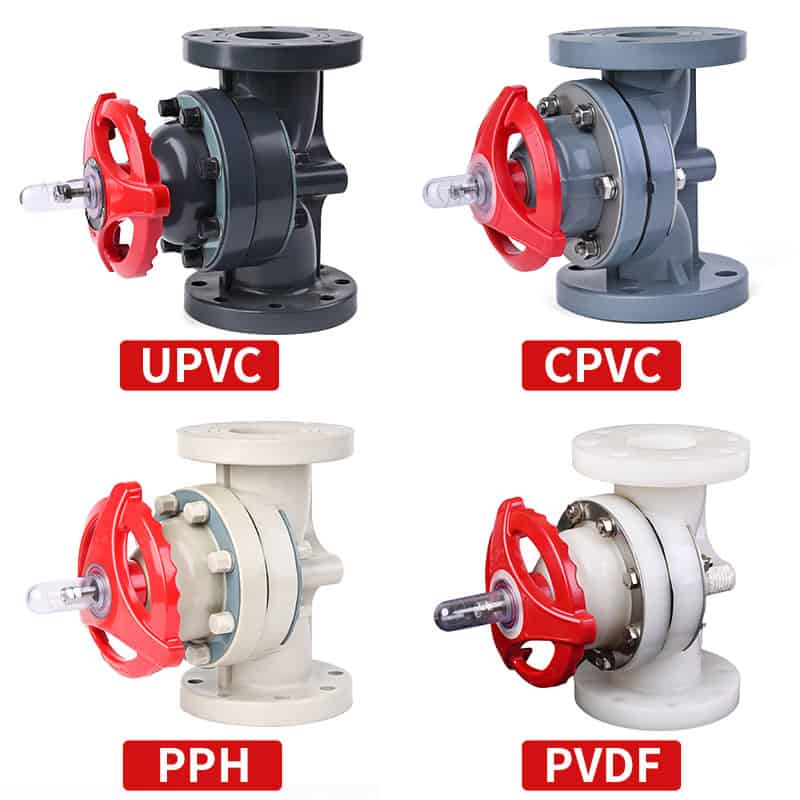
For plastic diaphragm valves — UPVC, CPVC, PPH and PVDF
Choosing the right diaphragm valve material means two decisions, and they do different jobs. A diaphragm valve has two material decisions, and they do different jobs. The body sets the temperature ceiling and the overall chemical range. The diaphragm is the wetted part that actually seals and meets the fluid — and it is where most field failures happen, because a diaphragm is really two layers, and the layer you cannot see is the one that fails when it is chosen wrong. This guide covers the dual-layer principle, our three diaphragm combinations and what each is for, a selection table by application, and the incompatibilities that catch people out.
Two decisions: body and diaphragm
The body material sets the envelope: UPVC to about 55 °C, PPH to about 85 °C, CPVC to about 90 °C, and PVDF to about 120 °C, each with its own chemical range — weigh them in our plastic valve material selection guide. Once the body is set by your medium and temperature, the remaining — and more failure-prone — choice is the diaphragm, which must match both the specific chemistry and the mechanical duty (how often the valve cycles). This guide focuses on the diaphragm.
Why the diaphragm is dual-layer
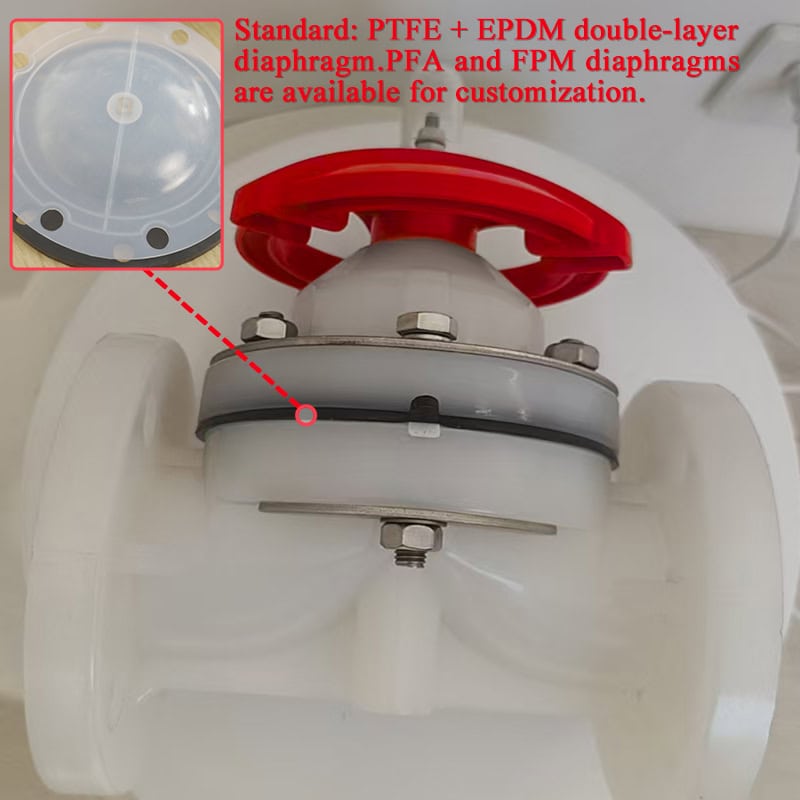
Our diaphragms are two plies: a wetted face chosen for chemical inertness or low permeation, bonded to a backing that provides mechanical flex and a second chemical barrier.
Here is the failure that surprises people. Small, aggressive molecules — hydrofluoric acid, chlorine — slowly permeate even an inert face over time. If the layer behind it is the wrong rubber, the permeated chemical attacks it: the backing swells, loses elasticity, ruptures, and the valve leaks — often with the stem and actuator corroding next. So the rule is: choose the backing for what gets through, not just the face for what it meets.
The three diaphragm combinations
EPDM + PTFE — the general-purpose value choice. A PTFE wetted face gives near-universal chemical inertness and a wide temperature range; the EPDM backing provides excellent flex and mechanical fatigue life at the most economical price. Best for ambient-to-mid-temperature (≤ 80 °C) inorganic acids and alkalis — dilute hydrochloric and sulfuric acid, sodium hydroxide — plus municipal and industrial wastewater, electroplating waste, and alcohols.
FKM + PTFE — for HF and hot, strong acids. The PTFE face meets the acid; the FKM (Viton) backing resists the aggressive molecules that permeate a single PTFE layer. This is the combination for hydrofluoric acid, and it also handles concentrated sulfuric and nitric acid, oils and aromatic hydrocarbons at high temperature. Do not use it with acetone, esters or ethers — those polar solvents swell and dissolve FKM.
EPDM + F46 (FEP) — for high purity and gas-tight service. F46 (FEP) is a melt-processable fluoroplastic; its molecular structure is denser than sintered PTFE, so gas and moisture permeation is much lower, and the surface is smoother and non-adsorbing. Best for semiconductor ultrapure water (UPW) — it holds 18.2 MΩ·cm purity with zero particle shed — high-vacuum and gas lines, and polar solvents such as acetone and ethanol.
| Diaphragm | Wetted face | Backing | Best for | Avoid |
|---|---|---|---|---|
| EPDM + PTFE | PTFE | EPDM | General acids/alkalis ≤80 °C, wastewater, alcohols | — |
| FKM + PTFE | PTFE | FKM (Viton) | HF, hot/strong acids, oils, aromatics | Acetone, esters, ethers |
| EPDM + F46 | F46 (FEP) | EPDM | UPW, gas-tight/vacuum, acetone & polar solvents | — |
Choose by application
| Application | Typical media | Body | Diaphragm |
|---|---|---|---|
| Semiconductor & UPW / acid clean | 18.2 MΩ·cm UPW; HF; concentrated HNO₃ | PVDF | EPDM+F46 (UPW); FKM+PTFE (HF/acids) |
| Chemical dosing & acid/alkali transfer | 98% H₂SO₄; 37% HCl; NaOH | PPH or PVDF | FKM+PTFE |
| Hydrometallurgy & leaching (slurry) | Dilute H₂SO₄ with ore slurry and crystals | CPVC or PPH | EPDM+PTFE |
| Chlor-alkali — hot caustic | 80–90 °C NaOH; hot brine | PPH or PVDF | FKM+PTFE |
| Wastewater neutralisation | Electroplating waste acid; lime-crystal neutralising waste | UPVC or CPVC | EPDM+PTFE |
| Electroplating & metal finishing | Plating and chrome baths; hot HCl | CPVC or PVDF | FKM+PTFE |
Two notes on this table. In every one of these duties the diaphragm valve is chosen for the same underlying reason — the diaphragm isolates the fluid from the stem, leaving no packing to leak and no cavity for crystals or solids to jam, which is exactly where ball valves fail on crystallising, slurry-laden and acid-mist service. And for extreme wet-chlorine or high-strength hypochlorite service, none of the three standard backings is ideal — chlorine permeates and attacks them — so please consult our engineers for a purpose-built specification.
Incompatibilities to know
These are the mistakes that cause the failures:
- FKM (Viton) backing — never with acetone, esters or ethers. These polar solvents pass the PTFE face and then swell or dissolve the FKM behind it. For polar solvents, use EPDM + F46.
- EPDM backing — not for wet chlorine or strong hypochlorite. Chlorine permeates the face and carbonises EPDM within weeks. Extreme wet-chlorine service needs a specialised build — consult our engineers.
- PTFE face for gas-tight or UPW duty. Sintered PTFE has slightly higher gas permeation than F46; where you need the tightest gas or moisture barrier, or ultrapure purity, choose the F46 (FEP) face.
Proven in the field
The principle is not theory. On a hydrofluoric acid line at a semiconductor fab, single-layer PTFE diaphragms permeated and their EPDM backing failed within months; an FKM + PTFE dual layer stopped it — the story is in our hydrofluoric acid valve guide. On an ore-slurry line at a mine, a CPVC body with an EPDM + PTFE diaphragm ran 8–10 years where ball valves kept jamming. And at a chlor-alkali plant handling crystallising hot caustic, switching to a weir diaphragm valve with a dual-layer diaphragm gave two years of stable service — see weir vs straight-through diaphragm valves.
Huiya — body and diaphragm, matched to your duty
We build weir diaphragm valves in UPVC, CPVC, PPH and PVDF — union DN15–DN50 and flanged DN25–DN200, rated PN10, manual or pneumatic — with the dual-layer diaphragm available in EPDM + PTFE, FKM + PTFE or EPDM + F46. For how the valve works and how the weir design extends diaphragm life, see our complete diaphragm valve guide, and check your exact medium against our chemical resistance checker. Tell us your medium, its concentration and temperature, and our engineers will specify both the body and the diaphragm — and flag any permeation or incompatibility before it becomes a problem. Browse the full range of plastic diaphragm valves — UPVC, CPVC, PPH and PVDF — or request a quote.
Frequently asked questions
Which diaphragm material should I use for hydrofluoric acid (HF)? An FKM + PTFE dual-layer diaphragm. The PTFE face meets the acid, and the FKM backing resists the HF molecules that slowly permeate a single PTFE layer — which is what destroys a cheaper EPDM backing.
Which diaphragm material for sulfuric or nitric acid? For concentrated or hot acid, FKM + PTFE. For dilute acid at ambient temperature, EPDM + PTFE is usually sufficient and more economical.
Which diaphragm material for ultrapure water (UPW)? EPDM + F46 (FEP). The F46 face is denser and smoother than PTFE, with the lowest permeation and zero particle shed, which is what holds 18.2 MΩ·cm purity.
Which diaphragm material for acetone or polar solvents? EPDM + F46. Never use an FKM (Viton) backing with acetone, esters or ethers — these solvents swell and dissolve FKM.
Which diaphragm material for chlorine or hypochlorite? An EPDM backing is not suitable — chlorine permeates and carbonises it. Extreme wet-chlorine or high-strength hypochlorite service needs a specialised build; consult our engineers.
What is the difference between a PTFE and an EPDM diaphragm? PTFE is the inert, chemically-resistant wetted face; EPDM is a flexible rubber used as the backing. A dual-layer diaphragm uses both — a PTFE (or F46) face for chemistry and a rubber backing for flex and as a second barrier.
What is an F46 (FEP) diaphragm? A diaphragm with a melt-processed F46 (FEP) fluoroplastic wetted face. It is denser and smoother than sintered PTFE, with lower gas and moisture permeation, making it the choice for high-purity and gas-tight service.
— Andy Xia, Huiya Engineering Team