
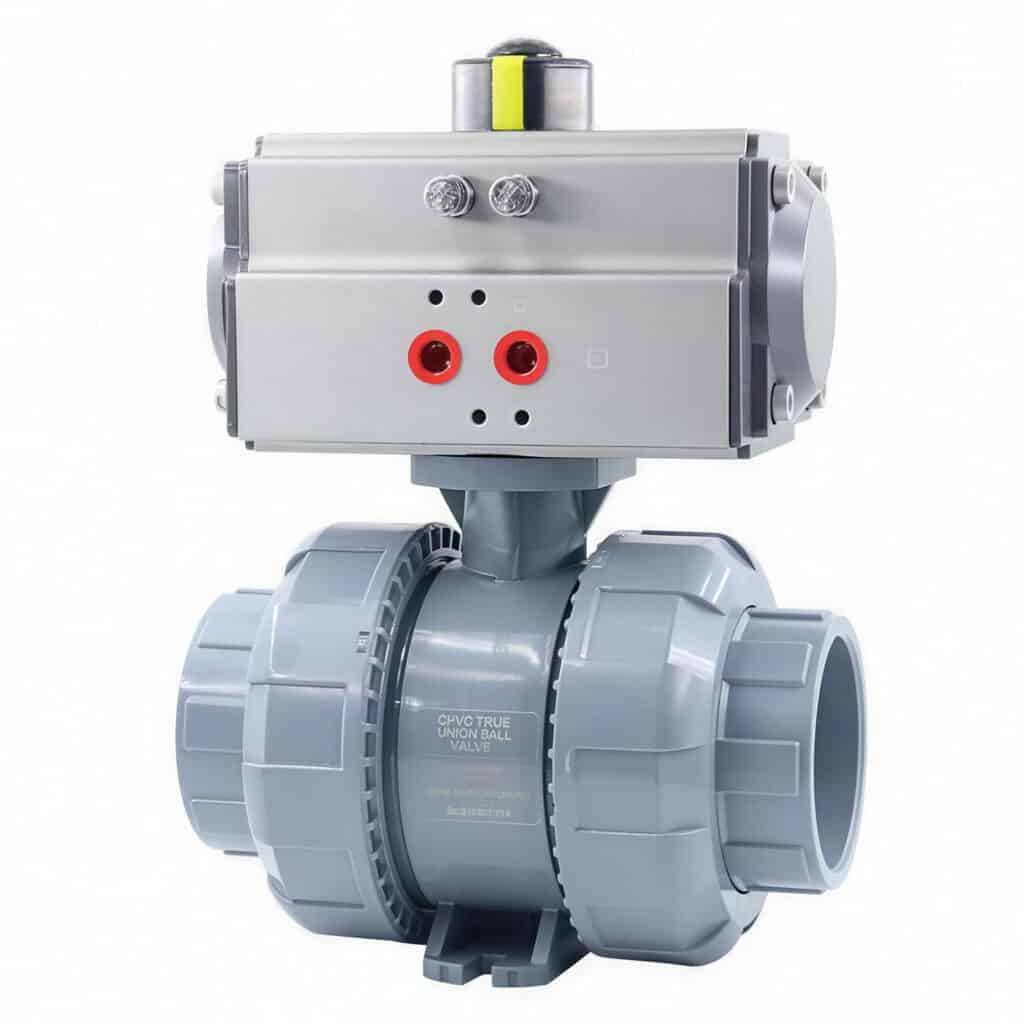
CPVC Pneumatic True Union Ball Valve
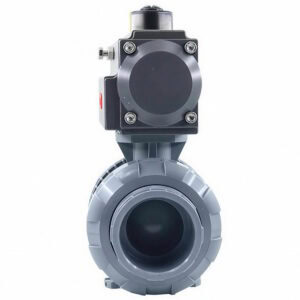
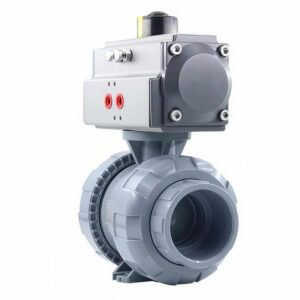
The Huiya CPVC pneumatic true union ball valve is a true union, two-piece automated valve built for corrosive and high-temperature fluid control in chemical processing, water treatment, electroplating, and mining. Rated up to 93°C (200°F) and PN16, it combines CPVC’s chemical resistance with the fast, reliable on/off control of a pneumatic actuator — and a true union design that lets you service the valve without ever cutting into your pipeline.
Service Without Cutting Pipes: The True Union Advantage
For any valve in a chemical line, the real cost isn’t the valve — it’s the downtime when it needs service. Standard flanged or solvent-welded valves force your maintenance team to cut the pipe, drain the line, replace the valve, re-cement the joints, and wait for the solvent to cure before restarting. On a hot acid line, that can mean a full day of lost production.
Huiya’s true union design eliminates this. Loosen the two union nuts, lift out the valve body, service or replace it, and reconnect — all without disturbing the surrounding pipework. The following components can be individually inspected or replaced: the ball, the PTFE seats, the stem, and the EPDM/FKM O-rings.
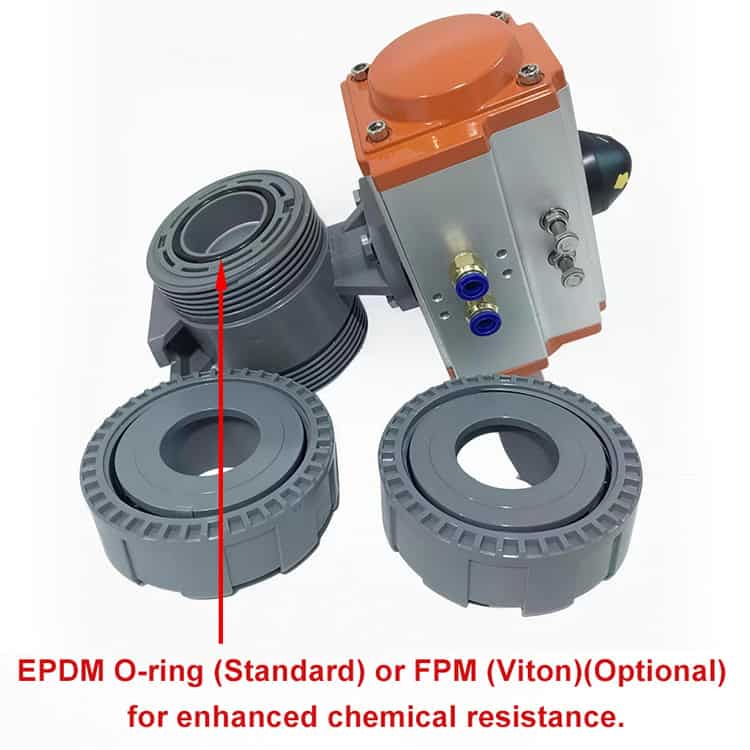
- No pipe cutting, no solvent-cement curing delays
- Minimal downtime — service in minutes, not hours
- Safer maintenance on hazardous media (no draining the full line)
- Lower lifetime cost — replace wear parts, not the whole assembly
Field story — Copper leaching plant, Chile:
A copper leaching plant was running standard flanged and solvent-welded valves on an 85°C sulfuric acid line. When a valve’s PTFE seat wore out from impurities, the maintenance team had to cut the pipe, drain the acid, replace the valve, re-glue the joints, and wait 24 hours for the cement to cure before restarting — every hour costing thousands in lost production. After upgrading to Huiya’s CPVC pneumatic true union ball valves, what used to be a full-day shutdown became a 15-minute job: no acid spills, no sawing pipes, no curing delays.
Technical Specifications
| Specification | Detail |
| Valve Type | True union, two-piece pneumatic ball valve |
| Body Material | CPVC |
| Size Range | DN15–DN100 (1/2″–4″) |
| Bore | Standard port |
| Pressure Rating | PN16 (1.6 MPa) at ambient temperature |
| Max. Temperature | 93°C (200°F) |
| End Connections | Socket (solvent weld) and threaded — ANSI, DIN, JIS, NPT, BSPT, G thread available |
| Ball | CPVC |
| Seats | PTFE |
| O-Rings / Seals | EPDM or FKM (selected by media) |
| Actuator | Pneumatic, double-acting or spring-return, aluminum alloy |
| Standards | ASTM D1784 (compound), ASTM F441 (dimensions) |
Dimensions
| Size | d | l | d1 | d2 | ||||||
|---|---|---|---|---|---|---|---|---|---|---|
| CPVC | CPVC | |||||||||
| DIN | JIS | ANSI | CNS | DIN | JIS | ANSI | CNS | |||
| 1/2″ (DN15) | 15 | 23.00 | 20.28 | 22.35 | 21.54 | 22.35 | 19.95 | 21.75 | 21.25 | 21.75 |
| 3/4″ (DN20) | 20 | 26.00 | 25.30 | 26.40 | 26.87 | 26.40 | 24.95 | 25.70 | 26.58 | 25.70 |
| 1″ (DN25) | 25 | 29.00 | 32.30 | 32.40 | 33.65 | 34.50 | 31.95 | 31.70 | 33.28 | 33.90 |
| 1-1/4″ (DN32) | 32 | 32.50 | 40.35 | 38.45 | 42.40 | 42.50 | 39.95 | 37.65 | 42.05 | 41.90 |
| 1-1/2″ (DN40) | 40 | 35.50 | 50.35 | 48.45 | 48.50 | 48.45 | 49.95 | 47.65 | 48.12 | 47.65 |
| 2″ (DN50) | 50 | 38.50 | 63.40 | 60.50 | 60.60 | 60.50 | 62.90 | 59.60 | 60.18 | 59.60 |
| 2-1/2″ (DN65) | 63 | 44.50 | 75.40 | 76.50 | 73.35 | 76.50 | 74.90 | 75.60 | 72.85 | 75.60 |
| 3″ (DN80) | 75 | 51.00 | 90.45 | 89.60 | 89.30 | 89.60 | 89.90 | 88.60 | 88.70 | 88.60 |
| 4″ (DN100) | 90 | 61.50 | 110.45 | 114.60 | 114.75 | 114.60 | 109.90 | 113.60 | 114.10 | 113.60 |
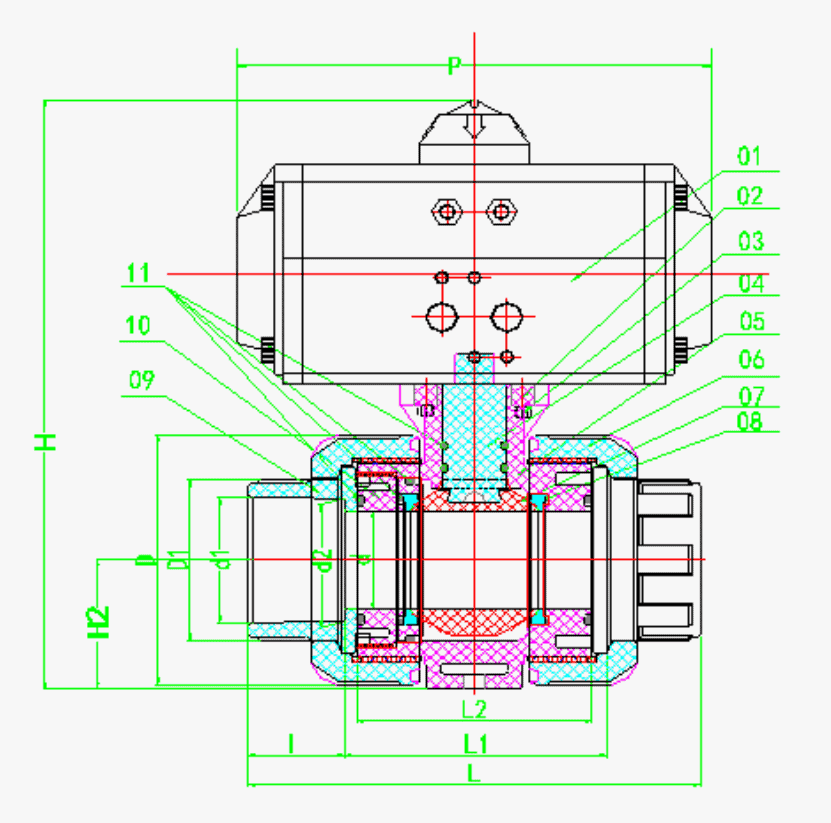
All dimensions in mm. Socket connections available in DIN, JIS, ANSI, and CNS standards. d = nominal size, l = socket depth, d1/d2 = socket diameters.
| Size | D | D1 | L | L1 | L2 | H | H2 |
|---|---|---|---|---|---|---|---|
| 1/2″ (DN15) | 56.0 | 32.0 | 112.0 | 66.0 | 57.0 | 162.0 | 28.7 |
| 3/4″ (DN20) | 65.0 | 37.0 | 120.0 | 68.0 | 59.0 | 174.0 | 32.7 |
| 1″ (DN25) | 76.0 | 45.5 | 136.0 | 68.0 | — | 208.0 | 38.75 |
| 1-1/4″ (DN32) | 87.0 | 55.5 | 150.5 | 85.0 | 76.0 | 214.0 | 44.25 |
| 1-1/2″ (DN40) | 101.0 | 62.0 | 168.0 | 95.5 | 86.5 | 237.0 | 51.5 |
| 2″ (DN50) | 121.0 | 79.0 | 180.0 | 103.0 | 92.0 | 258.0 | 62.0 |
| 2-1/2″ (DN65) | 150.0 | 94.2 | 235.0 | 146.0 | 134.0 | 310.0 | 79.5 |
| 3″ (DN80) | 169.5 | 113.0 | 265.0 | 163.0 | 148.0 | 341.0 | 90.0 |
| 4″ (DN100) | 190.0 | 135.0 | 304.0 | 181.0 | 157.0 | 379.0 | 96.0 |
All dimensions in mm. D = body diameter, L = end-to-end length, H = overall height with actuator. Full dimensional drawings available on request.
Actuator Torque Requirements
| Size | DN15 | DN20 | DN25 | DN32 | DN40 | DN50 | DN65 | DN80 | DN100 |
|---|---|---|---|---|---|---|---|---|---|
| Torque (N·m) | 6 | 8 | 10 | 12 | 15 | 20 | 40 | 45 | 65 |
Design torque values for actuator sizing — these already include a 1.6× safety factor over measured valve torque, so size the actuator directly against them. For scaling, slurry or crystallising media, see how to size a pneumatic actuator for the higher ratios. Our engineering team can confirm the actuator for your operating pressure.
Chemical Compatibility
Seal material is selected based on the chemical media. Choosing the right seal is critical — the wrong elastomer is one of the most common causes of premature valve failure.
EPDM seals — recommended for: Sodium hydroxide, hydrochloric acid, phosphoric acid, and a wide range of common salts including calcium chloride, barium chloride, sodium carbonate, and sodium sulfate.
FKM (Viton) seals — recommended for: Sodium hypochlorite, chlorine water, nitric acid (30%–50%), and sulfuric acid (10%–80%).
Applications
The CPVC pneumatic true union ball valve is used wherever corrosive or hot fluids need automated on/off control, especially in lines that require frequent maintenance or fast actuation:
Field story:
Lithium battery industry (Indonesia): Huiya supplied CPVC pipe, fittings, and valves for an electrolyte dosing system handling lithium hexafluorophosphate and other aggressive media. The system has run for two years with zero leaks and no corrosion.
Electroplating (Yueqing, China): A plating facility selected Huiya CPVC pipe and valves for its plating-solution dosing system. The CPVC components resist chromic acid and cyanide attack, running long-term with no clogging or leakage.
Why Choose a True Union Ball Valve vs a Flanged Valve?
Both have their place. Use this guide to choose:
- Choose a true union ball valve (this product) when you need a small-to-medium size (DN15–DN100), frequent maintenance access, compact installation, or the most cost-effective automated shut-off.
- Choose a flanged ball valve for larger sizes, higher-pressure duties, or when connecting directly to a flanged pipeline.
Engineering Note: Material Selection
A question we hear often: “I need a pneumatic valve for 85°C hot sulfuric acid — can I use UPVC?”
Our answer: upgrade to CPVC. UPVC softens and loses its pressure rating above about 60°C, which on a hot acid line risks leakage and failure. CPVC handles continuous service up to 93°C (200°F), giving you the temperature margin that hot acid duty demands. For most hot acid and aggressive chemical lines, CPVC is the minimum acceptable material — and where temperature or concentration exceeds CPVC’s limits, we’ll recommend PVDF instead.
This is the kind of honest, application-specific advice we give every customer: the right material specified once is always cheaper than the wrong material replaced twice.
Quality & Reliability
Every Huiya CPVC pneumatic ball valve is pressure-tested and seal-tested before shipment. Validated performance:
- Valve cycle life: tested to 10,000 open/close cycles
- Actuator cycle life: tested to 90,000 cycles
- Design service life: up to 15 years under normal operating conditions
- Pre-shipment testing: pressure, sealing, and actuation tested on every unit
Need a different material? This true union ball valve also comes in economical PVC for cooler water service, PPH for hot caustic, and PVDF for concentrated acids. Working with larger bores or vibrating pump lines? See the CPVC flanged ball valve; for big-diameter lines where weight and cost matter, the CPVC butterfly valve. Unsure which plastic suits your chemistry? Our engineers will tell you, free — Material Selection Service. View all CPVC valves.
Sizing the actuator? See how to size a pneumatic actuator for a plastic valve for torque tables and worked examples, or the complete pneumatic ball valve selection guide for seat and fail-safe choices. Still deciding whether to automate? Read manual vs pneumatic valves: when to automate. To compare CPVC against the other bodies, see the plastic valve material selection guide. Browse the full range of pneumatic plastic valves.
Frequently Asked Questions
Q: Can I service this valve without cutting the pipe?
Yes — that is the main advantage of the true union design. Loosen the two union nuts, remove the valve body, and service or replace the ball, PTFE seats, or O-rings, then reconnect. No pipe cutting and no solvent-cement curing delay.
Q: What is the maximum temperature for a CPVC pneumatic ball valve?
93°C (200°F) for continuous service. Above 60°C, UPVC is no longer suitable, which is why CPVC is the standard choice for hot acid and chemical lines.
Q: Which seal should I choose — EPDM or FKM?
EPDM for sodium hydroxide, hydrochloric acid, phosphoric acid and most salts. FKM (Viton) for sodium hypochlorite, chlorine water, nitric acid (30–50%) and sulfuric acid (10–80%). If you tell us your media, concentration and temperature, we’ll specify the correct seal.
Q: What end connections are available?
Socket (solvent weld) and threaded ends, in ANSI, DIN, JIS, NPT, BSPT, and G-thread standards — suitable for piping systems worldwide.
Q: What size range do you offer?
DN15 to DN100 (1/2″ to 4″), standard port, rated PN16.
Q: Can this valve handle sodium hypochlorite for water treatment?
Yes, with FKM seals. Sodium hypochlorite is an oxidizer, so FKM is specified rather than EPDM. This is a common water-treatment dosing application for this valve.
Q: Do you offer double-acting and spring-return actuators?
Yes. Double-acting for continuous air supply, spring-return for fail-safe open or fail-safe close. We can also supply solenoid valves, limit switches, and positioners.
Q: What is the actuator torque for sizing?
Break torque ranges from 6 N·m (DN15) to 65 N·m (DN100) — see the torque table above. Apply a safety factor when sizing; we can recommend the actuator for your pressure.
Get a factory-direct quote
Send us your medium, its concentration and temperature, and the line size. Our engineers confirm the right body material, seat and valve type — and reply within 24 hours.