
A specifier’s guide for export projects — UPVC, CPVC, PPH and PVDF valves and piping
The three flange standards you meet on an export project — ANSI (American), DIN / EN (European) and JIS (Japanese) — are not interchangeable. Even at the same nominal size, the number of bolts and the bolt-circle diameter usually differ, so an ANSI flange and a DIN flange of the “same” size often will not bolt together at all. On a shipment of valves and flanges heading overseas, getting the standard right before you order matters more than almost any other detail: a mismatch means parts that physically cannot be assembled on site. This guide explains what actually differs, gives a size-by-size bolt-pattern table, and covers what to watch for with plastic (lap-joint) flanges specifically. If you only need to check two standards against each other, jump straight to the flange compatibility checker.
The three standards at a glance
- ANSI / ASME B16.5 — North America, the Middle East and parts of Asia. Sizes in NPS (inches); pressure by Class (e.g. Class 150, written 150#).
- DIN / EN 1092 — Europe and much of the world. Sizes in DN (mm); pressure by PN (bar), e.g. PN10, PN16.
- JIS B2220 — Japan, Korea and parts of South-East Asia. Sizes in A (mm); pressure in K (kgf/cm²), e.g. 10K.
A word on the pressure names: Class 150, PN16 and JIS 10K are comparable low-pressure classes, but they are not exact equivalents (Class 150 is rated a little higher; 10K is closest to PN10). On export projects they are often paired, but their dimensions still differ, so you always match the actual standard — not the pressure number.
What actually stops two flanges mating
Three things differ between the standards, and any one of them will prevent assembly:
- Bolt count. At DN80 (3″), an ANSI Class 150 flange has 4 bolts, while DIN and JIS both have 8. You cannot bolt a 4-hole flange to an 8-hole flange.
- Bolt-circle diameter (PCD). Even when the count matches, the circle the bolts sit on is different — so the holes do not line up.
- Sealing face and outside dimensions. Raised face versus flat face, and different outside diameters and thicknesses.
Bolt-pattern comparison (the numbers that matter)
Bolt count and bolt-circle diameter (PCD) for the most common sizes, in the low-pressure class of each standard:
| Size | ANSI Class 150 | DIN PN10 / PN16 | JIS 10K |
|---|---|---|---|
| DN50 · 2″ | 4 bolts · PCD 120.7 mm | 4 bolts · PCD 125 mm | 4 bolts · PCD 120 mm |
| DN80 · 3″ | 4 bolts · PCD 152.4 mm | 8 bolts · PCD 160 mm | 8 bolts · PCD 150 mm |
| DN100 · 4″ | 8 bolts · PCD 190.5 mm | 8 bolts · PCD 180 mm | 8 bolts · PCD 175 mm |
| DN150 · 6″ | 8 bolts · PCD 241.3 mm | 8 bolts · PCD 240 mm | 8 bolts · PCD 240 mm |
The pattern to take away: at DN80 the bolt count itself differs (4 vs 8); at DN50 and DN100 the count matches but the PCD does not; and only occasionally (DN150, DIN vs JIS) do two standards happen to align. Never assume interchangeability — check both the count and the PCD against the mating flange. (Dimensions per ASME B16.5, EN 1092-1 and JIS B2220.)
Flange standards lookup
Bolt-circle diameter and bolt count for ANSI Class 150, DIN / EN 1092-1 PN10 and JIS 10K flanges, plus a quick check of whether two standards will bolt together.
Will they mate?
Pick a size and two standards. Flanges bolt together only when the count and the bolt circle both match.Figures per ASME B16.5, EN 1092-1 (PN10) and JIS B2220. Confirm against the mating flange before ordering.
Full flange drilling table (DN25–DN600)
The bolt-circle diameter (PCD) and bolt count across the full size range, for GB / DIN (EN 1092-1) PN10, JIS 10K and ANSI Class 150 flanges. Sizes are given in both DN and inches; for conversions outside this range, see the DN to inch chart.
| DN | inch | GB / DIN PN10 · PCD | GB / DIN · bolts | JIS 10K · PCD | JIS · bolts | ANSI 150 · PCD | ANSI · bolts |
|---|---|---|---|---|---|---|---|
| 25 | 1″ | 85 | 4 | 90 | 4 | 79 | 4 |
| 32 | 1¼” | 100 | 4 | 100 | 4 | 89 | 4 |
| 40 | 1½” | 110 | 4 | 105 | 4 | 98 | 4 |
| 50 | 2″ | 125 | 4 | 120 | 4 | 121 | 4 |
| 65 | 2½” | 145 | 4 | 140 | 4 | 140 | 4 |
| 80 | 3″ | 160 | 8 | 150 | 8 | 152 | 4 |
| 100 | 4″ | 180 | 8 | 175 | 8 | 190 | 8 |
| 125 | 5″ | 210 | 8 | 210 | 8 | 216 | 8 |
| 150 | 6″ | 240 | 8 | 240 | 8 | 241 | 8 |
| 200 | 8″ | 295 | 8 | 290 | 12 | 298 | 8 |
| 250 | 10″ | 350 | 12 | 355 | 12 | 362 | 12 |
| 300 | 12″ | 400 | 12 | 400 | 16 | 432 | 12 |
| 350 | 14″ | 460 | 16 | 445 | 16 | 476 | 12 |
| 400 | 16″ | 515 | 16 | 510 | 16 | 540 | 16 |
| 450 | 18″ | 565 | 20 | 565 | 20 | 578 | 16 |
| 500 | 20″ | 620 | 20 | 620 | 20 | 635 | 20 |
| 600 | 24″ | 725 | 20 | 730 | 24 | 749 | 20 |
PCD is in millimetres. Bold marks the standard whose bolt count is the odd one out at that size, because a mismatched hole count is the one problem no alignment or gasket can solve. GB / T 9119 drilling follows EN 1092-1 across this range. ANSI figures are converted from inches and rounded to the nearest millimetre.
The DIN column is PN10. PN10 and PN16 share the same drilling up to DN150, so below that the two ratings interchange freely. From DN200 up they diverge: DN200 PN16 takes 12 bolts against PN10’s 8 on the same 295 mm bolt circle, and from DN250 the bolt circle itself grows as well. If your line is PN16 above DN150, ask us for the PN16 figures rather than reading them off this table.
Dimensions per ASME B16.5, EN 1092-1 and JIS B2220. Always confirm both the bolt count and the PCD against the mating flange before ordering.
Can you mix standards?
In general, no. And the wrong fix — re-drilling a flange or forcing bolts into holes that nearly line up — is worse than useless on a plastic flange: it weakens the part and gives you a joint that leaks or cracks under load. The right options are to order the matching standard, or to use a transition / adapter flange (or a backing ring drilled to the mating standard) at the interface with existing pipework. If the connection is not fixed by existing pipework at all, a true union valve sidesteps the question: it is solvent-welded or threaded to the pipe, with no flange standard to match.
Plastic flanges are different — what to watch
Plastic valve and pipe flanges are usually the lap-joint (van-Stone / backing-ring) type: a plastic stub or flange adapter — the wetted part that contacts the fluid — plus a separate backing ring that carries the bolts. That design has two useful consequences:
- The backing ring can be drilled to ANSI, DIN or JIS independently of the plastic stub. The same valve can be adapted to a different flange standard just by changing the backing ring — which is how we supply our flanged plastic ball valves to customers on all three standards.
- DIN PN10 and PN16 backing rings share the same bolt pattern up to DN150, so a PN10 valve body and a PN16 backing ring bolt to the same mating flange without any conflict.
Two things to get right on plastic flanges: use a flat face with a full-face gasket (not a raised face), and torque evenly in a cross pattern without over-tightening — plastic flanges crack if they are over-bolted. Our valve bodies are rated PN10, with flanges or backing rings drilled to Class 150, PN10/PN16 or JIS 10K as the project requires.
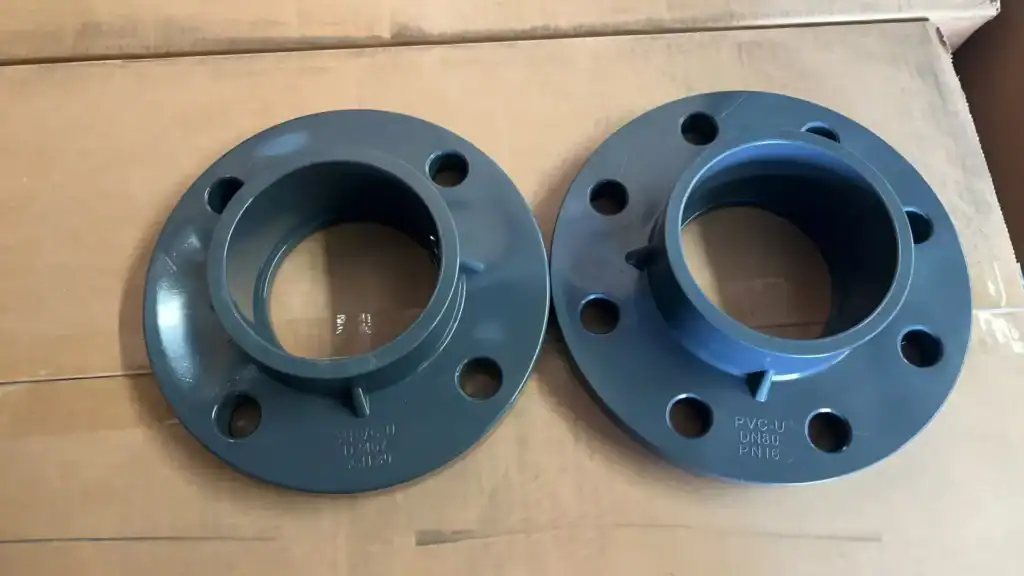
A real mismatch: Shanghai, 2004
A buyer was sourcing flanges for an ANSI 3″ (DN80) plastic butterfly valve. Assuming that a butterfly valve’s slotted, slightly oval bolt holes would fit any standard, they ordered DIN DN80 flanges instead. When the shipment arrived, the reality of the table above bit: the DIN DN80 flange has 8 bolt holes, while the ANSI 3″ pattern has only 4 — the two simply would not mate, and the flanges were unusable. A butterfly’s slots can absorb a small offset in bolt-circle, but they cannot bridge a different number of holes. A one-minute check of the bolt pattern before ordering would have avoided the whole loss.
How to specify — a quick checklist
- State the standard and the pressure class together: ANSI Class 150, DIN PN10/PN16, or JIS 10K.
- Give the nominal size in the matching unit — NPS (inch) for ANSI, DN (mm) for DIN, A (mm) for JIS.
- Specify the facing and gasket (flat face + full-face gasket for plastic).
- If you are tying into existing pipework of another standard, ask for a transition flange or a backing ring drilled to the mating standard — don’t plan to re-drill on site.
Huiya — plastic valves and flanges to ANSI, DIN and JIS
We manufacture UPVC, CPVC, PPH and PVDF valves — flanged ball valves, plastic butterfly valves and diaphragm valves — with flanges and backing rings drilled to ANSI Class 150, DIN PN10/PN16 or JIS 10K, so they drop straight onto your existing pipework anywhere in the world. Bodies are rated PN10. Tell us your standard, size and medium and we’ll supply the right drilling — request a quote.
Frequently asked questions
Are ANSI and DIN flanges interchangeable? No. At most sizes the bolt count and/or the bolt-circle diameter differ — for example, at DN80 (3″) an ANSI Class 150 flange has 4 bolts while a DIN flange has 8. They will not bolt together.
Can I bolt a JIS flange to an ANSI flange? Generally no. Even at 2″, where both have 4 bolts, the bolt circle is different (JIS 120 mm vs ANSI 120.7 mm), so the holes do not align. Use the matching standard or a purpose-made adapter flange.
What is the difference between PN10 and PN16? They are pressure ratings — 10 bar and 16 bar. For lap-joint and plastic flanges up to DN150 they share the same bolt pattern, so a PN10 and a PN16 flange of the same size bolt to the same mating flange.
Are ANSI Class 150, DIN PN16 and JIS 10K the same thing? No. They are comparable low-pressure classes and are often paired on export projects, but their physical dimensions differ. Always match the actual flange standard, not just the pressure number.
Can I re-drill a flange to make it fit? You should not, especially on plastic. Re-drilling weakens the flange and leads to leaks or cracking. Order the correct standard, or use an adapter flange or a backing ring drilled to the mating pattern.
What flange face do plastic valves use? A flat face with a full-face gasket. Tighten the bolts evenly in a cross pattern and avoid over-torquing, which can crack a plastic flange.
— Andy Xia, Huiya Engineering Team