
PPH Ball Valve (Manual)
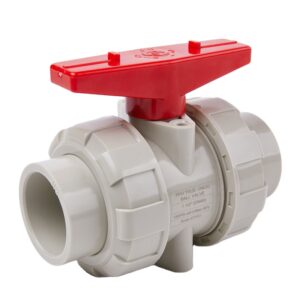
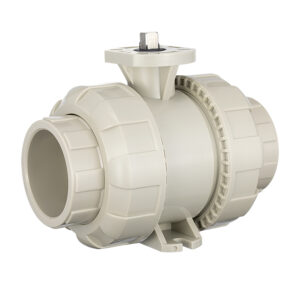
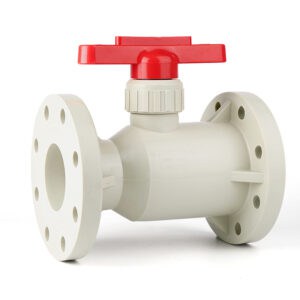
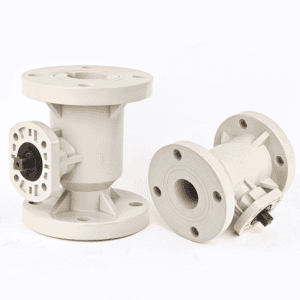
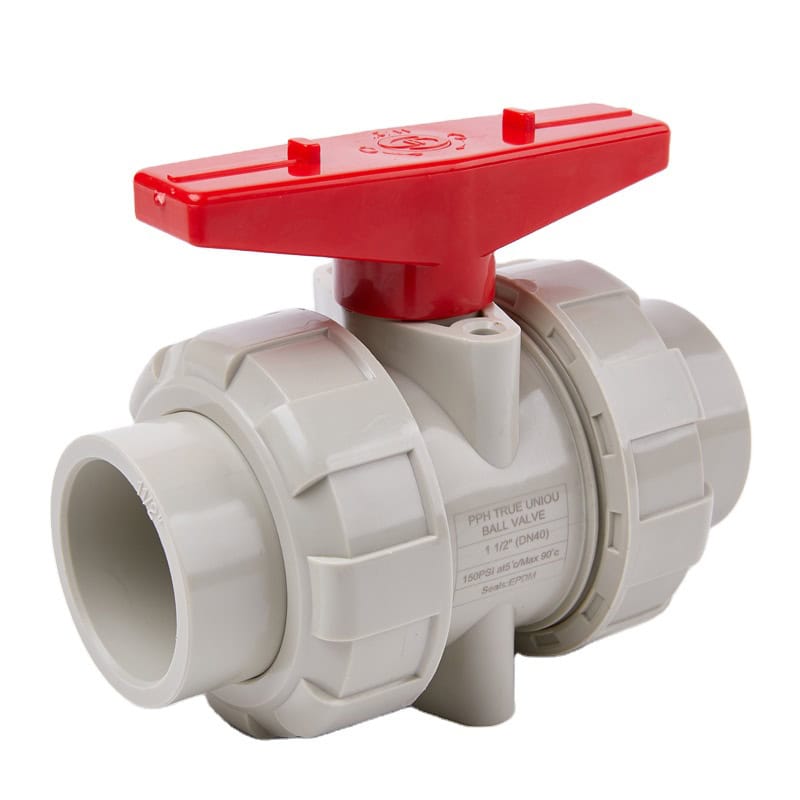
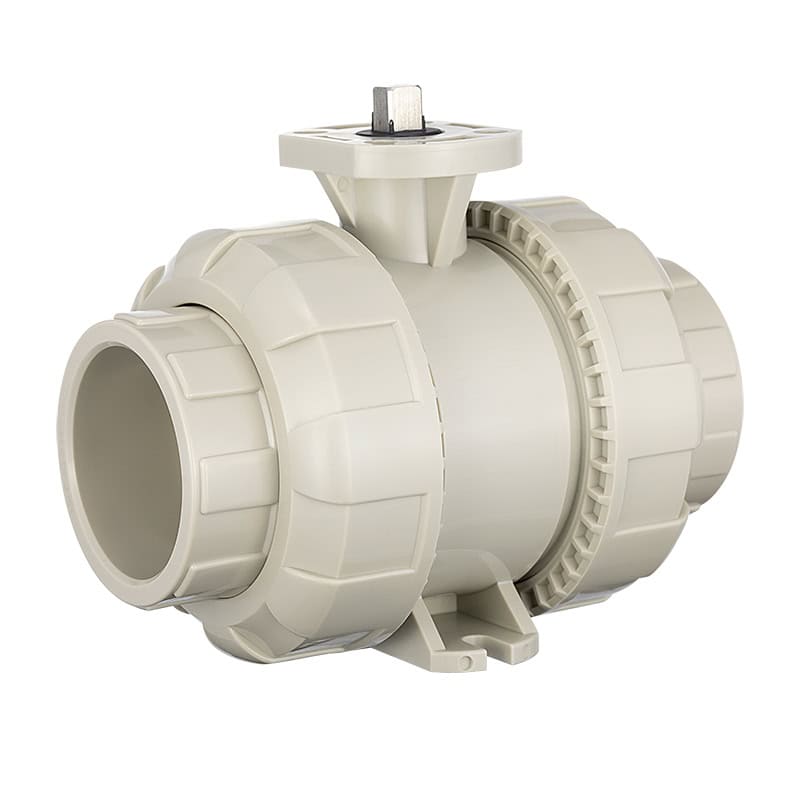
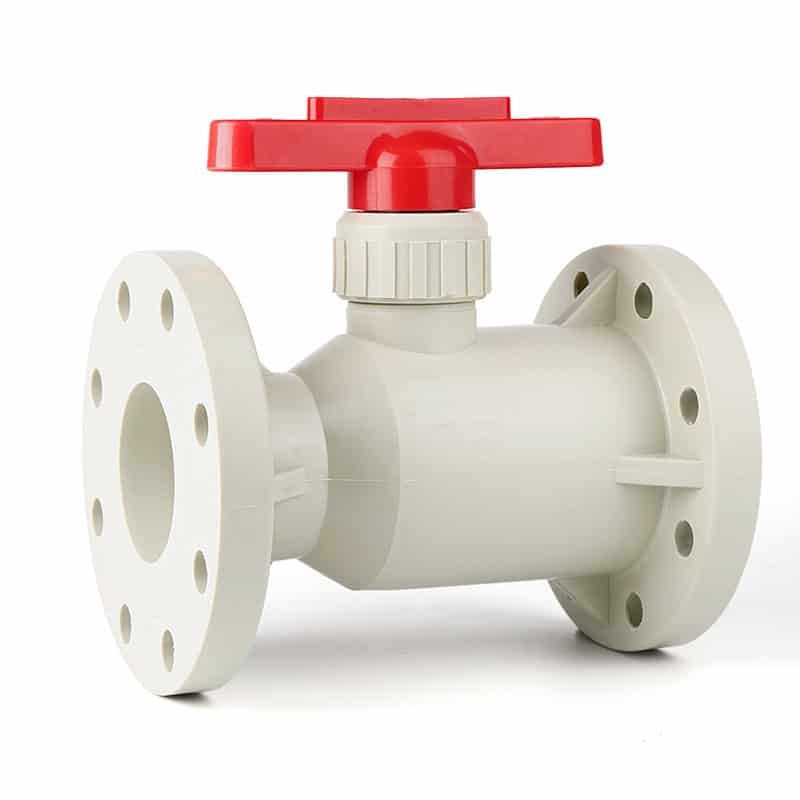
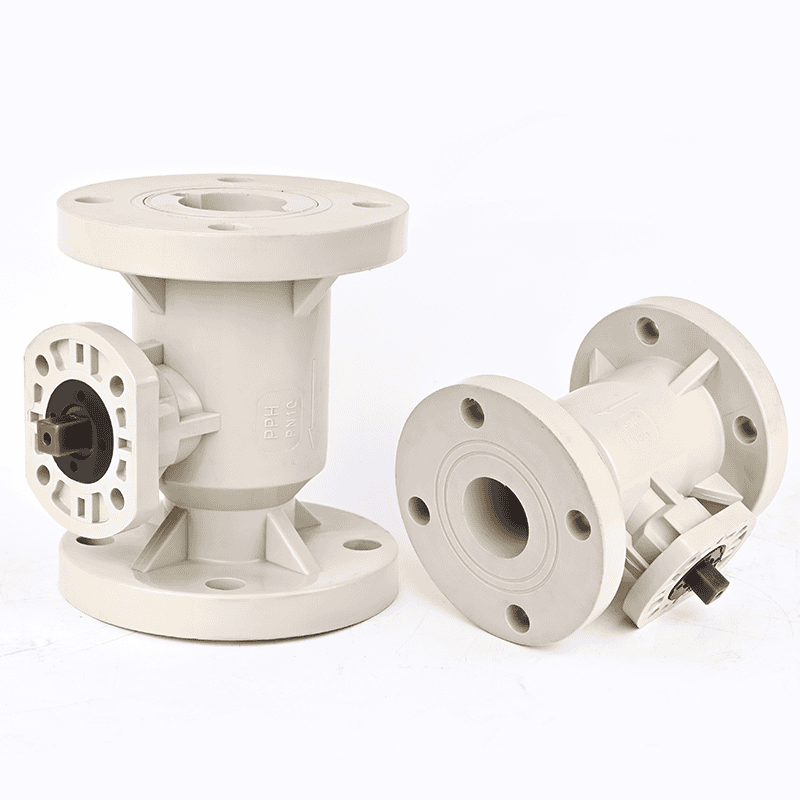
PPH ball valves (polypropylene) give you quarter-turn on/off control of hot alkaline media to about 85 °C — high-concentration caustic soda, alkali carbonates, and salt solutions — in a tough, hand-operated valve. We build ours from virgin PPH with a PTFE seat, in true union and flanged configurations for chlor-alkali, alkali recovery, and neutralisation duties.
A ball valve gives a full-bore, low-pressure-drop flow path and a fast quarter-turn action, while the PTFE seat handles frequent cycling without leaking. PPH adds the molecular toughness and wear resistance that make it the value choice for hot caustic service.
PPH chemical compatibility
PPH is rated to about 85 °C and excels in strong alkaline and salt service.
Suitable: high-temperature strong alkalis (high-concentration sodium hydroxide / caustic soda); alkali-metal carbonates; inorganic salt solutions; non-oxidising dilute inorganic acids.
Not recommended: strong oxidising acids (concentrated nitric, fuming sulfuric); high concentrations of free chlorine and halogen gases; aromatic hydrocarbons.
See our chemical resistance reference for more.
True union or flanged?
The true union version (DN15–DN100) screws apart at both ends, so you can remove the valve for cleaning or seat replacement without cutting pipe. It is the practical choice for bottom-of-tank sludge draining on a scrubber and for non-critical backup isolation.
The flanged version (DN15–DN200) bolts to the pipe through integral flanges for far greater strength against pipe stress, vibration, and thermal movement. It is the standard choice on larger-bore, permanent caustic and brine lines that need a joint that stays tight under thermal cycling.
Manual or pneumatic?
Choose the manual valve for low-frequency operation — sludge draining and non-critical backup paths. For automated corrosive-neutralisation dosing, emergency pressure relief, or high-cycle reactor feed, use our PPH pneumatic ball valve instead.— see how to select a pneumatic ball valve for actuator sizing and fail-safe options
Why our PPH manual ball valves
- PTFE seat for leak-free service through frequent cycling.
- Best value for caustics — excellent molecular toughness and wear resistance in strong alkaline media.
- High toughness — strong impact resistance and good resistance to thermal deformation and cracking under temperature swings.
- 304 or 316 stainless steel stem option, virgin branded resin, and factory-direct supply.
- Lightweight, low cost, minimal maintenance, water-hammer-friendly — the slow manual close avoids pressure surges in plastic lines.
Configurations
- True union: DN15–DN100 (1/2″–4″); socket or threaded ends.
- Flanged: DN15–DN200 (1/2″–8″); ANSI, DIN, or JIS flanges.
Specifications
| Body material | PPH / polypropylene (virgin branded resin) |
| Size range | True union DN15–DN100; flanged DN15–DN200 |
| Pressure rating | PN10 (derates with temperature) |
| Max temperature | ~85 °C |
| Seat | PTFE |
| O-ring | EPDM or FKM |
| Connection | True union (socket / threaded) or flanged (ANSI / DIN / JIS) |
| Operation | Manual lever |
| Stem | 304 or 316 stainless steel option |
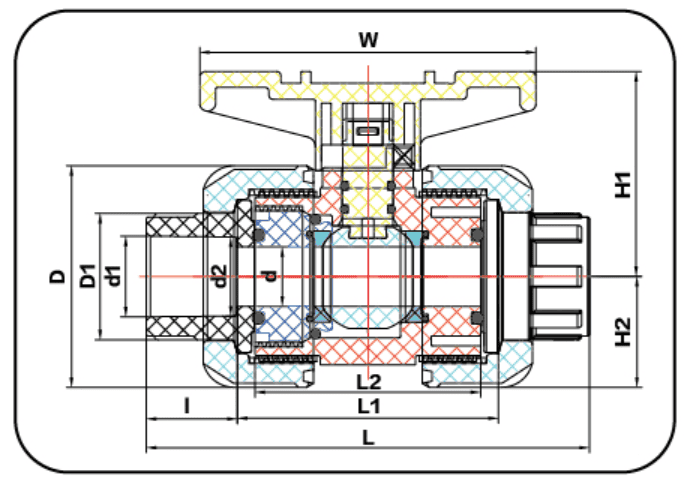
Dimensions — DIN (Series 1) 尺寸表 DIN(系列一)
| Size (DIN) | d | d1 | d2 | D | D1 | L | I | L1 | L2 | W | H1 | H2 |
|---|---|---|---|---|---|---|---|---|---|---|---|---|
| 1/2″ (DN15) | 15 | 19.50 | 19.30 | 56.00 | 32.00 | 112.00 | 23.00 | 66.00 | 57.00 | 85.00 | 51.80 | 28.00 |
| 3/4″ (DN20) | 20 | 24.40 | 24.10 | 65.00 | 37.00 | 120.00 | 26.00 | 68.00 | 59.00 | 90.00 | 61.00 | 32.50 |
| 1″ (DN25) | 25 | 31.30 | 31.00 | 76.00 | 45.50 | 136.00 | 29.00 | 76.00 | 68.00 | 106.00 | 69.30 | 38.00 |
| 1-1/4″ (DN32) | 32 | 39.30 | 38.90 | 87.00 | 55.50 | 150.50 | 32.50 | 85.00 | 76.00 | 116.00 | 80.80 | 43.50 |
| 1-1/2″ (DN40) | 40 | 49.30 | 48.90 | 101.00 | 62.00 | 168.00 | 35.50 | 95.50 | 86.50 | 128.00 | 92.00 | 50.50 |
| 2″ (DN50) | 50 | 62.20 | 61.70 | 121.00 | 79.00 | 180.00 | 38.50 | 103.00 | 92.00 | 155.00 | 108.00 | 60.60 |
| 2-1/2″ (DN63) | 63 | 74.00 | 72.70 | 150.00 | 94.20 | 235.00 | 44.50 | 146.00 | 134.00 | 195.00 | 135.00 | 75.00 |
| 3″ (DN80) | 75 | 88.80 | 87.40 | 169.50 | 113.00 | 265.00 | 51.00 | 163.00 | 148.00 | 215.00 | 150.50 | 85.00 |
| 4″ (DN100) | 90 | 109.00 | 107.00 | 190.00 | 135.00 | 304.00 | 61.50 | 181.00 | 157.00 | 255.00 | 166.00 | 95.00 |
d = size reference; d1 / d2 = solvent-weld socket diameters at two depths (DIN standard). L = face-to-face length; D, D1, I, L1, L2, W, H1, H2 are reference dimensions — see the dimension drawing.
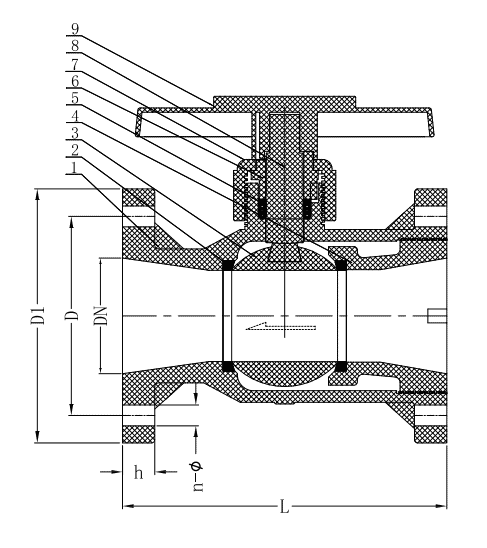
| No. | Parts | Materials |
|---|---|---|
| 1 | Body | PPH |
| 2 | Ballseal | PTFE |
| 3 | Ball | PPH |
| 4 | Inner plug | PPH |
| 5 | Stem seal | PTFE |
| 6 | Locator | PPH |
| 7 | Compression nut | PPH |
| 8 | Stem | PPH |
| 9 | Handle | ABS |
| DN | D1 (mm) |
D (mm) | L (mm) | h (mm) | n | Φ (mm) | ||||||
|---|---|---|---|---|---|---|---|---|---|---|---|---|
| DIN | JIS | ANSI | HG/DIN | JIS | ANSI | HG/DIN | JIS | ANSI | ||||
| 15 | 95 | 65 | 70 | 60 | 100 | 15 | 4 | 4 | 4 | 14 | 15 | 16 |
| 20 | 105 | 75 | 75 | 70 | 120 | 17 | 4 | 4 | 4 | 14 | 15 | 16 |
| 25 | 115 | 85 | 90 | 79 | 140 | 17 | 4 | 4 | 4 | 14 | 15 | 16 |
| 32 | 135 | 100 | 100 | 89 | 160 | 18 | 4 | 4 | 4 | 18 | 19 | 16 |
| 40 | 145 | 110 | 105 | 98 | 165 | 18 | 4 | 4 | 4 | 18 | 19 | 16 |
| 50 | 160 | 125 | 120 | 121 | 180 | 20 | 4 | 4 | 4 | 18 | 19 | 19 |
| 65 | 180 | 145 | 140 | 140 | 220 | 22 | 4 | 4 | 4 | 18 | 19 | 19 |
| 80 | 195 | 160 | 150 | 152 | 250 | 25 | 8 | 8 | 4* | 18 | 19 | 19 |
| 100 | 215 | 180 | 175 | 190 | 280 | 25 | 8 | 8 | 8 | 18 | 19 | 19 |
| 125 | 245 | 210 | 210 | 216 | 325 | 28 | 8 | 8 | 8 | 18 | 19 | 22 |
| 150 | 280 | 240 | 240 | 241 | 365 | 30 | 8 | 8 | 8 | 22 | 23 | 22 |
| 200 | 335 | 295 | 290 | 298 | 405 | 35 | 8 | 12* | 8 | 22 | 23 | 22 |
| 250 | 400 | 350 | 355 | 362 | 500 | 38 | 12 | 12 | 12 | 22 | 25 | 26 |
| 300 | 455 | 400 | 400 | 432 | 600 | 40 | 12 | 16* | 12 | 22 | 25 | 26 |
Convert sizes: DN to inch pipe size chart
Typical applications
PPH manual ball valves suit hot alkaline duty: chlor-alkali plant caustic and brine circulation lines, high-temperature alkali recovery in dyeing and paper mills, and waste-alkali neutralisation in steel pickling. To weigh PPH against the other thermoplastics, see our plastic valve material selection guide.See also our PPH butterfly valve and PPH diaphragm valve.
Other ball valve materials: UPVC (ambient water, value choice), CPVC (hot water and acids to ~90°C) and PVDF (aggressive acids, HF and high purity). Compare connection types — true union and flanged ball valves — or read our complete guide to choosing a plastic ball valve.
Browse all plastic valves. If a valve is leaking, see how to fix a leaking PVC ball valve.
Proven in the field: see how our integrated PPH valves replaced a failing field retrofit at a Vietnamese lithium plant.
Why buy PPH ball valves from Huiya
Our PPH ball valves are built for caustic and strong-alkaline service, supplied factory-direct — so you get the right configuration, competitive pricing, and a fast reply with no trading-company markup.
- ✅ Factory-direct — our own 2,000+ m² plant in Zhejiang, no middleman
- ✅ 100% virgin branded resin, fully traceable; produced at an ISO 9001-certified facility; material test reports on request
- ✅ Low MOQ — 20 pieces; samples available; OEM / custom welcome
- ✅ Fast lead time — about 7 days standard, 14 days custom
- ✅ 12-month warranty
Or explore our full range of PPH valves.
Get a factory-direct quote
Send us your medium, its concentration and temperature, and the line size. Our engineers confirm the right body material, seat and valve type — and reply within 24 hours.
Frequently asked questions
What is a PPH ball valve used for?
PPH (polypropylene) ball valves provide manual on/off isolation of hot strong-alkaline media to about 85 °C — caustic soda, alkali carbonates, and salt solutions — in chlor-alkali plants, alkali recovery, and waste-alkali neutralisation.
Is a PPH ball valve suitable for sodium hydroxide (caustic soda)?
Yes — this is where PPH excels. Its molecular toughness and wear resistance make it the value choice for high-concentration, high-temperature caustic soda and other strong alkalis.
What temperature can a PPH ball valve handle?
The PPH body is rated to about 85 °C, with the allowable pressure falling as temperature rises. Confirm the pressure–temperature point for your duty.
What chemicals is a PPH ball valve not suitable for?
PPH is not recommended for strong oxidising acids (concentrated nitric, fuming sulfuric), high concentrations of free chlorine and halogen gases, or aromatic hydrocarbons. For those duties, choose PVDF.
Should I choose a true union or flanged PPH ball valve?
Choose true union (DN15–DN100) for sludge draining and non-critical backup points that are serviced often. Choose flanged (DN15–DN200) for larger-bore, permanent caustic and brine mains.