
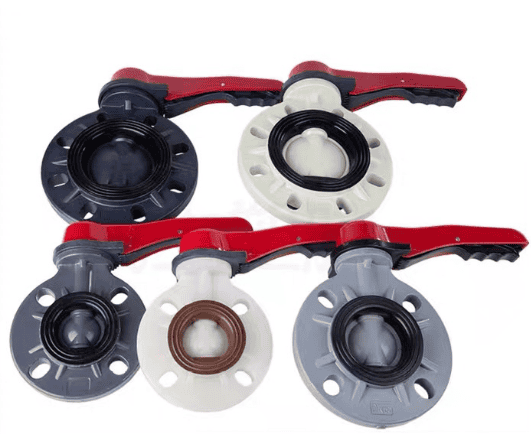
When engineers compare PVDF vs PTFE vs CPVC for a corrosive-service valve, they are usually comparing three materials that actually play different roles. CPVC is the economical structural body for hot water and moderate acids. PVDF is a structural body with near-PTFE chemical resistance and a higher temperature rating. PTFE is the most chemically inert of the three — but it is too soft to be a valve body, so it is used as the seat or diaphragm face. This guide compares them on chemical resistance, temperature, mechanics, and cost, and shows how to choose the right one.
The key difference: structural body vs sealing surface
The first thing to get straight is what each material can physically be.
CPVC and PVDF are structural thermoplastics. You can mould them into a full valve body, weld them (solvent cement for CPVC, fusion or IR welding for PVDF), and flange them into a piping system. They carry pressure and stand up to mechanical load.
PTFE is different. It has the best chemical resistance of any common polymer, but it is mechanically soft and “cold-flows” — it creeps under sustained load and cannot be welded. So PTFE is not used as a structural valve body. Instead it appears as the wetted sealing surface: the seat in a ball valve, or the face of the diaphragm in a diaphragm valve, where the surrounding body supplies the strength and the PTFE supplies the chemical barrier.
So “PVDF vs PTFE” is not really body against body. It is a PVDF structural body against PTFE used as a sealing surface — and the best solution often combines them: a PVDF body with a PTFE-faced diaphragm or a PTFE seat.
PVDF vs PTFE vs CPVC: chemical resistance
| CPVC | PVDF | PTFE | |
|---|---|---|---|
| Role | Structural valve body | Structural valve body | Seat / diaphragm face / lining — not a body |
| Chemical range | Good, but narrower | Excellent — strong acids, HF, halogens | The benchmark — near-universal |
| Max temperature | ~90 °C | ~120 °C | Very wide (as seat / diaphragm) |
| Mechanical | Rigid, weldable | Tough, weldable | Soft, creeps — not structural |
| Relative cost | Baseline (economical) | About 4× CPVC | Adds cost (as a seat / liner) |
| Best for | Hot water, dilute–moderate acids in range | Aggressive acids, HF, halogens, high purity | The sealing surface for the harshest media |
On breadth of chemical resistance the order is clear: PTFE, then PVDF, then CPVC. PTFE resists almost everything. PVDF handles concentrated sulfuric acid, hydrofluoric acid, hydrochloric acid, and halogens, with limits mainly around strong hot caustic and a few solvents — see our PVDF chemical compatibility guide for the detail, for a cross-material comparison, see our chemical resistance chart. CPVC covers many acids and oxidizers too, but over a narrower range: it is not suitable for hydrofluoric acid, strong oxidizers, or aromatic solvents.
Temperature — and the trap that catches people
CPVC is rated to about 90 °C, PVDF to about 120 °C, and PTFE seats and diaphragms work across a very wide band. But the most common and most dangerous mistake is to read a temperature rating as if it applies to every chemical.
A real example. A chemical plant in Mexico needed to handle 50% hydrofluoric acid at 70 °C. The plant’s engineer first specified a CPVC valve, reasoning that CPVC is rated to about 90 °C, so 70 °C looked comfortable. After they spoke with us, our engineer Andy flagged the problem: CPVC is not suitable for hydrofluoric acid above roughly 60 °C — its 90 °C rating is for benign service such as hot water, not for hot HF. He recommended a PVDF diaphragm valve instead: a PVDF body with a PTFE-faced diaphragm, both of which resist HF. That choice avoided a leak, a costly replacement, and a serious safety incident.
The lesson is the rule for all three materials: a temperature rating only holds for media the polymer is already compatible with. Always check resistance at your actual medium and your actual temperature — not the headline number.
Mechanical strength and installation
CPVC and PVDF behave like real piping materials. CPVC is rigid and joins with solvent cement; PVDF is the toughest of the common thermoplastics and joins by fusion or IR welding, with no adhesive and no leak path. Both can be flanged and built into a system that carries pressure.
PTFE cannot do any of this on its own — it is too soft, it creeps under load, and it will not weld. That is precisely why it lives inside the valve as a seat or diaphragm face rather than as the structure around it.
Cost
CPVC is the economical baseline. PVDF costs roughly four times as much as CPVC, and adding a PTFE seat or PTFE-faced diaphragm adds cost as well. That price gap is the whole reason to choose carefully rather than defaulting to the most resistant option:
- Use CPVC where it is both chemically and thermally sufficient — it is the value choice and there is no reason to overpay.
- Step up to PVDF only when the medium or the temperature exceeds what CPVC can take, as with hot HF.
- Use PTFE as the seat or diaphragm face when you need the ultimate sealing barrier, paired with a PVDF (or other) body.
How to choose
- CPVC — hot water and dilute-to-moderate acids and oxidizers within its chemical range, up to about 90 °C. Best value.
- PVDF — aggressive acids including HF, halogens, oxidizers, and high-purity service, up to about 120 °C. Near-PTFE resistance in a structural, weldable body. Learn more in our technical index on PVDF acid and solvent resistance.
- PTFE — as the seat or diaphragm face where the media demand the most inert sealing surface, combined with a structural body.
How we help
We build valves in CPVC and PVDF from 100% virgin branded resin, and we use PTFE seats and PTFE-faced diaphragms where the media call for them. If you are weighing CPVC against PVDF, the deciding factors are almost always your exact medium, its concentration, and its temperature — send us those three and our engineers will recommend the right material and configuration, and flag any temperature trap before it becomes a problem.
Explore our CPVC valves and PVDF valves — including PVDF diaphragm valves with PTFE-faced diaphragms, PVDF butterfly valve, CPVC butterfly valve and industrial CPVC ball valve — or compare all four plastics in our material selection guide. When you are ready, request a quote with your media, concentration, and temperature.
For PVDF’s performance with a single demanding medium, see our guide to hydrofluoric acid valves. Explore PVDF in every pattern — ball, butterfly and diaphragm — or step down to CPVC where its range is enough.
— Andy Xia, Huiya Engineering Team